
Articles · Sep 11, 2026
Hedra vs. HeyGen: Which one is better?
Hedra and HeyGen compared across video creation, prerendered and real-time avatars, languages, models and infrastructure, and pricing, with a verdict for each job and where LemonSlice fits.
Hedra and HeyGen end up on the same shortlist often. The two platforms overlap on prerendered character video, generated from an image and an audio track, sold through self-serve plans and enterprise contracts alike, and delivered without a camera or a shoot. Outside that shared ground, the two companies have grown in very different directions.
This page lays out the comparison in detail: we compare their video creation workflows, prerendered avatars, real-time avatars, languages and audio, models and infrastructure, and pricing, with a verdict for each use case.
What is Hedra?
Hedra is the harder of the two to introduce, because the company changed shape. It no longer markets itself primarily as an avatar app: the homepage reads "Visualize Anything," and the company describes itself as "an inference and research company building the infrastructure for visual intelligence." The avatar models are still there, now one part of a wider offer.
That offer spans Creative Studio, an agentic workspace across video, image, and audio models, a Developer API putting roughly 80+ third-party models behind one key and one bill, managed inference on your own cluster, and an MCP server plus CLI. The catalog even carries HeyGen Photo Avatar 4, so the company compared against HeyGen here also sells access to a HeyGen model.
Hedra's own avatar models are Character 3, released March 2025, and Hedra Avatar, a talking-head model with the same published specs. A third, Omnia, was announced in February 2026 with no specs, pricing, or product page yet. Everything Hedra renders is prerendered, and it says so itself; the real-time avatar section below quotes it directly.
What is HeyGen?
HeyGen is an AI video platform built around avatars of real people, positioned as "AI videos starring you, made in minutes."
The product splits into AI Studio, the script-first editor, Video Agent for one-prompt finished cuts, Video Translation for localizing existing footage into 175+ languages with lip re-sync, photo avatars that animate one image, and a pay-as-you-go API launched April 2026.
The models carry the weight. Avatar IV, released May 2025, animates a single photo including sketches, anime characters, and animals, and accepts tilted and profile shots. Avatar V, the April 2026 flagship, trains from a 15-second webcam recording, separates identity from appearance, and stays stable in videos beyond 30 minutes.
HeyGen sells interactive avatars as well, through a separately priced product named LiveAvatar, which matters here because Hedra fields no counterpart; the real-time avatar section below covers it.
Hedra vs HeyGen: Comparison at a Glance
The quick view first, then the detailed breakdown:
| Hedra | HeyGen | |
|---|---|---|
| Main job | Multi-model creative platform and inference infrastructure, with first-party avatar models | Avatar videos of real people for marketing, sales, and localization |
| Interactive avatars | None | LiveAvatar, sold separately from $19/month |
| First-party avatar models | Character 3, Hedra Avatar (Omnia announced, no public specs) | Avatar IV, Avatar V |
| Custom avatar input | Any image plus a required audio track | Single photo (Avatar IV) or 15-second video (Avatar V) |
| Non-human and stylized characters | Yes (animals, claymation, illustration, mascots) | Yes (anime, animals, sketches) |
| Stock avatar library | None published; generate a face or upload any photo | 500+ free, 700+ on paid plans |
| Max video length | Up to 10 minutes per generation | Stable beyond 30 minutes (Avatar V) |
| Voices and languages | 4,000+ voices via ElevenLabs and MiniMax; lip sync follows the audio language | 1,000+ voices; 175+ languages and dialects |
| Translation of existing footage | None published | Yes, up to 10 languages in one pass |
| Third-party models served | Roughly 80+, including Kling, Veo, Seedance, ElevenLabs, and HeyGen Photo Avatar 4 | Seedance 2.0 integrated into the platform |
| Free plan | Yes; included credit amount not published | 3 videos per month, up to 1 minute, watermarked |
| Paid plans from | $15/month (annual prices not published) | $29/month ($24 billed annually) |
| API pricing | Per-second rates, 2.5 to 6.25 cents by resolution | Pay-as-you-go from $5; Avatar III $1/min, Avatar IV $3 to $5/min |
One note on reading the table. Every row except the second describes prerendered video, the one product area these two companies share; the uneven second row gets a section of its own below.
Character video generation
The two platforms start a video from different raw materials.
Hedra starts from an image and an audio track. You supply the start frame, the required audio drives the performance, and Character 3 renders at 540p, 720p, or 1080p across seven aspect ratios, up to 10 minutes per generation, with multi-speaker scenes driven by up to 4 audio tracks. Around the models sits Creative Studio, the agentic workspace: you brief it, and it plans, generates, and edits across video, image, and audio models on a shared canvas, with team Spaces and reusable Skills.
HeyGen starts from a script. AI Studio reads like a document where you type the lines and choose the presenter, Video Agent compresses the whole job into a single prompt that comes back as a finished cut, and the photo avatar tools turn one image into a presenter when nobody wants to film.
The inputs predict the outputs. Audio-first Hedra suits performance pieces, where a voice track, a song, or a podcast clip is the point and the character exists to deliver it. Script-first HeyGen suits presenter-led formats, where a person, real or synthetic, explains something to camera and the fastest path from text to published video wins.
Prerendered avatars
Every avatar product is one of two kinds. A prerendered avatar performs for a file. You hand the platform an image and an audio track or a script, it renders for as long as it needs, and the result is a video that plays the same way for every viewer. An interactive avatar performs for a person. Its frames are generated during a live exchange, shaped by what the user just said, on a budget of roughly a second per reply. Hedra and HeyGen meet only on the first kind, which this section compares; the second kind comes next.
| Prerendered avatar | Interactive avatar | |
|---|---|---|
| Deliverable | A video file, watched later | A live conversation, different every time |
| Rendering window | Minutes if needed, retakes allowed | About a second per reply, single take |
| In this pair | Hedra's Character 3 and Hedra Avatar, HeyGen's Avatar IV and V | Covered in the real-time avatar section |
The matchup itself is closer than the usual avatar contest, because both platforms animate far more than a corporate headshot.
Character range is Hedra's known strength. Character 3's own gallery runs from photoreal humans to a talking bear roofing contractor, a claymation musician, a 2D-illustrated podcast host, and brand mascots. The input rule is simple. Any face the video should speak through works, whether a photo of a real person, a mascot, or a generated character, and you never need to film yourself. Hedra frames the difference as performance, where mouth shapes track phonemes and expression follows the emotion in the audio, and micro-expressions like blinks and head tilts sync to speech. Its own model page even admits a quirk, overly dramatic hand gestures, which users restrain through the text prompt.
HeyGen covers a wide range too. Avatar IV animates a single photo including sketches, anime characters, animals, and fantasy creatures, and accepts tilted and profile shots. Where HeyGen pulls ahead is with videos of real people. Avatar V's identity separation means one 15-second recording yields any outfit, any setting, and multiple camera angles, with the identity stable past the 30-minute mark, against Hedra's published 10-minute cap per generation. HeyGen also ships a 700+ stock avatar library for teams that want a presenter without creating one; Hedra publishes no stock library and expects you to upload or generate the face.
The practical split is this. For an original character or mascot, both work and Hedra treats it as the headline act. For a consistent digital twin of a real person across a season of content, Avatar V has no Hedra equivalent.
Real-time avatars
A real-time avatar is the interactive kind in action: its frames are rendered during the conversation itself, and it hears the user and answers within a couple of seconds, which is what makes avatar tutors, support agents, product demos, and kiosks workable. It is also the area where this pair stops being a pair, because only one side sells anything.
| Hedra | HeyGen LiveAvatar | |
|---|---|---|
| Status | No interactive avatars offered | Generally available, sold separately |
| Pricing | Not applicable | Free tier, then $19 to $475/month |
| Resolution | Not applicable | 1080p streams |
| Custom avatars | Not applicable | From an image or 2 minutes of footage |
| Concurrency | Not applicable | Unlimited from the $19 Starter plan |
HeyGen quotes enterprise LiveAvatar rates down to $0.01 per minute, and its headline latency claim, a median time to first frame under 300ms, deserves a careful reading, since that clock starts when the avatar begins rendering, while the wait a user actually feels also runs through speech recognition, the LLM, and speech synthesis.
Hedra declines the category in its own words. Its buying guide tells readers, "We are not a real-time conversation engine like a live digital twin," and points anyone hiring for that job to other tools. Nothing in the Studio, the API catalog, or the model pages streams a live conversational avatar.
So within this pair, a live avatar means LiveAvatar or nothing. Whether a video company's second product is the right foundation when the conversation is the entire product is a question the LemonSlice sections near the end take up.
Languages and audio
The two platforms publish different kinds of numbers here, so read the units carefully.
| Hedra | HeyGen | |
|---|---|---|
| Headline metric | 4,000+ AI voices across ElevenLabs, MiniMax, and more | 175+ languages and dialects |
| Language coverage | Dozens of languages, stated loosely | 175+ on paid plans, 30+ on free |
| Stock voices | Drawn from the partner voice stack | 1,000+ |
| Voice cloning | Set up once, reused across every avatar | From as little as 10 seconds of audio |
| Translating existing footage | None published | Up to 10 languages in one pass, voice preserved, lips re-synced |
Two things sit behind the counts. Hedra's lip-sync claim is structural, since audio drives the animation, so the mouth follows whatever language the track speaks. And the translation row is the one gap that changes a buying decision, because HeyGen localizes footage you already have while Hedra's multilingual story is about generating new videos.
If the job is generating character video in whatever language your script demands, both platforms cover it, and Hedra's ElevenLabs and MiniMax stack gives you the deeper voice menu. If the job is taking a finished video and shipping it into 10 markets, only HeyGen sells that.
Models and infrastructure
This section barely existed in avatar comparisons two years ago, and now it is where these companies differ most.
| Hedra | HeyGen | |
|---|---|---|
| Strategy | Broad catalog plus infrastructure | Vertical stack around its own models |
| First-party avatar models | Character 3, Hedra Avatar; Omnia announced without public specs | Avatar IV, Avatar V |
| Third-party models | Roughly 80+ served, including Kling, Veo, Seedance, ElevenLabs, and MiniMax | Seedance 2.0, integrated into the platform |
| Developer surface | One key, one endpoint, one bill, with jobs, webhooks, and a pre-run cost estimate | Own API exposing six model families, pay-as-you-go |
| Beyond the API | Creative Studio agent, MCP server and CLI, managed inference on your own cluster | HyperFrames, an open-source rendering framework |
The catalog even includes HeyGen Photo Avatar 4, so a developer can render HeyGen's photo avatar model on Hedra's GPUs, a fact strange enough to bear repeating from the profile above.
The purchase decision underneath is different too. Buying Hedra buys a catalog and the infrastructure around it, from the agentic Creative Studio above the API to the sovereign diffusion stack below it. Buying HeyGen buys one company's avatar stack, built from Avatar 3 through Avatar V, published as research, and tuned end to end for its own models.
Pricing and plans
| Hedra | HeyGen | |
|---|---|---|
| Free plan | Advertised with no credit card; included credit amount not published | 3 videos a month, up to 1 minute, watermarked |
| Entry plan | Basic, $15/month with 1,500 credits | Creator, $29/month ($24 billed annually) with 600 credits |
| Higher tiers | Creator $30 with 5,400 credits; Professional and Teams $75 with 14,400; every paid plan includes commercial use, no watermark | Unlimited web creation on paid plans; advanced models metered in credits |
| Credit rollover | Monthly credits expire; credit-pack credits never do | Unused credits roll over one extra month |
| API billing unit | Per second of video, from a prepaid wallet separate from Studio credits | Per minute, pay-as-you-go from $5 |
| API rates | 2.5 cents at 540p, 5 cents at 720p, 6.25 cents at 1080p | Avatar III $1/min; Avatar IV $3 to $5/min |
| Annual pricing | Dollar prices not published | Creator drops to $24/month |
| Enterprise | Custom, with private deployments and dedicated engineers | Custom, with reserved compute and consent tooling |
Two judgments sit outside the table. A Hedra credit and a HeyGen credit are unrelated units that expire on different schedules, so compare rendered minutes and ignore credit counts when pricing a workload on both.
On the API side the units finally line up once you do the arithmetic. Hedra's per-second rates work out to $1.50, $3.00, and $3.75 per minute by resolution, so at 1080p the two land in the same band, with Hedra's $3.75 sitting inside HeyGen's Avatar IV range and HeyGen's Avatar III undercutting both when standard quality is enough.
The technical approaches
Both flagship engines are modern generative models, and their published designs explain the capability differences above.
| Hedra Character 3 | HeyGen Avatar V | |
|---|---|---|
| Model class | Omnimodal model processing image, text, and audio jointly | Diffusion transformer with flow matching |
| Input | Start frame plus a required audio track | 15-second reference recording |
| Output | Up to 10 minutes, length set by the audio | Multi-angle, identity stable beyond 30 minutes |
| Signature strength | Audio-driven performance across any character style | Identity stability across outfits and takes |
| Published evidence | Model pages with full specs and admitted quirks | Self-run benchmark wins on lip sync and face similarity |
Hedra Character 3 treats the audio as the driver. The video runs exactly as long as the track you supply, the animation follows the performance in it, and Hedra tells users that clean audio quality directly dictates output quality. Text prompting steers behavior on top, down to restraining those hand gestures.
HeyGen Avatar V conditions on the full token sequence of your reference video, with Sparse Reference Attention keeping compute near linear. That full-video conditioning is HeyGen's published answer to identity drift, and the company backs it with a self-run benchmark suite showing the highest lip-sync accuracy score (LSE-C 8.97), the highest face similarity (0.840), and pairwise preference wins of 68.9% to 85.7% against systems including Veo 3.1 and Seedance 2.0. Vendor-run numbers, but unusually detailed ones.
Both are prerendered systems, and that is a budget statement. Each can spend seconds to minutes on every output, retry, and keep the best take, which is where the polish comes from. A live avatar gets roughly a second and no retries, which is why real-time is a different engineering problem, why HeyGen ships LiveAvatar as a separate product, and why Hedra ships nothing live at all.
What is LemonSlice?
LemonSlice makes interactive avatars, the second of the two kinds defined earlier. The company is an AI research lab whose stated mission is to build the emotional engine of AI, characters that form a genuine emotional connection with the humans they talk to, and it pioneered an approach called Character World Models in pursuit of that. What LemonSlice produces is a conversation running inside your product rather than a file.
The engine is an end-to-end video diffusion transformer, the model family behind Veo 3 and Sora, run in real time. It draws every pixel of the character and its surroundings at 20fps on a single GPU while the exchange happens, without face rigs, body rigs, or composited footage anywhere in the pipeline. And because there is no human face template underneath, the character is whatever photo you supply. One image becomes a live avatar on the spot, whether the face belongs to a person, a cartoon, an animal, or a mascot, and every plan carries unlimited avatars with no training step or per-character fee.
The performance covers the whole body. Hands gesture with the audio on their own, posture and body language follow the speech, and the Action Engine adds direct control, firing specific gestures, emotions, and whole-body actions on cue during the call. A live image update can even swap the avatar's outfit or move the scene while the conversation continues.
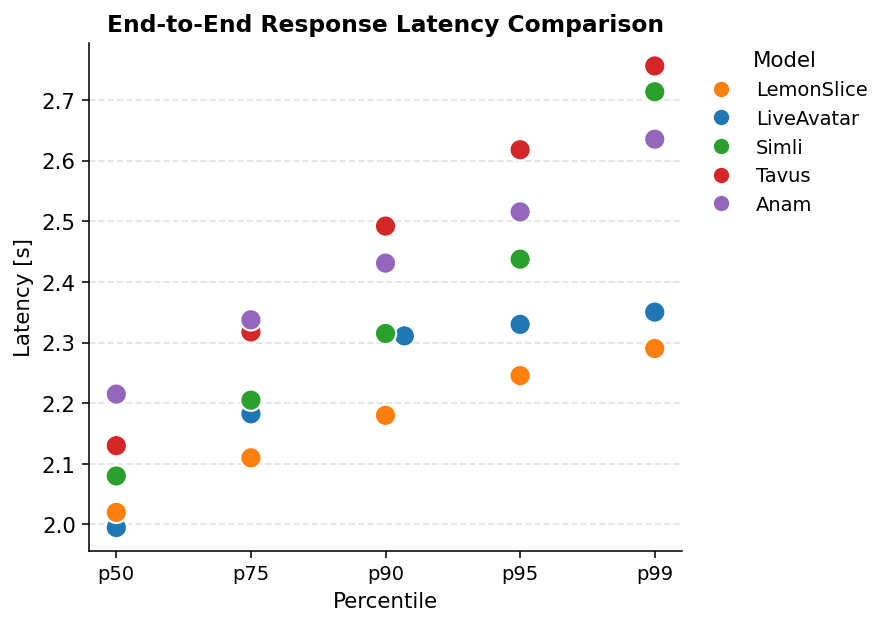
Speed is a published number here. LemonSlice 2.1 Flash averages 471ms for the avatar layer and 2.04 seconds for the complete response, counting speech recognition, the LLM, speech synthesis, and video together, which is the wait a user actually experiences.
The system has also worked in public at scale. Microsoft selected LemonSlice to drive a life-size interactive Theodore Roosevelt at the Roosevelt Presidential Library.
Try LemonSlice before you weigh anything else here: the featured interactive avatars at lemonslice.com are free to chat with, and once you want a real-time avatar of your own, plans open at $8 a month.
Hedra vs HeyGen vs LemonSlice
Everything above compares prerendered video, the one product area Hedra and HeyGen share. The closing comparison moves to real-time avatars, where the three companies hold three different positions. Hedra has stepped out of the category by its own statement. HeyGen steps in through a second product, purchased separately from its video platform. LemonSlice has been built around the live conversation from the start.
| LemonSlice | HeyGen (LiveAvatar) | Hedra | |
|---|---|---|---|
| Interactive avatar status | Core product, generally available | Separate product, generally available | None; Hedra states it is not a real-time conversation engine |
| Custom avatar creation | Instant, from one photo, unlimited on every plan | From an image or 2 minutes of footage, 1 custom avatar on $99 and $475 plans | Not applicable |
| Character range | Humans, cartoons, animals, and mascots, in any style | 100+ presets, human presenters | Not applicable |
| Hands and body in real time | Dynamic hand gestures and whole-body motion | Half-body or full-body framing | Not applicable |
| Mid-call appearance changes | Yes, clothing, scene, and character swaps in about 600ms | No equivalent published | Not applicable |
| Entry price | $8/month, every plan includes API access | $19/month (LiveAvatar Starter) | Not applicable |
The pattern in those rows follows from product history. Interactive avatars grown inside a video company inherit video-company furniture, presenter framing, preset libraries, and per-avatar slots, because the conversation arrived second. LemonSlice designed for the conversation from the start, which is why instant characters from one photo, live hands and whole-body motion, and mid-call outfit and scene changes appear in its column and show up elsewhere as unpublished or absent.
Honesty points the other way on the prerendered job. For rendered character video, mascot spots, or long-form presenter modules, the shortlist is Hedra and HeyGen, and LemonSlice does not belong on it, since it produces no files at all. The three meet on exactly one question, who should carry the live conversation, and there the platform that exists only for that job is the strongest answer.
The Verdict
Choose Hedra if the star of the video is a character, or if you are buying a platform. It animates any face, from mascots to claymation, treats character video as the headline product, starts at $15 with commercial use on every paid plan, and wraps the whole thing in a multi-model API, agent workspace, and managed inference that HeyGen simply does not sell.
Choose HeyGen if the star of the video is a real person, or the job touches localization. Avatar V's identity stability, multi-angle output, and 30-minute-plus videos have no Hedra counterpart, the 700+ stock library covers teams without a presenter, and translation ships one video into 10 languages at once. LiveAvatar is also the only live option between the two.
Choose LemonSlice if what you are shipping is a live conversation. It is the only platform of the three built specifically for real-time interactive avatars. One photo becomes a live character in any style, every plan includes unlimited avatars and API access from $8 a month, and the avatar gestures with its hands, moves its whole body, and changes outfits or scenes while the call runs.
The clearest way to decide: ask two questions. Is the face on screen a specific real person? If yes, HeyGen; if it is a character, Hedra earns the first look. And is the viewer watching or talking back? When they talk back, take the platform that was built for exactly that.