
Articles · Sep 11, 2026
HeyGen Review 2026: Features, Pricing, and How It Compares
An honest HeyGen review for 2026: what Avatar V and LiveAvatar do well, where they fall short, pricing by plan, and how it compares for interactive avatars.
This review is for teams deciding whether HeyGen fits their next avatar project. We looked at both sides of the product: the studio side that renders finished videos on the Avatar V model, and the real-time side, LiveAvatar, which answers users on a live call.
Along the way we checked avatar creation, expressiveness, ease of use, latency, languages, output quality, and pricing, using HeyGen's own product pages as the source for every fact. Where HeyGen does something well, we say so, and where it falls short, we say that too.
What is HeyGen?
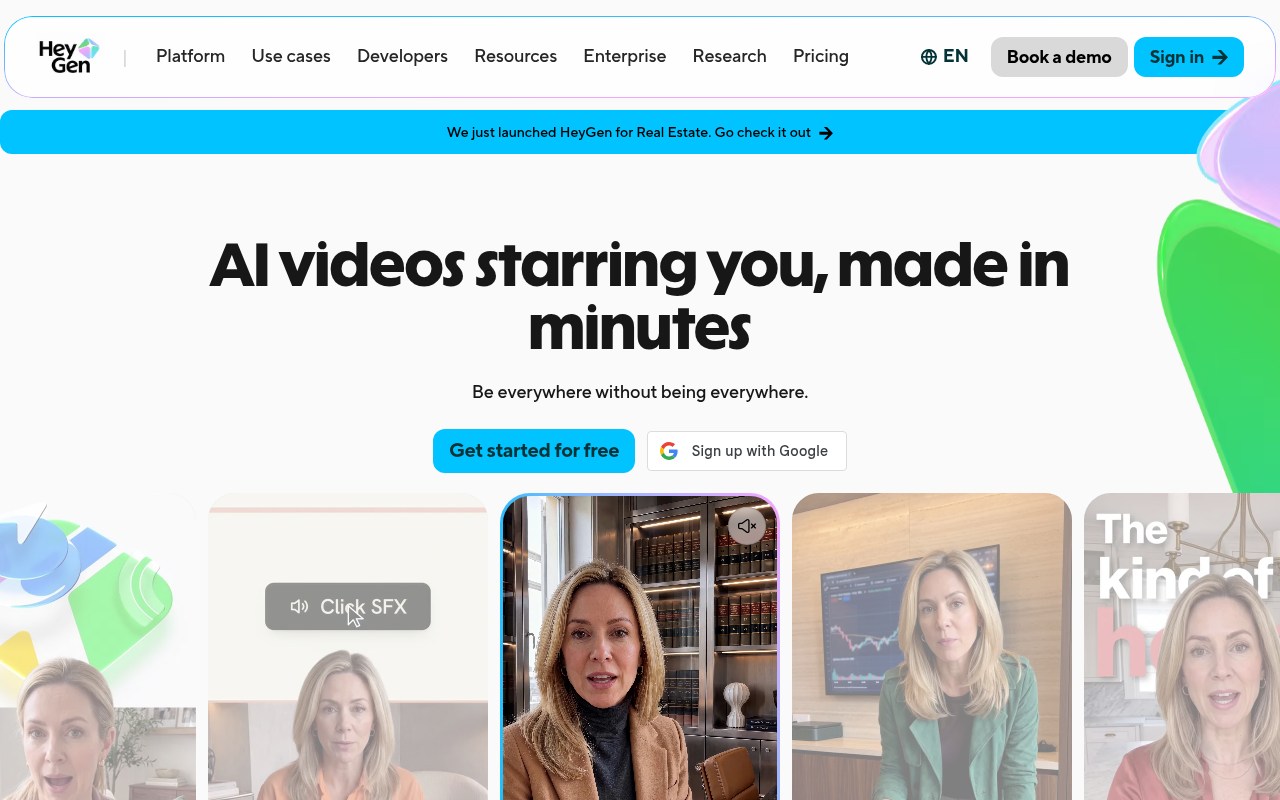
HeyGen describes its product as AI videos starring you, made in minutes. It sells to creators and businesses that want a video presence without a camera, and it reports more than 30 million users across 196 countries.
The product splits into two big jobs. The studio generates finished avatar videos from a script, running on Avatar V, the company's most advanced avatar model, while LiveAvatar holds real-time conversations with users on websites, apps, and kiosks. HeyGen has moved LiveAvatar onto its own platform, with its own plans and API.
The company keeps shipping, too. Avatar V arrived in April 2026 and builds your avatar from a 15-second webcam recording. Also, their Video Agent feature turns a typed idea into a share-ready video, and a translation tool re-voices finished footage from a file or a YouTube link in one click.
Pre-rendered vs. interactive avatars
Since HeyGen sells both pre-rendered and interactive avatars, it helps to understand the difference between the two before we go feature by feature.
A pre-rendered avatar video is generated ahead of time. You write a script, pick a presenter, and the platform renders a finished clip, so every viewer watches the same video. An interactive avatar works more like a video call. It is generated during the conversation itself, which means it listens while you talk, thinks about a reply, and renders the character saying it in real time.
| Pre-rendered avatar video | Interactive avatar | |
|---|---|---|
| What it is | A finished clip rendered from a script before anyone watches it | A character generated during the conversation itself |
| HeyGen's product | The studio on Avatar V, plus Video Agent and translation | LiveAvatar, on its own platform at liveavatar.com |
| How you interact | Playback only, the same clip for every viewer | Two-way, it answers you like a video call |
| Typical uses | Marketing clips, courses, translated video | Support, sales demos, tutoring, kiosks |
HeyGen ships both, and its core is the pre-rendered videos, because the studio, the plans, and the credit system all revolve around rendered clips. LiveAvatar carries the interactive avatars, and HeyGen runs it as a separate platform with separate plans.
HeyGen review at a glance
Here's how HeyGen performs across the dimensions we evaluated:
| Dimension | What HeyGen ships | Notes |
|---|---|---|
| Primary product | Pre-rendered avatar video via the studio | LiveAvatar is the interactive product, on its own platform |
| Avatar creation | 15-second recording for an Avatar V twin, photo and stock avatars | Custom video avatars capped per plan |
| Expressiveness | Motion and gestures learned from your own recording | Upper-body framing in pre-rendered videos |
| Latency | Sub-300ms median time to first frame claimed for LiveAvatar | Vendor figure, measures the first frame only |
| Languages | 175+ languages and dialects, voice cloning, 1,000+ voices | Free plan covers 30+ languages |
| Resolution | 1080p export on Creator, up to 4K from Pro, 1080p live streams | Custom LiveAvatar avatars are 720p on Essential |
| Pricing | Credit plans from $29/month, LiveAvatar from $19/month | Credit use varies by model, length, and complexity |
Product and pricing information: HeyGen product and pricing pages and liveavatar.com, September 2026.
Characters and avatar creation
Avatar creation touches the pre-rendered videos and the interactive avatars alike, because both products build avatars from your own footage or a picture. HeyGen gives you a few ways in, depending on how much source material you have:
- An Avatar V twin builds from a 15-second webcam recording and learns how you move and gesture
- Photo avatars animate from a single picture
- Stock avatars come ready-made, 500+ on the free plan and 700+ on paid plans
- LiveAvatar customs build from one image or two minutes of footage, next to a library of 100+ presets
Strength: You do not need a studio to get started, because a webcam clip is enough for a twin that keeps the same face and micro-expressions across every video it appears in.
Limitation: Custom video avatars are capped per plan, one on Creator, and every custom avatar requires on-camera identity verification from the person depicted. The lineup is built around real people, which leaves cartoons and mascots out.
Expressiveness and body language
This one covers both pre-rendered and interactive avatars, though each product frames the avatar differently. Avatar V learns motion from your recording instead of animating a still photo, so the way you gesture and express yourself carries into the generated video, and the model applies that motion to any version of you.
Strength: Gestures come from your own recorded behavior, so the avatar moves like the person it is based on instead of cycling through canned motions.
Limitation: Pre-rendered videos frame the avatar with fluid upper-body motion, and full-body framing lives only in LiveAvatar. Neither product animates a non-human character.
Ease of use and editing
This section is about the pre-rendered avatars, because the studio is where they are made. The studio centers on a text-based editor that works like writing a document, so the script is the interface, and tone, delivery, and pacing all follow from what you type.
There are shortcuts around the editor too. Video Agent turns a typed idea straight into a share-ready video, a PowerPoint or PDF upload turns each slide into a scene, and 75+ templates plus a screen recorder cover the common formats.
Strength: A typed idea or an uploaded deck is enough to get a first video, and edits happen in the script, with no timeline to manage.
Limitation: The free plan caps output at 3 videos per month and one minute each, so real testing runs into the paid plans quickly.
Latency and response times
Latency matters for the interactive avatars, because a live conversation stalls when the avatar is slow to answer. LiveAvatar quotes a median time to first frame below 300 milliseconds, with 99.99% uptime and no cap on concurrent sessions from the Starter plan up.
One caveat on reading that number. Time to first frame measures when the avatar starts rendering. The full reply a user waits through is longer, because it also includes speech recognition and the language model. Interface research going back decades puts the threshold near one second before a pause starts to feel broken, and a first-frame figure alone cannot tell you whether the full reply lands inside it.
Strength: The quoted first-frame time is quick, and HeyGen publishes its uptime and concurrency figures openly enough to test against.
Limitation: HeyGen does not publish a full-pipeline response figure for LiveAvatar, so test a complete reply with your own voice stack before you commit.
Languages and voices
Language coverage is a pre-rendered story first, because it lives in the studio and the translation tool. The platform lip-syncs in 175+ languages and dialects from the Creator plan up, and the voice options include 1,000+ AI voices plus voice cloning from your own recording.
On top of that, video translation re-voices finished footage into other languages in one click, from an uploaded file or a YouTube link, and keeps the speaker's tone.
Strength: Multilingual reach is a dimension HeyGen handles well, and if your audience spans many markets, this alone is a reason to shortlist it.
Limitation: The free plan covers 30+ languages and a single voice clone, so the full language suite starts at Creator.
Developers and integration
The APIs cover both products. HeyGen for Developers exposes video generation, translation, and lip-sync for the pre-rendered avatars, while LiveAvatar ships its own real-time API with a setup HeyGen says takes five minutes.
LiveAvatar runs in two modes as well. Full Mode includes the whole voice stack, speech recognition, language model, and voices, while Avatar Only lets you bring your own and keeps HeyGen for the avatar and the streaming.
The no-code automations live on the Business plan, with integrations for n8n, Make, HubSpot, and Zapier, plus SCORM export and LMS connections for training teams.
Strength: The two LiveAvatar modes give developers a real choice, because you can ship with HeyGen's stack on day one or wire the avatar into a voice pipeline you already run.
Limitation: The workflow integrations and SCORM export sit on the Business plan, so smaller plans automate through the API or not at all.
Resolution and output
Most of the numbers here describe the pre-rendered avatars. Creator exports at 1080p, Pro and above export up to 4K, and video length runs to 30 minutes on Creator and Pro, 60 on Business, and uncapped on Enterprise. On the interactive side, LiveAvatar streams its preset avatars at 1080p.
Strength: Output quality is an area HeyGen handles well, and 4K export from the Pro plan up delivers if resolution is your first requirement.
Limitation: Watermark removal starts at Creator, so free videos carry a mark, and a custom LiveAvatar avatar streams at 720p on the Essential plan, with 1080p customs reserved for the tier above.
Pricing and plans
The pre-rendered and interactive avatars bill separately, and both run on credits. On the studio side, credits are the single currency across videos, avatars, and translation, and the amount a video uses varies with the AI model, the length, and the complexity of the generation. LiveAvatar meters its own credits on its own site.
The free plans are real. The studio's covers 3 videos per month at up to one minute each, and LiveAvatar's includes a small monthly credit balance with sessions capped at two minutes.
| Plan | Monthly price | Included | Notes |
|---|---|---|---|
| Free | $0 | 3 videos/month, 1-min cap | Watermark, 30+ languages |
| Creator | $29 | 600 credits | 1080p export, 175+ languages, $24/month on annual billing |
| Pro | $49 | 1,000 credits | 4K export, higher tiers add credits only |
| Business | $149 | 1,500 credits | Teams, $20 per extra seat, SCORM and integrations |
| LiveAvatar Starter | $19 | 200 credits | 5-minute session cap |
| LiveAvatar Essential | $99 | 1,100 credits | One 720p custom avatar, 20-minute sessions |
| LiveAvatar Business | $475 | 6,000 credits | One 1080p custom avatar, 60-minute sessions |
Pricing captured from HeyGen's pricing page and liveavatar.com, September 2026, with monthly billing selected. Confirm current rates before you buy.
Read the rollover rules before you choose. Monthly credits roll over for one extra month, annual credits accumulate until renewal, and credits expire when a subscription ends, so a paused month forfeits the balance you already paid for.
What is LemonSlice and why it's a better HeyGen alternative
LemonSlice is an AI research lab building interactive characters that talk, listen, and react in real time. You give it a photo, and moments later that character is on screen holding a live conversation with your users.
The easiest way to picture it is through what you can build. An avatar tutor can walk a student through a problem step by step and react to every answer. A support agent can greet customers on your site and help them face to face, not through a chat window. A sales avatar can run a demo, answer questions, and qualify the lead while it talks. The same characters work as onboarding guides inside a product, kiosk concierges, and language partners that let learners practice without pressure.
Under the hood it runs a Character World Model, an end-to-end video diffusion transformer. It is the same class of model behind Veo 3 and Sora, run live during the conversation. Every pixel is generated at 20fps on a single GPU, body and background included, so nothing is composited or pre-recorded.
Creation is instant, with no training to wait on, no per-avatar fee, and unlimited avatars on every plan. If it has a face, LemonSlice can animate it, so cartoons, animals, and mascots work as well as photorealistic humans.
The character also has a body and an environment. Hand gestures and natural body language emerge as part of the performance. You can trigger emotions like happiness, sadness, and anger through the Action Engine, and an image update changes clothing or scene mid-conversation.
It's fast too. LemonSlice 2.1 Flash responds in 471ms on average, making it the fastest model among major avatar providers in published benchmarks, and users consistently rate the avatars as more expressive and natural to talk to.
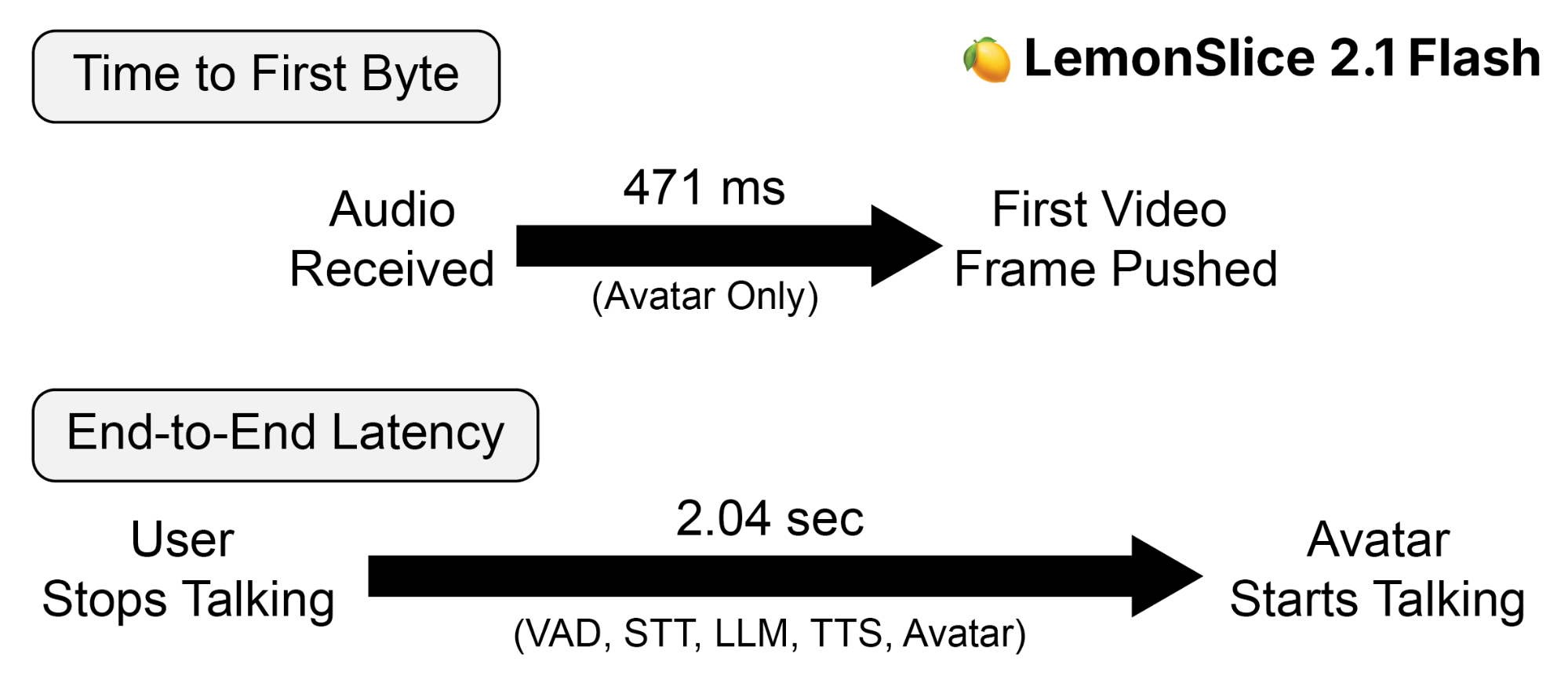
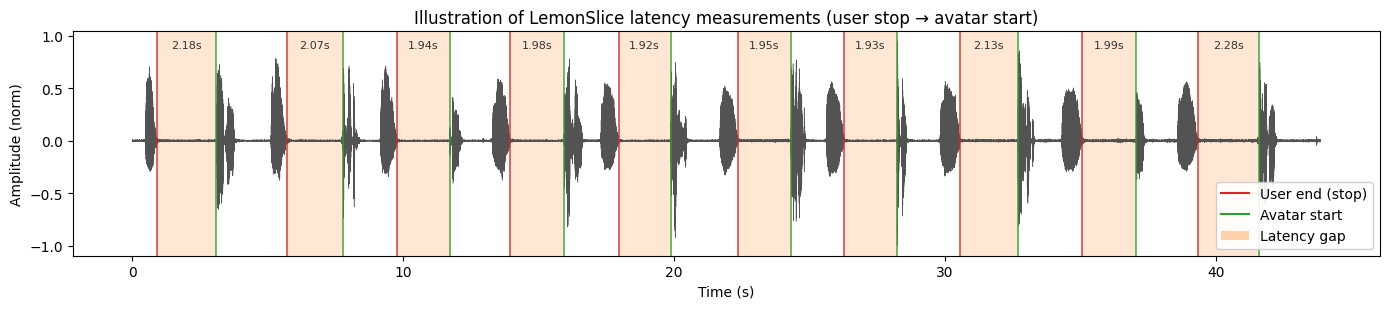
That is why LemonSlice is the better HeyGen alternative for interactive avatars. HeyGen's interactive avatars are realistic human presenters, while LemonSlice generates any character with working hands and controllable emotions.
You can chat with a featured avatar for free, then build your own from $8/month.
LemonSlice vs. HeyGen: comparison at a glance
Here's how the two stack up side by side:
| LemonSlice | HeyGen | |
|---|---|---|
| Photorealistic humans | ✅ | ✅ |
| Cartoon and stylized characters | ✅ | ✖️ |
| Non-human characters | ✅ | ✖️ |
| Dynamic hand gestures | ✅ | Half-body or full-body framing, gestures not triggerable |
| Controllable emotions | ✅ Action Engine | ✅ Voice-synced emotion in pre-rendered videos |
| Clothing and scene swaps | ✅ Mid-conversation image update | ✅ Pre-rendered only, chosen per video |
| Custom avatar cost and creation time | $0, instant from one photo, unlimited on every plan | 15-second recording for a twin, custom video avatars capped per plan |
| Cost per minute | $0.1367/min avatar-only (top self-serve plan) | Credit-metered, vendor quotes $0.01/min at the top Enterprise volume tier |
| Speed in end-to-end benchmarks | Fastest among major avatar providers | No published end-to-end benchmark, vendor quotes sub-300ms to first frame |
| Integrations | LiveKit, Pipecat, Agora, WebSockets, any LLM or voice provider | API, bring-your-own LLM and TTS, n8n and Zapier on Business |
| Resolution | 512px standard, HD on Enterprise | ✅ 1080p live streams, up to 4K pre-rendered export |
| No-code path | Widget embed, two lines of code | ✅ Full studio with templates and stock avatars |
| Pre-rendered clip production | ✖️ | ✅ |
| Entry price | $8/month | $29/month studio, $19/month LiveAvatar |
Product and pricing information: vendor product and pricing pages, September 2026.
Who should use HeyGen
Choose HeyGen for script-to-video production at scale. Marketing, training, and founder-comms teams get a studio that works like a document, 175+ languages, one-click translation, and identity verification with SOC 2 Type II and GDPR compliance behind it.
It's also a reasonable way to ship a first conversational agent, because LiveAvatar's Full Mode includes the whole voice stack and the setup is quick, so a working avatar can take questions the same day.
Who should use LemonSlice
Choose LemonSlice when the interactive avatar is the product. Consumer-facing experiences, tutors, and companion apps reward expressiveness, and users consistently rate LemonSlice avatars as more natural to talk to.
It's also the better fit for physical installations, because LemonSlice powers some of the most visible in the world, including Microsoft's life-size AI Teddy Roosevelt.
And if you're a developer wiring a face onto an existing voice agent, LemonSlice plugs straight into LiveKit, Pipecat, and Agora, and works with any LLM or voice provider.
The Verdict
Choose HeyGen if your main job is pre-rendered avatar video. The studio is easy to use, the avatars hold a consistent identity across every clip, language coverage is wide, and output reaches 4K. Video Agent and one-click translation round out a complete production platform.
Choose LemonSlice if your main job is an interactive avatar. The avatars are more expressive and natural, with hands and a full body rather than just a talking head. They can be any character in any style, created instantly from a single photo, and the published response times lead the category.
The clearest way to decide: if the avatar performs a script, choose HeyGen. If it holds a conversation you want users to stay in, choose LemonSlice. And if you want to see the difference before you decide, talk to a LemonSlice avatar and judge it for yourself.