
Articles · Sep 11, 2026
HeyGen vs. D-ID: Which one is better?
HeyGen and D-ID compared across avatars, video creation, real-time agents, and pricing, with a verdict for each job and where LemonSlice fits.
HeyGen and D-ID end up in the same evaluation shortlist often. The two platforms turn a script and a face into a finished presenter video, sell APIs that developers build talking-head pipelines on, and run from individual plans up to enterprise contracts. Most teams buying an AI avatar platform will compare the two before deciding.
This page lays out the comparison in detail: we compare their video creation and translation, their prerendered avatar models, their real-time avatars, and their credits and pricing, with a verdict for each use case.
What is HeyGen?
HeyGen is an AI video platform organized around avatars of real people. Record yourself once or pick a stock presenter, type a script, and the platform renders the video.
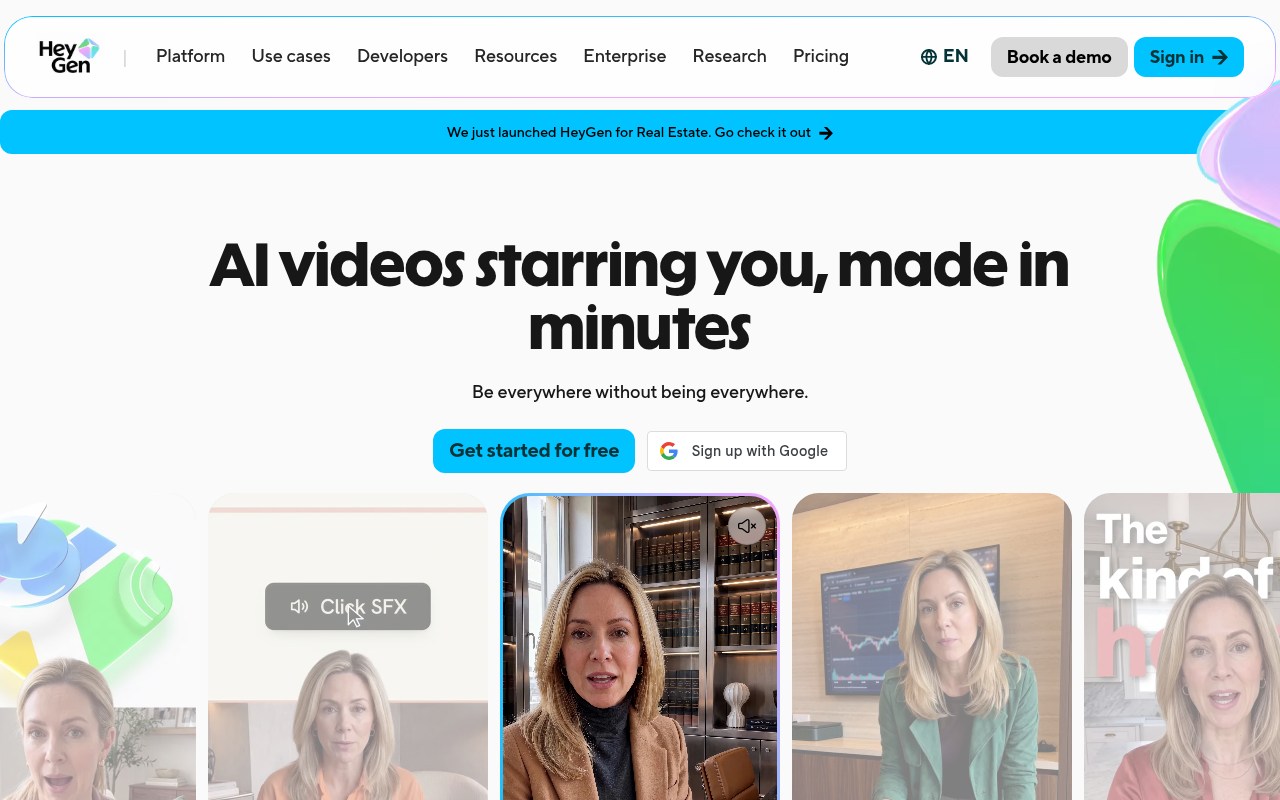
AI Studio is the text-based editor that reads like a document, Video Agent turns a one-line prompt into a share-ready cut, Video Translation localizes footage into 175+ languages and dialects with the original voice preserved, and a developer API exposes the same engines pay-as-you-go.
Avatar IV, released May 2025, animates a single photo, sketches and anime characters included. Avatar V, released April 2026, learns you from a 15-second webcam clip and keeps that identity steady across outfits, camera angles, and videos past 30 minutes.
The interactive avatars are sold separately as LiveAvatar, compared head-to-head with D-ID's agents in the real-time avatar section below.
What is D-ID?
D-ID, founded in 2017, calls itself a digital human platform: Video Studio for prerendered avatar videos, Visual AI Agents for real-time conversation, and one avatar layer feeding both, with an API where a talking-head video takes a single photo and one request.
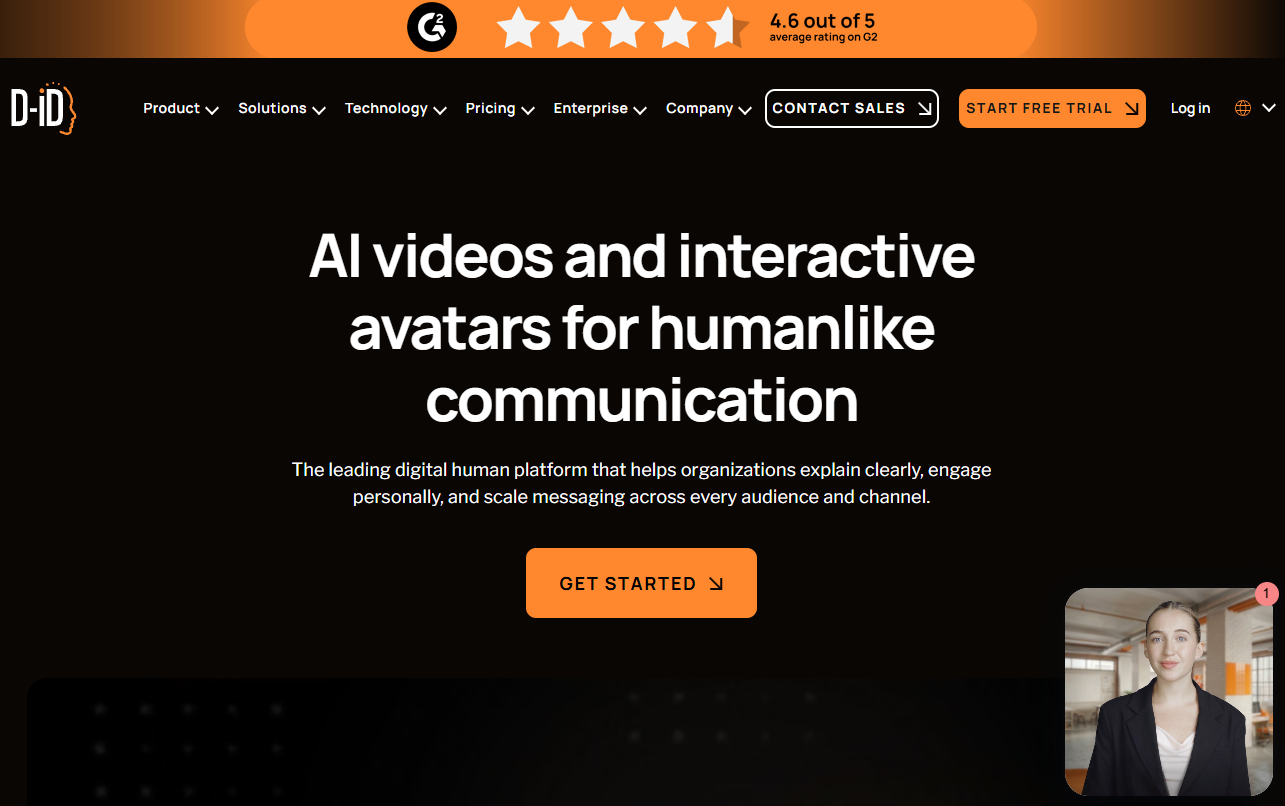
Four model generations make up that avatar layer: V2 from one image instantly, V3 Instant from about a minute of video, V3 Pro from a 3 to 5 minute recording, and V4 Expressive, launched March 2026, a diffusion model trained on captured actor performances. Custom V4 builds are Enterprise-only.
D-ID's interactive avatars, Visual AI Agents, are generally available on every plan, and a March 2025 Microsoft partnership brought them to Azure with a path into Teams. Plans start at $5.90 a month, on credit math the pricing section unpacks.
HeyGen vs D-ID: Comparison at a Glance
Here is the side-by-side view before the deep dive:
| HeyGen | D-ID | |
|---|---|---|
| Main job | Avatar videos for marketing, sales, and creators | Avatar videos and interactive agents for business, sold API-first |
| Interactive avatars | LiveAvatar, sold separately from $19/month | Visual AI Agents, generally available on every plan |
| Stock avatars | 500+ free, 700+ on paid plans | Total library size not published; V4 launched with 15+ |
| Custom avatar from a photo | Yes (Avatar IV) | Yes (V2, instant) |
| Custom avatar from video | 15-second recording (Avatar V) | 1-minute video (V3 Instant) or 3 to 5 minutes (V3 Pro, ready in 24 hours); custom V4 is Enterprise-only |
| Non-human and stylized characters | Yes (anime, animals, sketches) | Partial: a detectable face is required; animals, cartoons, and anime figures are rejected |
| Languages | 175+ languages and dialects (30+ on free) | 120+ (the FAQ says 119) |
| Translation of existing footage | Yes, voice preserved, up to 10 languages at once | Yes, Video Translate, 30+ output languages |
| Free plan | 3 videos per month, up to 1 minute, watermarked | 14-day trial with 3 total minutes; 200 free agent sessions |
| Paid plans from | $29/month ($24 billed annually) | $5.90/month (Lite; the pricing page's $4.70 is the annual-billing rate) |
| Export resolution | 1080p on Creator, 4K on Pro and above | Up to 1280x1280 standard, 1080p premium presenters, up to 4K on V4 |
| API | Pay-as-you-go from $5, Avatar III at $1/min | Credit-based plans; streaming billed at half the credit rate |
| Compliance posture | GDPR, SOC 2 Type II, consent verification | ISO 27001, 27017, 27018, 42001, SOC 2 |
Every row in this table except the interactive-avatars one describes prerendered video, the business both platforms grew up on. The sections below take those rows in turn, starting with video creation, and the interactive avatars get a head-to-head of their own instead of a caveat.
Video creation and translation
HeyGen feels like a creator tool with production polish as the point. Video Agent turns a prompt into a finished cut, AI Studio reads like a document, exports reach 4K on Pro plans, and Avatar V holds a stable identity through videos longer than 30 minutes. Translation is a headline feature, covering 175+ languages and dialects with the original voice preserved, one video into up to 10 languages in a single pass, with a free tier of 3 translated videos a month.
D-ID's Studio is built for volume and cost. Scripts, briefs, decks, and documents go in, multilingual avatar videos come out, and the same credits drive the API for programmatic generation. The specs are more modest. Standard presenters render up to 1280x1280, premium presenters reach 1080p, and only V4 output goes to 4K. On video length, D-ID's own pages disagree, with the FAQ capping Studio and API videos at 5 minutes while the pricing table lists durations up to 30 minutes; plan around the lower figure until D-ID reconciles them. Video Translate covers 30+ output languages per the pricing table, though other D-ID pages say 29 and 40+.
For polish, long-form stability, and translation reach, HeyGen is ahead. For cheap, repeatable, script-to-video generation at API scale, D-ID is the more economical machine.
Prerendered avatars
Avatar platforms sell two different products. A prerendered avatar performs a script into a video file, rendered before anyone watches, so every viewer gets the same take. An interactive avatar performs live, generating its frames while the user speaks, so no two conversations look alike. HeyGen and D-ID built their businesses on the prerendered kind, and that is the kind this section compares. Unusually for this category, both vendors also ship generally available interactive avatars, and those meet in their own head-to-head further down.
| Prerendered avatar | Interactive avatar | |
|---|---|---|
| Deliverable | A rendered video file | A live conversation |
| When frames are made | Before anyone watches | While the user speaks |
| Rendering budget | Minutes per take, retries allowed | Around a second, no second takes |
| Where this pair sells it | HeyGen and D-ID core platforms | Covered in the real-time avatar section |
On the prerendered job, HeyGen wins on breadth. Its stock library runs 500+ avatars free and 700+ paid; D-ID does not publish a total library count, and its newest V4 generation launched with 15+ ready-to-use avatars.
Character range also favors HeyGen. Avatar IV animates whatever photo you give it, and HeyGen's own material shows sketches, anime characters, and fantasy creatures presenting to camera. D-ID takes photos and illustrations, but the system requires a detectable face and its own FAQ names animals, cartoons, and anime figures as inputs that get rejected. If the presenter is anything other than a human face, HeyGen is the only one of the two that will animate it.
Custom avatars are where D-ID's four-generation ladder shows its logic. A V2 avatar comes from one image instantly on any plan. V3 Instant needs about a minute of video. V3 Pro needs 3 to 5 minutes, takes 24 hours, and requires a Pro plan or above. Custom V4, the flagship, is an Enterprise service built from multiple emotional recordings. HeyGen compresses that whole ladder into one step: Avatar V trains from a 15-second webcam clip, separates identity from appearance, and produces any outfit, any setting, and multiple camera angles from that single recording.
One detail matters for the real-time avatar section later: of D-ID's four generations, V2, V3 Pro, and V4 can stream in live conversations, while V3 Instant is video-only. Check which generation your plan and input actually buy before assuming an avatar can go interactive.
Real-time avatars
A real-time avatar draws its frames during the conversation itself, listening and responding within a couple of seconds instead of handing over a finished file. That budget is what puts an avatar in front of a live customer, student, or kiosk visitor. This is where the HeyGen vs D-ID matchup stops resembling the usual video-platform comparison: both vendors ship generally available interactive avatars, and the two answer different questions.
| HeyGen LiveAvatar | D-ID Visual AI Agents | |
|---|---|---|
| Status | Generally available, separate platform | Generally available on every Studio plan |
| Pricing | Free tier, then $19, $99, and $475 per month; enterprise floor $0.01/min | Metered in the same plan credits as everything else; 200 free trial sessions |
| Resolution | 1080p streaming | Up to 4K on V4 |
| Latency claim | Under 300ms median time to first frame | Under 500ms end to end on V4 |
| Integration | Full Mode (HeyGen supplies ASR, LLM, voice) or Avatar Only (bring your own stack) | No-code builder or API, webhooks, embeds for websites, apps, LMS platforms, kiosks |
| Knowledge base | Not published; Avatar Only assumes you bring your own | RAG over up to 5 documents of up to 500,000 characters each |
D-ID sells the complete agent. Upload your documents and the agent answers from them, with D-ID claiming over 90% accuracy in under two seconds, any LLM connectable, and webhooks firing workflows mid-call. Building one takes no code, and embedding it takes a link or a snippet. On V4, agents add generative UI, an optional camera "eyesight" mode, and MCP apps.
HeyGen sells the layer underneath the agent. LiveAvatar streams the avatar at 1080p into a conversational stack you assemble yourself, with unlimited concurrency from the $19 Starter tier, or hands you the whole voice stack in Full Mode if you would rather skip the assembly.
The practical split follows. A knowledgeable talking agent on your site this week, with no engineering, points to D-ID. A developer composing a custom stack who needs the avatar as one component points to LiveAvatar. What each vendor's latency figure actually measures is covered in the technical section below.
Pricing and plans
| HeyGen | D-ID | |
|---|---|---|
| Free option | Permanent free plan, 3 videos/month, 1 minute each, watermarked | 14-day trial, 3 total minutes, watermarked, plus 200 free agent sessions |
| Entry price | Creator, $29/month ($24 billed annually) | Lite, $5.90/month; the $4.70 shown by default is the annual rate |
| Credit unit | One currency; cost varies by model, duration, and complexity | 1 credit = up to 15 seconds of video; API streaming billed at half rate |
| Rollover | Unused credits roll one month on monthly plans | None; usage rounds up to 15-second increments |
| API | Pay-as-you-go from $5; Avatar III $1/min, Avatar IV $3 to $5/min | Build, Launch, and Scale tiers drawing on the same credit balance |
| Enterprise gates | Highest concurrency, custom digital twins via API | Unlimited video minutes, custom V4 avatars |
Two caveats deserve more space than a table cell. The first is D-ID's default pricing display. The figures its page renders first, $4.70 for Lite, $16 for Pro, $108 for Advanced, are annual-billing rates, and annual discounts run up to 45%, so the monthly-billing price sits meaningfully above the number you see first.
The second is agent billing, where D-ID's own pages disagree. The help center prices each agent message at 0.5 credits per 15 seconds of speaking time, while the agents page FAQ says 0.5 credits per 30 seconds. The help-center figure is more recent, and until D-ID reconciles the two, model your costs on the more expensive reading. Video Translate adds its own multiplier, charging per output language.
The caution from every comparison in this series applies double here. A HeyGen credit and a D-ID credit are unrelated units, so price the exact video or conversation you plan to run, on the exact model, on the billing cycle you will actually choose, before comparing invoices.
The technical approaches
Many of the gaps above start in the model architecture, so here is a mental model of each engine.
| HeyGen Avatar V | D-ID V4 Expressive | |
|---|---|---|
| Model class | Diffusion Transformer with flow matching | Diffusion model trained on captured actor performances |
| Input | 15-second reference recording | 15+ stock avatars; custom builds from multiple emotional recordings, Enterprise-only |
| Tuned for | Identity stability in prerendered output | The live conversational turn |
| Speed and output | Stable past 30 minutes; 4K on Pro plans and above | 200+ FPS generation pipeline; up to 4K |
| Latency claim | Under 300ms median time to first frame (LiveAvatar) | Under 500ms end to end; under 120ms core model |
| Published evidence | LSE-C 8.97; face similarity 0.840 | SyncNet benchmark, June 2026, ranked first on lip-sync |
HeyGen Avatar V conditions on the full token sequence of your reference video, with Sparse Reference Attention keeping the compute manageable. The design goal is identity. The model learns static features, like facial geometry and skin texture, alongside dynamic ones, like talking rhythm and habitual micro-expressions, and that combination buys the stability across outfits, angles, and long videos.
D-ID V4 Expressive points the same model family at the opposite constraint. Where Avatar V optimizes for consistency in a file, V4 optimizes for the live turn, generating faster than real time so the avatar can answer inside a conversation without the user waiting on a render.
Read the two evidence rows the same way, because each vendor publishes the benchmark it wins, on the test set it chose. And read the latency rows for what each clock measures. HeyGen's figure is median time to first frame, which starts when the avatar begins rendering. D-ID's figure is labeled end to end. The loop a user actually experiences runs through speech recognition, the LLM, and speech synthesis before a single frame appears, so the only comparison that counts is one you time yourself, across the whole loop, on your own stack.
What is LemonSlice?
LemonSlice is an AI research lab that specializes in interactive avatars, the real-time kind. A LemonSlice character lives inside your product, listening and answering while the exchange happens, and a session ends in a goodbye instead of a file. The company's stated mission is to build the emotional engine of AI, characters people form a genuine emotional connection with, and it pioneered an approach called Character World Models to pursue it.
The engine is a video diffusion transformer trained end to end, the same family as Sora or Veo 3, with the defining difference that every pixel is drawn live at 20fps on one GPU. No rig sits under the face or body, and no stock footage gets stitched in; the model generates the character, its motion, and its surroundings directly from the incoming audio and the state of the call.
That architecture collapses avatar creation to a single step. Hand the system one photo and the character is ready that instant, and every plan carries unlimited avatars because there is no per-avatar model to train or pay for. The photo does not need to show a human, either. Cartoons, animals, mascots, and statues carry conversations as readily as photoreal people.
The body joins the performance. Hands gesture and posture shifts as a natural part of speaking, the Action Engine fires specific gestures, emotions, and whole-body actions on cue, and a live image update can change the character's clothing or scene in the middle of a call.
The speed claims come with numbers attached. LemonSlice 2.1 Flash averages 471ms for the avatar layer and 2.04 seconds for the complete loop of speech recognition, LLM, speech synthesis, and video.
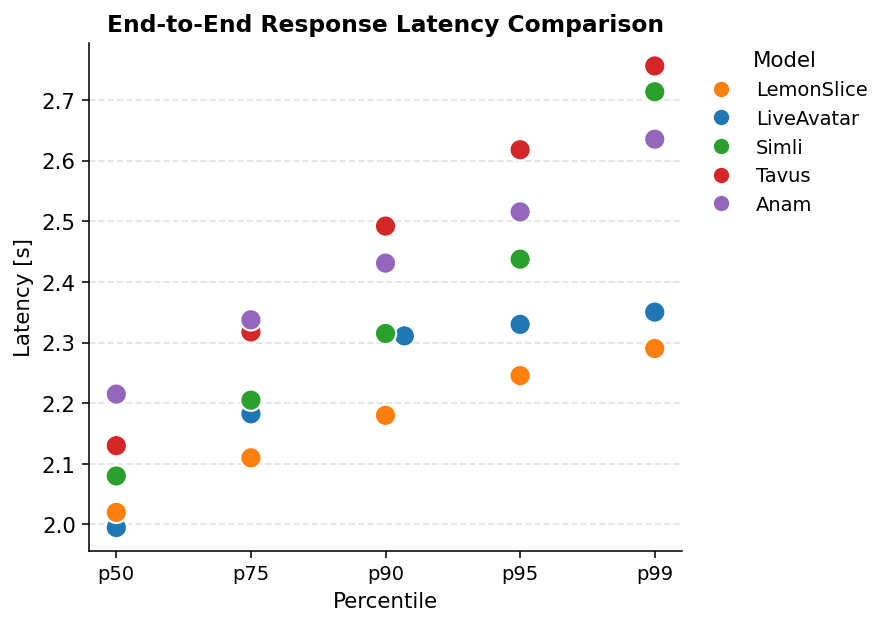
The model has already faced the public at scale. Microsoft ran a life-size interactive Theodore Roosevelt on LemonSlice at the Roosevelt Presidential Library, and every plan includes API access.
Try LemonSlice before you settle the shortlist. Chatting with the featured interactive avatars at lemonslice.com is free, and building a real-time avatar of your own starts with plans at $8 a month.
HeyGen vs D-ID vs LemonSlice
Everything before the LemonSlice profile judged these platforms on prerendered work. This closing comparison judges all three on the interactive job, and the field changes shape, because interactive avatars are LemonSlice's specialty. The three real-time offerings line up like this:
| LemonSlice | HeyGen (LiveAvatar) | D-ID (Visual AI Agents) | |
|---|---|---|---|
| Real-time product status | Core product, generally available | Separate product, generally available | Core product, generally available |
| Custom avatar creation | Instant, from one photo, unlimited on every plan | From an image or 2 minutes of footage, 1 custom avatar on $99 and $475 plans | V2 from one photo on all plans; streamable V3 Pro on Pro and above; custom V4 Enterprise-only |
| Character range | Any character: humans, cartoons, animals, mascots | 100+ presets, human presenters | Human faces required; animals, cartoons, and anime rejected |
| Hands and body in real time | Dynamic hand gestures and whole-body motion | Half-body or full-body framing | Not published |
| Mid-call appearance changes | Yes, clothing and scene swaps via image update | No equivalent published | No equivalent published |
| Built-in knowledge base | Bring your own: any LLM and knowledge base via API | Full Mode includes voice stack and LLM | RAG over up to 5 uploaded documents |
| Entry price | $8/month, every plan includes API access | $19/month (LiveAvatar Starter) | Inside Studio plans from $5.90/month, metered in credits |
What makes this trio unusual is that both competitors arrive with genuine, shipping products, and the table still splits the same way. A packaged agent and a streaming avatar layer are different shapes, yet each carries the assumptions of the video platform that raised it, preset presenter libraries, custom avatars sold by the slot, and usage metered like renders. LemonSlice had no video platform to inherit from. It designed for the conversation alone, which is why instant characters in any style, live hands and body, and a mid-call outfit change exist in its column and read as not published or absent in the other two.
The same honesty applies in reverse. If the job is rendering avatar videos, translating footage into dozens of languages, or generating talking-head clips through an API, HeyGen and D-ID are the right shortlist and LemonSlice is not on it. The three compete on exactly one thing, the live conversation, and there a system designed only for that job wins.
The Verdict
Choose HeyGen if production quality and reach come first. Marketing, sales, social, personal brand, and translation at scale. It has the larger avatar library, the wider character range including non-humans, Avatar V's identity stability for long-form content, 175+ languages, and 4K exports. Its LiveAvatar interactive avatars are also the stronger option for developers who want a raw real-time avatar stream inside their own stack.
Choose D-ID if you are buying an agent or buying on price. It is the cheapest entry point on this page, the API is the product rather than an add-on, and Visual AI Agents is the fastest path from documents to a knowledgeable talking agent embedded on your site, with the Azure partnership as a bonus in Microsoft environments. Budget time to work through the credit math and the annual-versus-monthly pricing before you commit.
Choose LemonSlice when the deliverable is the conversation itself. It is the only one of the three built specifically for interactive avatars. One photo becomes a character instantly, every plan carries unlimited avatars and API access from $8 a month, hands and body move live, clothing and scenes change mid-call, and the published full-loop response time sits around two seconds.
The clearest way to decide: ask what the person on the other end is doing. Watching a file means choosing between HeyGen and D-ID on polish or price. Talking back means choosing the platform that was built for exactly that.