
Articles · Sep 11, 2026
HeyGen vs. Synthesia: Which one is better?
HeyGen and Synthesia compared across avatars, video creation, languages, pricing, and real-time options, with a verdict for each job and where LemonSlice fits.
HeyGen and Synthesia end up in the same evaluation shortlist often. The two platforms turn a script into a finished video with a realistic presenter, sell to teams that would rather not film and reshoot, and run from free tiers all the way to enterprise contracts. Most teams buying an AI video platform will compare them before deciding.
This page lays out the comparison in detail: we compare their avatar models and libraries, video creation workflows, languages and translation, pricing, and their real-time interactive avatars, with a verdict for each use case.
What is HeyGen?
HeyGen is an AI video platform built around avatars of real people. You pick a stock presenter or create a digital twin of yourself, give it a script, and HeyGen renders the video, pitched as "AI videos starring you, made in minutes."
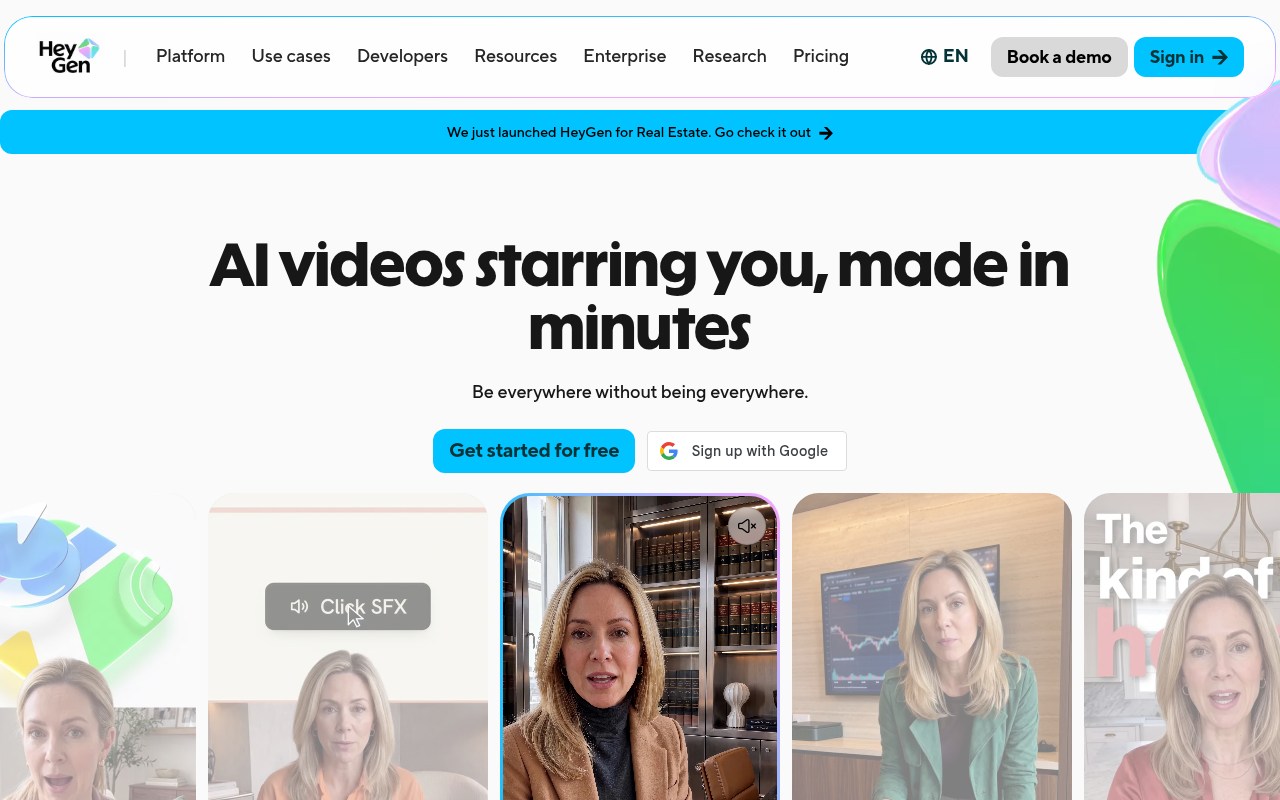
The platform covers several products. AI Studio is the text-based editor for avatar videos, Video Agent turns a prompt into a finished cut, Video Translation localizes existing footage into 175+ languages with lip re-sync, photo avatars animate a single image, and an API exposes the same engines on pay-as-you-go pricing.
The avatar models are the core of it. Avatar IV, released May 2025, animates a single photo, including sketches, anime characters, and animals. Avatar V, released April 2026, trains from a 15-second webcam recording and holds your identity stable across outfits, camera angles, and videos longer than 30 minutes.
HeyGen also sells interactive avatars through a separately priced product called LiveAvatar, covered in the real-time avatar section below.
What is Synthesia?
Synthesia is an AI video platform built for business communication, with a compliance posture aimed at enterprise buyers: security certifications, C2PA content credentials on by default, and early alignment with the EU AI Act.
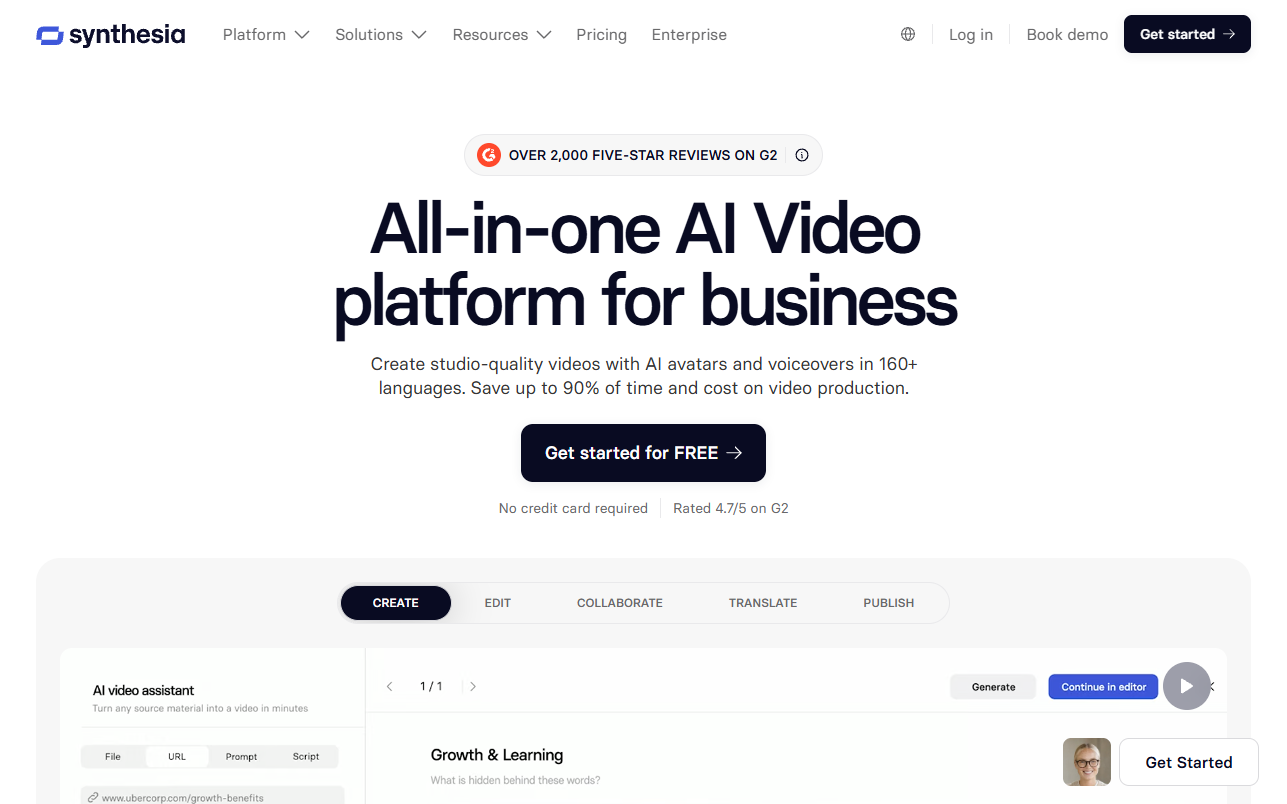
The product turns documents and scripts into presenter-led video. The Assistant drafts a video from a prompt or document, the editor handles scenes and brand kits, AI Dubbing translates existing footage into 140+ languages on enterprise plans, and an Interactivity layer adds quizzes and branching for training content bound for an LMS.
The avatar engine is on its third generation. Express-2 renders full-body avatars with gestures at 1080p and 30fps, and Express-3, launched July 2026, follows the sentiment of the script and generates up to twice as fast. Personal avatars come from a photo or a short recording with a consent verification step, ready in one business day.
Synthesia's interactive avatars are earlier-stage, a closed beta covered in the real-time avatar section below.
HeyGen vs Synthesia: Comparison at a Glance
Here is how the two platforms compare at a glance:
| HeyGen | Synthesia | |
|---|---|---|
| Main job | Avatar videos for marketing, sales, and creators | Avatar videos for training and internal comms |
| Interactive avatars | LiveAvatar, sold separately from $19/month | Closed beta, no public API or pricing |
| Stock avatars | 500+ free, 700+ on paid plans | 9 to 240+ depending on plan |
| Custom avatar from a photo | Yes (Avatar IV) | Yes (Personal Avatar) |
| Custom avatar from video | 15-second recording (Avatar V) | Short recording plus consent video, ready in 1 business day |
| Non-human and stylized characters | Yes (anime, animals, sketches) | Partial (Style Avatars from prompts and presets) |
| Languages | 175+ languages and dialects | 160+ languages and voices |
| Translation of existing footage | Yes, voice preserved, up to 10 languages at once | Yes, AI Dubbing, 140+ languages on Enterprise |
| Free plan | 3 videos per month, up to 1 minute, watermarked | 10 minutes per month, 9 avatars |
| Paid plans from | $29/month ($24 billed annually) | $19/month ($14 billed annually) |
| Export resolution | 1080p on Creator, 4K on Pro and above | 1080p, 30fps |
| API | Pay-as-you-go from $5, Avatar III at $1/min | On Creator plan and above, prerendered only |
| Compliance posture | SOC 2 Type II, GDPR, consent verification | SOC 2 Type II, ISO 42001, C2PA by default, EU AI Act signatory |
The sections below walk through the rows that decide purchases, starting with the avatars themselves.
Video creation
HeyGen feels like a creator tool. The text editor reads like a document. Video Agent turns a one-line prompt into a finished cut with b-roll and captions, and the photo avatar tools generate fresh looks and wardrobes from a prompt. The platform assumes the video is headed somewhere public, so it optimizes for variety and speed.
Synthesia feels like a workplace tool. The Assistant drafts a video from a document, the editor thinks in scenes and brand kits, and the output flows toward an LMS: SCORM export, quizzes, branching, and a multilingual player that serves each viewer their own language. The platform assumes the video is training or internal communication and optimizes for consistency over flash.
Neither approach is wrong, because they are tuned for different desks. A marketing team will produce more, faster, in HeyGen. An L&D team gets better governance at scale in Synthesia.
Prerendered avatars
Avatar products come in two kinds. A prerendered avatar is generated ahead of time: you submit a script, the platform renders a video file, and every viewer sees the same finished take. An interactive avatar is generated live, reacting to a real person mid-conversation. HeyGen and Synthesia built their businesses on the first kind, which this section compares; real-time avatars get their own section below.
| Prerendered avatar | Interactive avatar | |
|---|---|---|
| What you make | A finished video file | A live conversation |
| When frames are generated | Before anyone watches | While the user is talking |
| Rendering budget | Seconds to minutes per take, with retries | About a second, no retries |
| Sold by | HeyGen and Synthesia core platforms | Covered in the real-time avatar section |
On the prerendered job, the two differ most visibly in library and range. HeyGen ships 500+ stock avatars free and 700+ paid, against Synthesia's 9 on the free tier, 125+ on Starter, and 240+ only at Enterprise. Character range also favors HeyGen: Avatar IV animates whatever photo you give it, and HeyGen's own material shows sketches, anime characters, and animals presenting to camera. Synthesia added Style Avatars in 2026, stylized and cartoon characters built from prompts and presets, but the library is younger and a reference-image option is still marked as coming.
Custom avatars are close to parity on paper and different in feel. HeyGen's Avatar V trains from a 15-second webcam clip and then treats identity and appearance separately, so one recording produces any outfit, any setting, and multiple camera angles. Synthesia's Personal Avatars take a short recording plus a live consent video and are ready the next business day, and its Studio tier films you professionally for $1,000 a year. HeyGen optimizes for speed and range; Synthesia adds process, partly because its consent and compliance framework demands it.
Languages, translation, and dubbing
The raw numbers sit close together, so the differences are in the packaging rather than the counts.
| HeyGen | Synthesia | |
|---|---|---|
| Avatar speech | 175+ languages and dialects (30+ on free) | 160+ languages and voices, all plans |
| Translating uploaded footage | Yes, up to 10 languages in one pass | AI Dubbing, 70+ languages self-serve, 140+ Enterprise |
| Translating platform-made video | Same translation feature | 1-Click Translation, 80+ languages, Enterprise |
| Voice handling | Original voice preserved via cloning | Voice cloning with consent verification |
| Distribution | Free tier: 3 translated videos a month | Multilingual player auto-serves each viewer's language |
HeyGen keeps it simple: one pass, up to 10 languages, the speaker's own voice preserved. Synthesia splits the job in two, dubbing for footage you upload and 1-Click Translation for videos made in the editor, then closes the loop with a player that picks the right language per viewer, which is a distribution feature HeyGen does not match.
For pure translation volume on public content, HeyGen is simpler. For governed multilingual training rolled out across regions, Synthesia's pipeline is more complete.
Pricing and plans
| HeyGen | Synthesia | |
|---|---|---|
| Free plan | 3 videos/month, 1 minute each, watermark | 10 minutes/month, 9 avatars |
| Entry plan | Creator, $29/month ($24 annual) | Starter, $19/month ($14 annual) |
| Included volume | Unlimited web creation; advanced models metered in credits | About 12 minutes of video a month on Starter |
| Mid tier | Pro, $49/month | Creator, $89/month, about 30 minutes |
| API | Pay-as-you-go from $5; Avatar III $1/min, Avatar IV $3 to $5/min | Creator plan and above |
| Enterprise gates | 4K exports, higher API concurrency | Full avatar library, 140-language dubbing, unlimited minutes |
Free tiers. Synthesia's is more usable, with 10 minutes of video a month and 9 avatars to work with. HeyGen's free plan renders 3 videos a month, capped at 1 minute each, with a watermark.
What a dollar buys. Both platforms meter usage in credits, and this is where the comparison needs care. Synthesia counts rendered minutes against a monthly pool. HeyGen prices unlimited web creation into its paid plans but meters its advanced avatar models through credits, and its API meters per minute, where the model you pick moves the bill more than the plan does.
One caution applies to both. A HeyGen credit, a Synthesia credit, and a minute of finished video are three different units. Price the video you actually plan to make, on the model you actually plan to use, before comparing invoices.
Real-time avatars
A real-time avatar, also called an interactive avatar, is generated while the conversation happens. It listens, answers within a couple of seconds, and reacts to what the user just said, which is what makes face-to-face experiences like tutors, support agents, sales demos, and kiosks possible. Neither company treats interactive avatars as its main business, but both have an answer, and the two answers are at very different stages.
| HeyGen LiveAvatar | Synthesia Interactive Avatars | |
|---|---|---|
| Status | Generally available, separate product | Closed beta |
| Pricing | Free tier, then $19 to $475/month | Not published |
| Resolution | 1080p | Not published |
| Latency claim | Under 300ms median time to first frame | Not published; listed as active work |
| Integration | Own platform and API | LiveKit plugin, bring your own LLM |
| Concurrency | Unlimited from the $19 Starter plan | Not published |
HeyGen's answer is a shipping product with enterprise rates that fall to $0.01 a minute. One note on its latency claim: time to first frame covers the moment the avatar begins rendering. The full loop a user experiences between finishing a sentence and hearing an answer also includes speech recognition, the LLM, and speech synthesis on top.
Synthesia's answer is a beta for selected teams, where you bring your own agent stack and Synthesia renders the avatar layer. The company itself lists quality, latency, and interruption handling as active work. Its one generally available real-time product is Roleplay Sessions, a per-seat training tool where learners rehearse conversations against an avatar.
If a real-time avatar is a requirement this quarter, HeyGen has something you can ship and Synthesia mostly does not, yet. Whether either is the right foundation for a conversation-first product is a question for the LemonSlice sections below.
The technical approaches
Many of the differences above trace back to model architecture, so here is a mental model of each.
| HeyGen Avatar V | Synthesia Express-2 / Express-3 | |
|---|---|---|
| Model class | Personal model per avatar, trained from video | Diffusion transformer pipeline |
| Input | 15-second reference recording | Script plus avatar selection |
| Output | Multi-angle, stable beyond 30 minutes | Full-body, 1080p at 30fps, any length |
| Signature strength | Identity stability across outfits and takes | Native gesture generation, script sentiment |
| Published evidence | Benchmark wins on lip-sync and face similarity | Architecture detail across three sub-models |
HeyGen Avatar V separates who you are from how you look in a given clip. That separation is what buys identity stability across outfits, angles, and long videos, and HeyGen publishes benchmark wins on lip-sync accuracy and face similarity to back it. It is a rendering system tuned for one job: making a specific person look consistently real on camera, take after take.
Synthesia Express-2 and Express-3 pair a voice model with a motion model and a renderer. Full-body gesture generation is native, and Express-3 adds sentiment, so the avatar's delivery follows the emotional register of the script. Synthesia publishes the architecture in unusual detail, three coordinated sub-models for motion, alignment, and rendering.
Both are prerendered systems, and that constraint shapes everything about how they look. They can spend seconds to minutes rendering each output, retry bad takes, and pick the best. That budget buys polish. A real-time avatar gets no retries and roughly a second of budget, which is why it is a different engineering problem, and why both companies ship their interactive avatars separately from their flagship engines.
What is LemonSlice?
LemonSlice is an AI research lab focused entirely on real-time interactive avatars: characters that listen, talk, and react live inside your product. The mission is to build the emotional engine of AI, characters that form a real emotional connection with humans, through a technical approach the lab pioneered called Character World Models.
Under the hood is an end-to-end video diffusion transformer, the same model class as Veo 3 or Sora, generating every pixel at 20fps on a single GPU while the conversation happens. No face rig, no body rig, no pre-recorded footage stitched together. Because the model is not tied to a human face rig, any character with a face works: photorealistic humans, cartoons, animals, and brand mascots all hold conversations, created instantly from one photo, with unlimited avatars on every plan and no per-avatar training or fee.
The body is part of the performance. Hand gestures and natural body language emerge from the audio on their own, the Action Engine triggers specific gestures, emotions, and whole-body actions during a call, and the avatar's clothing or scene can change mid-conversation through a live image update.
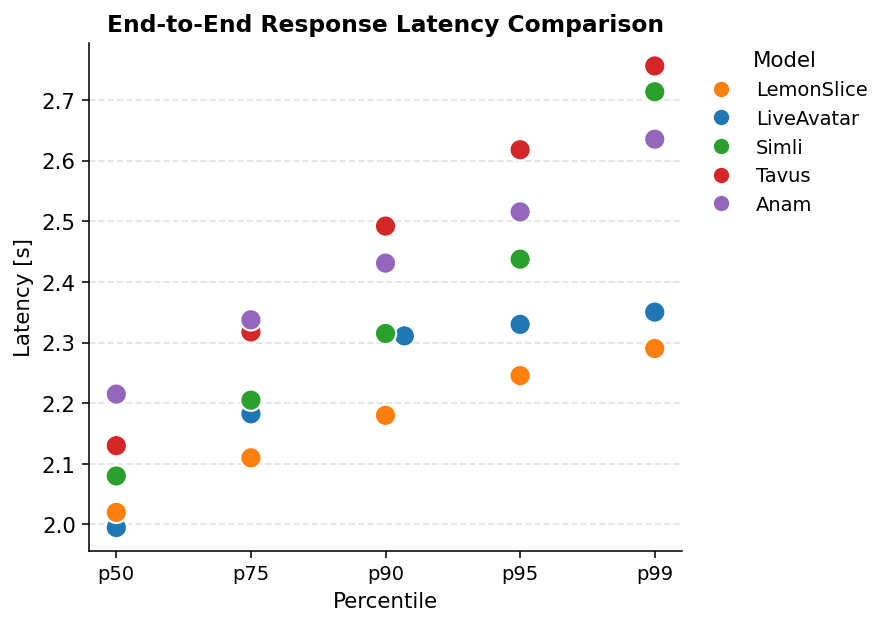
Speed holds up under measurement. LemonSlice 2.1 Flash averages 471ms for the avatar itself and 2.04 seconds for the full response loop of speech recognition, LLM, speech synthesis, and video, timed across the whole exchange a user actually waits through.
Proof lives outside the demo reel too: Microsoft chose LemonSlice to power a life-size interactive Theodore Roosevelt at the Roosevelt Presidential Library.
Try LemonSlice: chat with the featured interactive avatars at lemonslice.com for free, then build your own real-time avatar from $8 a month with API access on every plan.
HeyGen vs Synthesia vs LemonSlice
The head-to-head above covered prerendered video. This last comparison covers real-time interactive avatars, where the shortlist changes shape: HeyGen brings its separately sold LiveAvatar, Synthesia brings a closed beta, and LemonSlice brings a platform designed for exactly this category.
| LemonSlice | HeyGen (LiveAvatar) | Synthesia (beta) | |
|---|---|---|---|
| Real-time product status | Core product, generally available | Separate product, generally available | Closed beta, no public API |
| Custom avatar creation | Instant, from one photo, unlimited on every plan | From an image or 2 minutes of footage, 1 custom avatar on $99 and $475 plans | Not publicly available |
| Character range | Any character: humans, cartoons, animals, mascots | 100+ presets, human presenters | Not publicly documented |
| Hands and body in real time | Dynamic hand gestures and whole-body motion | Upper-body presenter framing | Not publicly documented |
| Mid-call appearance changes | Yes, clothing and scene swaps via image update | No equivalent published | Not publicly documented |
| Entry price | $8/month, every plan includes API access | $19/month (LiveAvatar Starter) | Not published |
The rows above are where a dedicated platform shows. A video company's interactive avatars inherit video-company assumptions, presenter framing, preset libraries, and per-avatar slots, because the live conversation is its second business. LemonSlice designed for the conversation first, which is why instant characters, live hands and body, and mid-call scene changes exist there and are unpublished or absent elsewhere.
Fairness cuts the other way on the prerendered job. If you need training videos in 40 languages or a daily avatar clip for social, HeyGen and Synthesia are the right shortlist, and LemonSlice does not belong on it. The three meet on one question only, the live conversation, and there the specialist wins.
The Verdict
Choose HeyGen if the videos face outward. Marketing, sales, social, personal brand. It has the larger avatar library, the wider character range, the stronger photo-to-avatar path, translation built for public content, and the more usable developer API. Its LiveAvatar interactive avatars are also the more mature real-time option of the two video platforms.
Choose Synthesia if the videos face inward. Training, onboarding, internal comms, anything that ends up in an LMS or an audit. It starts cheaper, governs better, documents its models more openly, and carries the compliance posture that enterprise buyers clear fastest.
Choose LemonSlice if the deliverable is a live conversation. It is the only one of the three built exclusively for interactive avatars: any character from one photo, unlimited avatars on every plan, live hand gestures and body language, and a full response loop around two seconds, from $8 a month.
The clearest way to decide: ask what the viewer is doing. If they are watching, pick between HeyGen and Synthesia by whether the content is public or internal. If they are talking back, pick the tool that only does that.