
Articles · Sep 11, 2026
Tavus Review 2026: Features, Pricing, and How It Compares
An honest Tavus review for 2026: what the Conversational Video Interface does well, where it falls short, pricing by plan, and how it compares for interactive avatars.
This review is for teams deciding whether Tavus fits their next avatar project. We looked at both sides of the product: the real-time side built around the Conversational Video Interface, where an avatar holds a live conversation with your users, and the smaller video generation side that remains from the company's personalized-video years.
Along the way we checked avatar creation, expressiveness, latency, perception, languages, output quality, and pricing, using Tavus's own product pages as the source for every fact, plus our own head-to-head testing. Where Tavus does something well, we say so, and where it falls short, we say that too.
What is Tavus?
Tavus calls itself the human computing company. It is an AI research lab that has been building AI video since 2020, and it sells to developers who want to put a talking, listening face inside their products.
The company started out in personalized video, where a sales team recorded one video and generated thousands of personalized versions from it. In 2024 it shifted to a developer platform, and its main product today is the Conversational Video Interface, or CVI, a face-to-face avatar that holds real-time conversations and that you build through an API. Tavus reports more than 100,000 developers on the platform.
The avatars are called Replicas, and the agents behind them are called PALs, short for Personified Application Layers. A no-code builder called PAL Maker sits alongside the API, and every plan still includes a small allowance of video generation minutes for finished, pre-rendered clips.
Pre-rendered vs. interactive avatars
Since Tavus sells both pre-rendered video generation and interactive avatars, it helps to understand the difference between the two before we go feature by feature.
A pre-rendered avatar video is made ahead of time. You give the platform a script and a presenter, it renders a finished clip, and every viewer watches that same clip. An interactive avatar is closer to a video call. The character is generated during the conversation itself, which means it listens while you talk, works out a reply, and says it to you in real time.
| Pre-rendered avatar video | Interactive avatar | |
|---|---|---|
| What it is | A finished clip rendered from a script before anyone watches it | A character generated during the conversation itself |
| Tavus's product | Video generation minutes included on each plan | The Conversational Video Interface (CVI) |
| How you interact | Playback only, the same clip for every viewer | Two-way, it answers you like a video call |
| Typical uses | Personalized outreach, explainers, training clips | Screening, support, sales demos, kiosks |
Tavus's position is unusual because it moved from one avatar type to the other. Its history is pre-rendered, since the company spent its first years generating personalized sales videos, but its primary product today is the interactive one. CVI carries the platform, and pre-rendered video generation remains as the smaller side of the same plans.
Tavus review at a glance
Here's how Tavus performs across the dimensions we evaluated:
| Dimension | What Tavus ships | Notes |
|---|---|---|
| Primary product | Interactive avatars via CVI | Video generation is the smaller remaining product |
| Avatar creation | Replicas from a photo or a short video, plus a stock library | Human-shaped subjects only, monthly training quotas |
| Expressiveness | 10+ emotional states, active listening | No dynamic hand gestures in our testing |
| Latency | Utterance-to-utterance pipeline built for real time | 2.13s median in our full-pipeline test |
| Perception | Raven-1 reads expression, gaze, and shared screens | Works only in the full CVI pipeline |
| Languages | 30+ languages on the pricing page | Docs cite 42+ depending on the voice engine |
| Resolution | 1080p and 24kHz audio on every plan | Chest-up or waist-up framing on the newest model |
| Pricing | Free plan, then $59/month Starter | Conversation and video generation metered separately |
Product and pricing information: Tavus product, pricing, and documentation pages, September 2026.
Characters and avatar creation
Avatar creation covers the interactive avatars and the pre-rendered videos alike, because both run on the same Replicas. You create a Replica from a single photo or a short recorded video, and Tavus trains a model on it before you can use it. The current lineup gives you three ways in:
- Phoenix-4.5, the newest model, trains from a photo or a video and gives you a preview face within minutes, then keeps tuning in the background
- Phoenix-4 trains from a photo or a video, supports wider body shots, and is usable only when the whole training job finishes
- The stock library offers 100+ ready-made Replicas on the higher plans, with 25 on the free plan
In our own testing, a full Phoenix-4 training run took between two and six hours per Replica. One more thing to check before you upload: Tavus auto-edits the source image, and in our testing the edit changed the identity of the person in the photo.
Strength: You do not need source material of your own to get started, because the stock library covers 100+ Replicas, and the newest model turns a photo into a usable preview face in about a minute.
Limitation: Every model accepts only human or clearly human-shaped subjects, so animals, mascots, and objects with faces are out. Custom Replicas also draw from monthly training quotas, three per month on Starter, with a flat fee for each extra.
Expressiveness and body language
This is about the interactive avatars, because Phoenix-4 is the model that performs live. It renders every frame in real time instead of looping recorded clips, and it shifts between 10+ emotional states as the conversation moves, from concern and surprise to curiosity and contentment. The avatar also reacts while you talk, keeping eye contact and changing expression instead of holding still until its turn.
Strength: The face work is an area Tavus handles well. Expressions follow the tone of the conversation in real time, and the listening behavior makes the avatar feel present between its own turns.
Limitation: The performance stays in the face. Tavus does not support dynamic hand gestures, and in our testing a source image that contained hands either errored out or produced an avatar whose hands never moved.
Latency and response times
Latency matters most for the interactive avatars, because a reply that runs long breaks the feeling of a conversation. Tavus builds its pipeline around utterance-to-utterance latency, the full round trip from when you stop talking to when the avatar answers, and its docs describe the whole stack as optimized for real-time use.
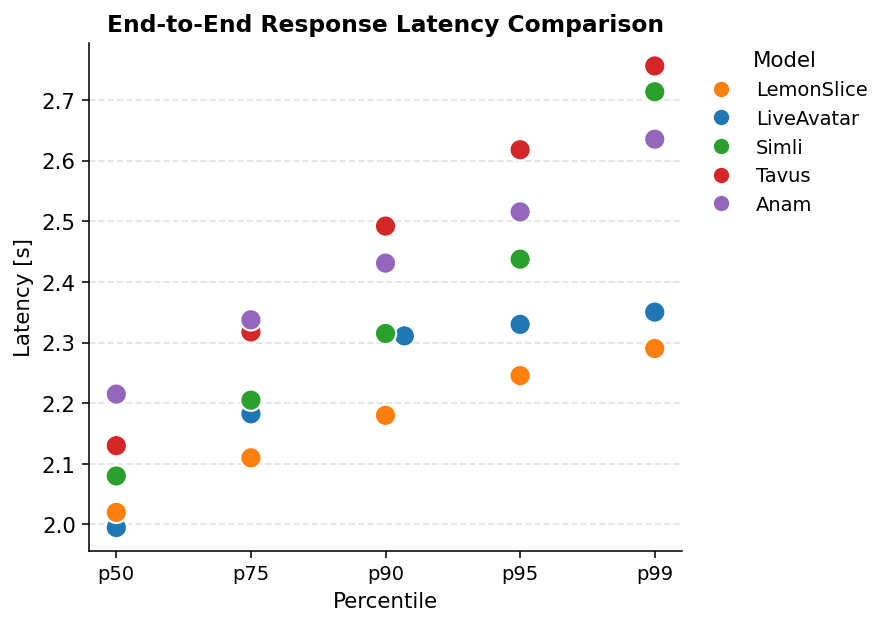
We also measured it ourselves. Under a LiveKit pipeline with the same speech recognition, language model, and voice on every run, repeated 50 times, Tavus answered in 2.13 seconds at the median, 2.31 seconds at the 75th percentile, and 2.75 seconds at the 99th. Interface research going back decades puts the threshold near one second before a pause starts to feel broken, and the tail of the distribution is what users notice.
Strength: Because Tavus runs every step of the pipeline itself, from perception through rendering, there are fewer handoffs between vendors to slow a reply down.
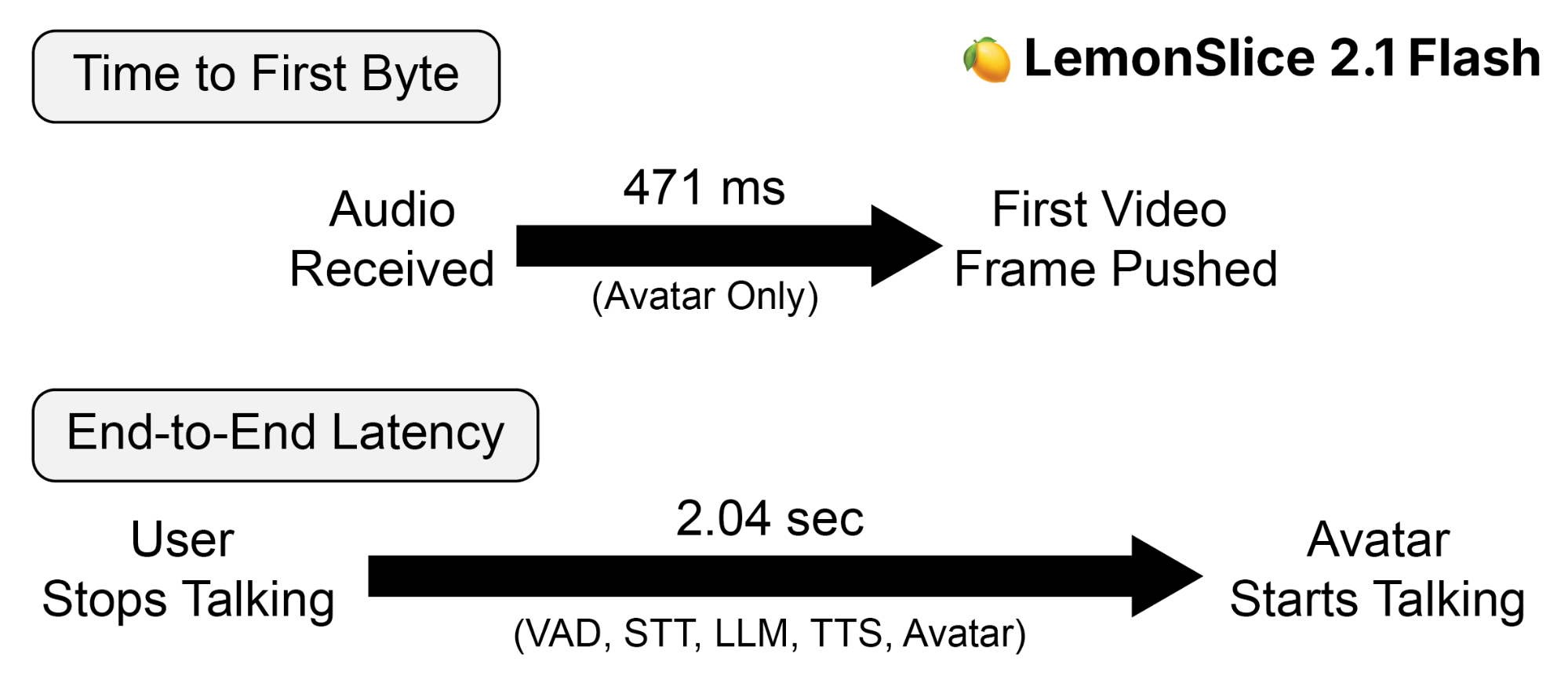
Limitation: Vendor figures like the sub-600ms number Tavus has published measure only the avatar rendering step, and the full reply a user waits through takes longer, so ask where any quoted measurement starts and stops.
Perception and turn-taking
This applies to the interactive avatars, and only through the full CVI pipeline. Raven-1 is Tavus's perception model. It watches the user's camera and reads expression, gaze, tone, emotion, and even what's on a shared screen, then turns all of that into signals the agent can react to. Sparrow-2 handles the rhythm of the conversation. It models interruptions, backchannels, background speech, and noise to decide when the avatar should listen, wait, or keep talking.
Strength: Built-in perception is a dimension Tavus handles well. The avatar can respond to what it sees as well as what it hears, and you do not have to wire up a separate vision model.
Limitation: Perception requires the full CVI pipeline. The alternate build paths, including Echo Mode and the LiveKit and Pipecat integrations, are incompatible with the perception and speech recognition layers.
Languages and voices
Language coverage works the same for the interactive avatars and the pre-rendered videos, because both speak through the voice layer. The pricing page lists 30+ languages, while the docs cite 42+ depending on the text-to-speech engine, so the practical answer depends on the voice you pick. The supported engines are Cartesia by default, plus ElevenLabs and Azure, and you can bring your own language model for the reply text itself.
Strength: The voice layer is pluggable, so if a supported engine speaks your market's language, the avatar does too, and custom Replica training includes a custom voice model.
Limitation: Tavus's own pages disagree on the count, 30+ on the pricing page against 42+ in the docs, so confirm your specific languages before you commit.
Developers and integration
Tavus is a developer platform first, and the API covers both the interactive avatars and the pre-rendered videos. The main path is the full CVI pipeline, where perception, turn-taking, speech recognition, the language model, the voice, and the rendering come as one stack over WebRTC. Around it sit a React component library, a Knowledge Base that lets the agent answer from your documents, Memories that persist across conversations, function calling, and guardrails that keep a conversation on track. A PAL can even join a Google Meet call as a participant.
If you already run a voice pipeline, the alternate paths matter more. Echo Mode sends your own text or audio straight to the avatar for playback and bypasses most of the pipeline, and the LiveKit and Pipecat integrations let a Tavus face render inside a stack you already operate. On the no-code side, PAL Maker builds and deploys an agent without touching the API.
Strength: The platform is complete. The full pipeline ships with perception, retrieval, memory, and tooling that most avatar vendors leave for you to build yourself.
Limitation: Those features assume the full pipeline. If you build through Echo Mode or the LiveKit and Pipecat integrations, the perception and speech recognition layers stop working, so the flexible route gives up the platform's smartest parts.
Resolution and output
The output numbers cover both the interactive avatars and the pre-rendered videos. CVI streams at 1080p with 24kHz audio on every developer plan, free tier included, and an alpha channel option cuts the avatar out against a transparent background so you can place it inside your own interface.
Strength: Output quality is an area Tavus handles well, and 1080p on every plan, with no premium gate, is more than most real-time avatar platforms ship.
Limitation: The framing is a video call. The newest face model frames the avatar chest-up or waist-up, and while Phoenix-4 offers wider body shots, the movement concentrates in the face.
Pricing and plans
Pricing runs on two meters, because conversation minutes and video generation minutes are tracked separately on the same plans. The free tier renews every month instead of expiring as a trial, with 25 minutes of conversational video and 5 minutes of video generation each month, and no upfront payment.
| Plan | Monthly price | Included minutes | Notes |
|---|---|---|---|
| Basic | Free | 25 min conversation, 5 min video generation | 25 stock Replicas, 1 concurrent stream |
| Starter | $59 | 100 min conversation, 10 min video generation | 3 Replica trainings/month, 3 concurrent streams |
| Growth | $397 | 1,250 min conversation, 100 min video generation | 7 Replica trainings/month, 10 concurrent streams |
| Enterprise | Custom | Custom volume | White-label, SLAs, custom concurrency |
Pricing captured from Tavus's pricing page, September 2026. Confirm current rates before you buy.
Read the meter rules before you choose:
- Every conversation carries a 30-second minimum charge, and usage rounds to the nearest 6 seconds
- Conversation overage runs $0.37 per minute on Starter and $0.32 per minute on Growth
- An extra Replica beyond the monthly training quota costs a flat $65 on Starter or $40 on Growth
Tavus also sells separate consumer plans for its PAL companions, but this review covers the developer platform.
What is LemonSlice and why it's a better Tavus alternative
LemonSlice is an AI research lab building interactive characters that talk, listen, and react in real time. You give it a photo, and moments later that character is on screen holding a live conversation with your users.
The easiest way to picture it is through what you can build. An avatar tutor can walk a student through a problem step by step and react to every answer. A support agent can greet customers on your site and help them face to face, not through a chat window. A sales avatar can run a demo, answer questions, and qualify the lead while it talks. The same characters work as onboarding guides inside a product, kiosk concierges, and language partners that let learners practice without pressure.
Under the hood it runs a Character World Model, an end-to-end video diffusion transformer. It is the same class of model behind Veo 3 and Sora, run live during the conversation. Every pixel is generated at 20fps on a single GPU, body and background included, so nothing is composited or pre-recorded.
Creation is instant, with no training to wait on, no per-avatar fee, and unlimited avatars on every plan. If it has a face, LemonSlice can animate it, so cartoons, animals, and mascots work as well as photorealistic humans.
The character also has a body and an environment. Hand gestures and natural body language emerge as part of the performance. You can trigger emotions like happiness, sadness, and anger through the Action Engine, and an image update changes clothing or scene mid-conversation.
It's fast too. LemonSlice 2.1 Flash responds in 471ms on average, making it the fastest model among major avatar providers in published benchmarks. In our head-to-head LiveKit test against Tavus, LemonSlice answered faster at every percentile, 2.0 seconds against 2.13 at the median and 2.29 against 2.75 at the 99th.
That is why LemonSlice is the better Tavus alternative for interactive avatars. Tavus animates a photorealistic human with the performance concentrated in the face, while LemonSlice generates any character with working hands, whole-body motion, and controllable emotions.
You can chat with a featured avatar for free, then build your own from $8/month.
LemonSlice vs. Tavus: comparison at a glance
Here's how the two stack up side by side:
| LemonSlice | Tavus | |
|---|---|---|
| Photorealistic humans | ✅ | ✅ |
| Cartoon and stylized characters | ✅ | ⚠️ Human-shaped characters only |
| Non-human characters | ✅ | ✖️ |
| Dynamic hand gestures | ✅ | ✖️ |
| Controllable emotions | ✅ Action Engine | ✅ 10+ emotional states |
| Clothing and scene swaps | ✅ Mid-conversation image update | ✖️ |
| Built-in perception | ✖️ Connect your own perception model | ✅ Raven-1, full CVI only |
| Custom avatar cost and creation time | $0, instant from one photo, unlimited on every plan | Monthly training quotas, 3/month on Starter, $65 per extra Replica |
| Cost per minute | $0.1367/min avatar-only, $0.2133/min full pipeline (top self-serve plan) | $0.32 to $0.37/min full pipeline, no published avatar-only rate |
| Speed in end-to-end benchmarks | Faster at every percentile: p50 2.0s, p99 2.29s | p50 2.13s, p99 2.75s in the same test |
| SDK integrations | LiveKit, Pipecat, Agora, WebSockets, any LLM or voice provider | LiveKit, Pipecat, Daily WebRTC, bring your own LLM |
| Technical approach | Character World Model, an end-to-end video diffusion transformer | Gaussian-diffusion based face rendering (Phoenix-4) |
| Resolution | 512px standard, HD on Enterprise | ✅ 1080p on every plan |
| No-code path | Widget embed, two lines of code | ✅ PAL Maker with the full CVI stack built in |
| Pre-rendered video generation | ✖️ | ✅ |
| Entry price | $8/month | $59/month, free tier available |
Product and pricing information: vendor product and pricing pages, September 2026. Latency figures: LemonSlice's controlled LiveKit test, identical pipelines, N=50.
Who should use Tavus
Choose Tavus if you want to ship a complete interactive avatar experience with little code. The full CVI stack hands you perception, turn-taking, speech recognition, and rendering as one pipeline, and PAL Maker puts a working agent online without any code at all.
Structured conversations reward that stack most. Screening, interviews, healthcare intake, and qualification flows benefit from built-in perception, photorealistic humans at 1080p, and SOC 2 and HIPAA compliance that shortens security review. It's also a reasonable choice for corporate training and other presenter work, where a restrained, professional human face is what the audience expects.
Who should use LemonSlice
Choose LemonSlice when the interactive avatar is the product. Consumer-facing experiences, tutors, and companion apps reward expressiveness, and users consistently rate LemonSlice avatars as more natural to talk to. It's also the pick when your character is not a photorealistic human, because cartoons, animals, and mascots work from the same single photo.
It's the better fit for physical installations too, because LemonSlice powers some of the most visible in the world, including Microsoft's life-size AI Teddy Roosevelt.
And if you're a developer wiring a face onto an existing voice agent, LemonSlice plugs straight into LiveKit, Pipecat, and Agora, and works with any LLM or voice provider.
The Verdict
Choose Tavus if you want the surrounding infrastructure handed to you. The low-code product is complete, with perception, turn-taking, memory, and retrieval built into one pipeline, it renders photorealistic humans at 1080p on every plan, and the free tier is a real monthly allowance.
Choose LemonSlice if the avatar itself is what matters. The avatars are more expressive and natural, with hands and a full body rather than a talking head. They can be any character in any style, created instantly from a single photo, and they answered faster at every percentile in our head-to-head test.
The clearest way to decide: if the avatar needs to be a face that speaks and you want the infrastructure handled for you, choose Tavus. If it needs to be a character your users want to keep talking to, choose LemonSlice. And if you want to see the difference before you decide, talk to a LemonSlice avatar and judge it for yourself.