Blog · Dec 16, 2025
Introducing LemonSlice-2
Supporting the release of LemonSlice Avatars is LemonSlice-2, a novel video diffusion transformer model and inference framework that enables real-time, interactive avatar experiences.
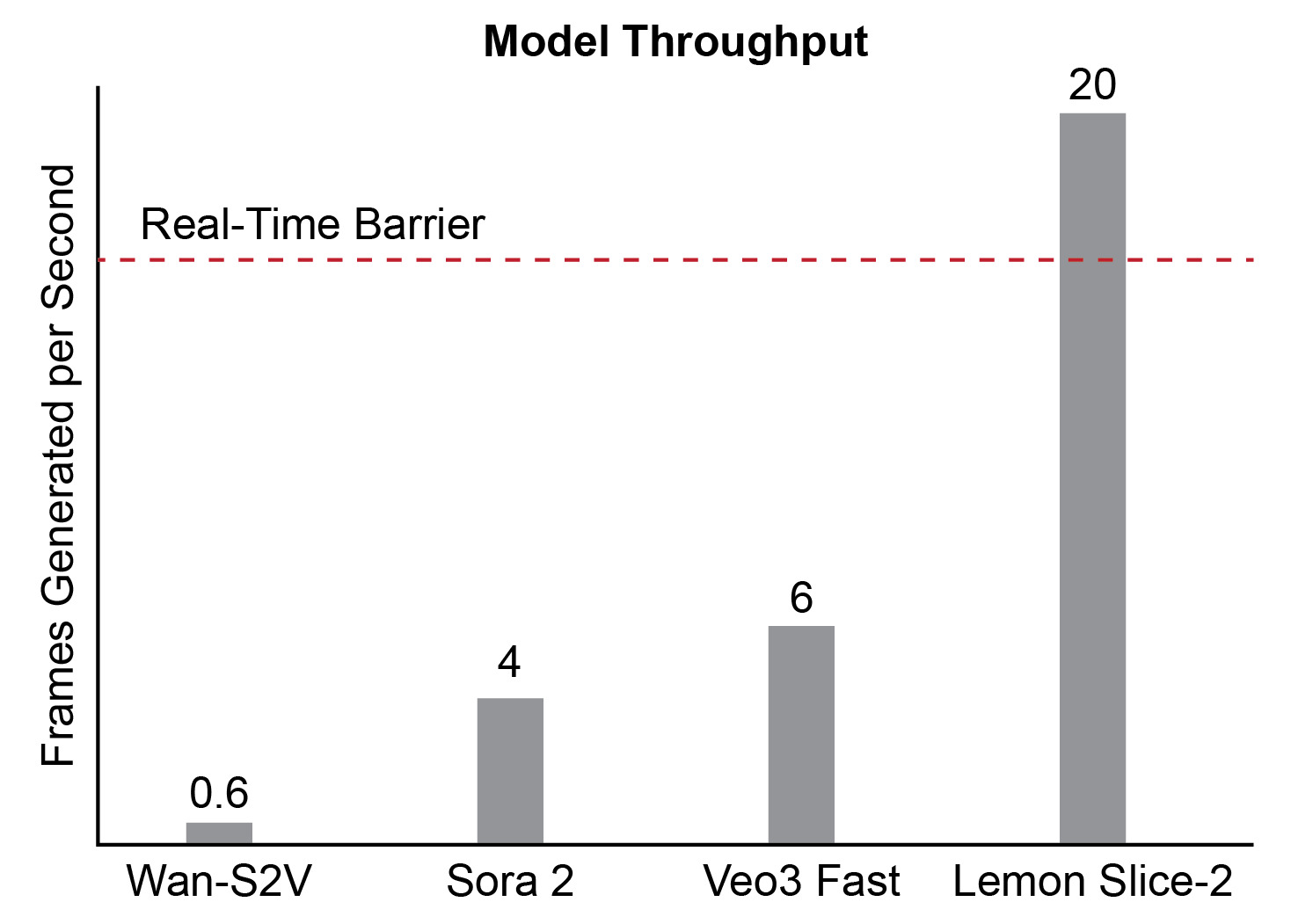
LemonSlice-2 is a 20-billion-parameter, few-step causal model that achieves a generation throughput of 20 frames per second on a single GPU. Efficient attention and caching strategies enable ultra-fast response times in an interactive setting and infinite-length videos with zero error accumulation. LemonSlice-2 supports full-body avatar generation with expressive and semantically aware gestures. It is available to the public for general use.
Any character
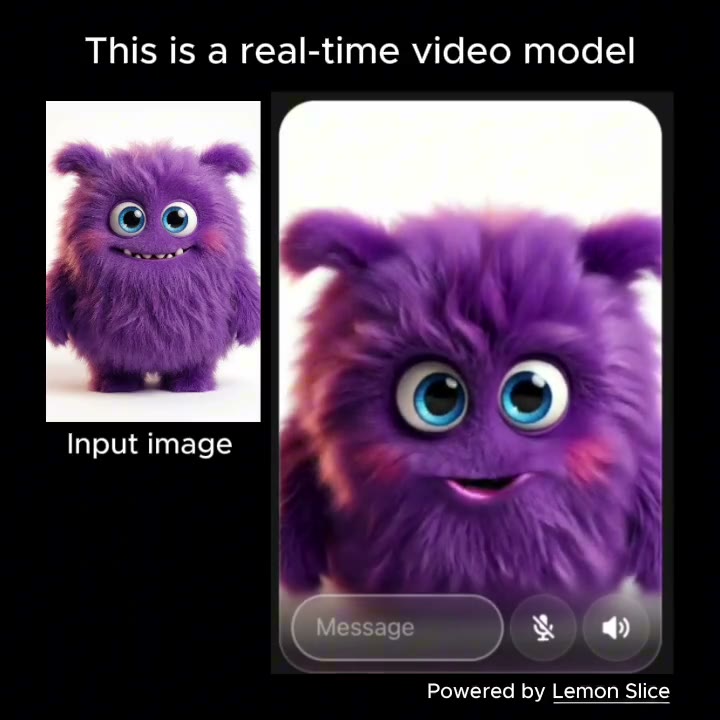
Videos generated in real time from a single image and audio sample on one GPU.
Any style
The same model works across photorealistic, illustrated, sculptural, and highly stylized characters.
Expressive gestures & scene awareness
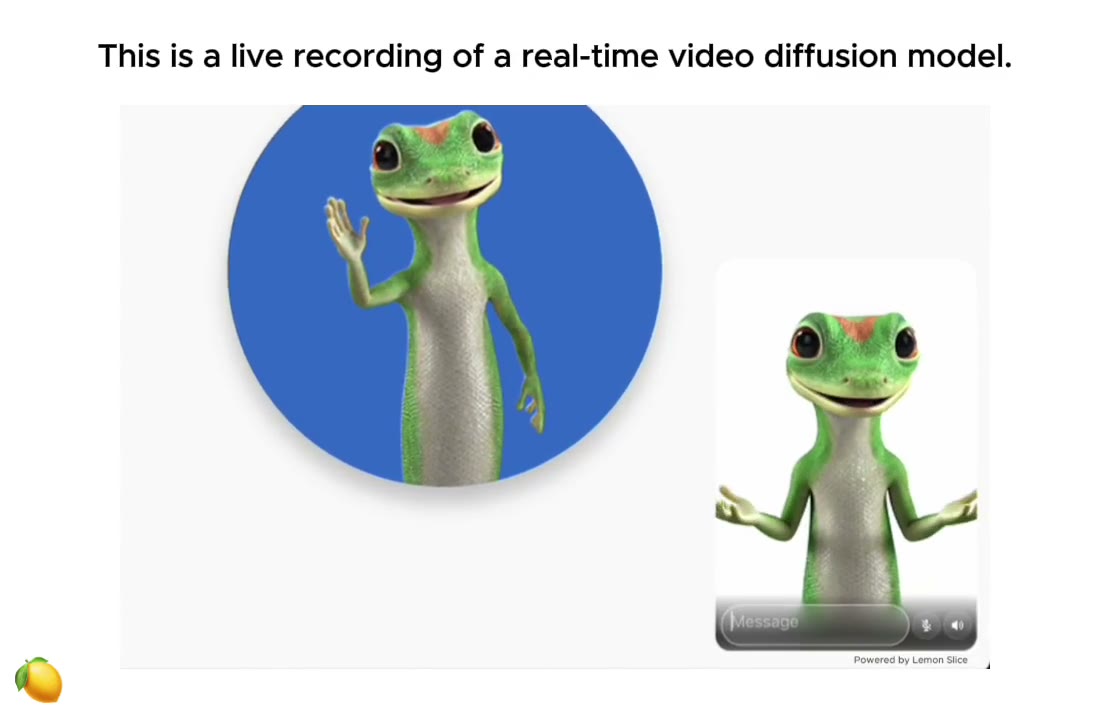
LemonSlice-2 generates expressive, semantically aware gestures and preserves motion in the surrounding scene.
Real-time interactions
LemonSlice-2 enables real-time interactions with any character. Below are screen recordings of the embeddable widget and full-screen experiences powered by the model.
Education
Entertainment
Kids
Emotional support
Education
Entertainment
Kids
Emotional support
Education
Entertainment
Kids
Emotional support
Customer support
Ecommerce
Lead qualification
Two-way video
Customer support
Ecommerce
Lead qualification
Two-way video
Customer support
Ecommerce
Lead qualification
Two-way video
Breaking the real-time barrier
LemonSlice-2 generates video frames faster than they can be watched. Strategies we used to break the real-time barrier include causal attention, a novel distribution-matching-distillation-inspired training paradigm, efficient caching, CUDA graph acceleration, and quantization.
Infinite video
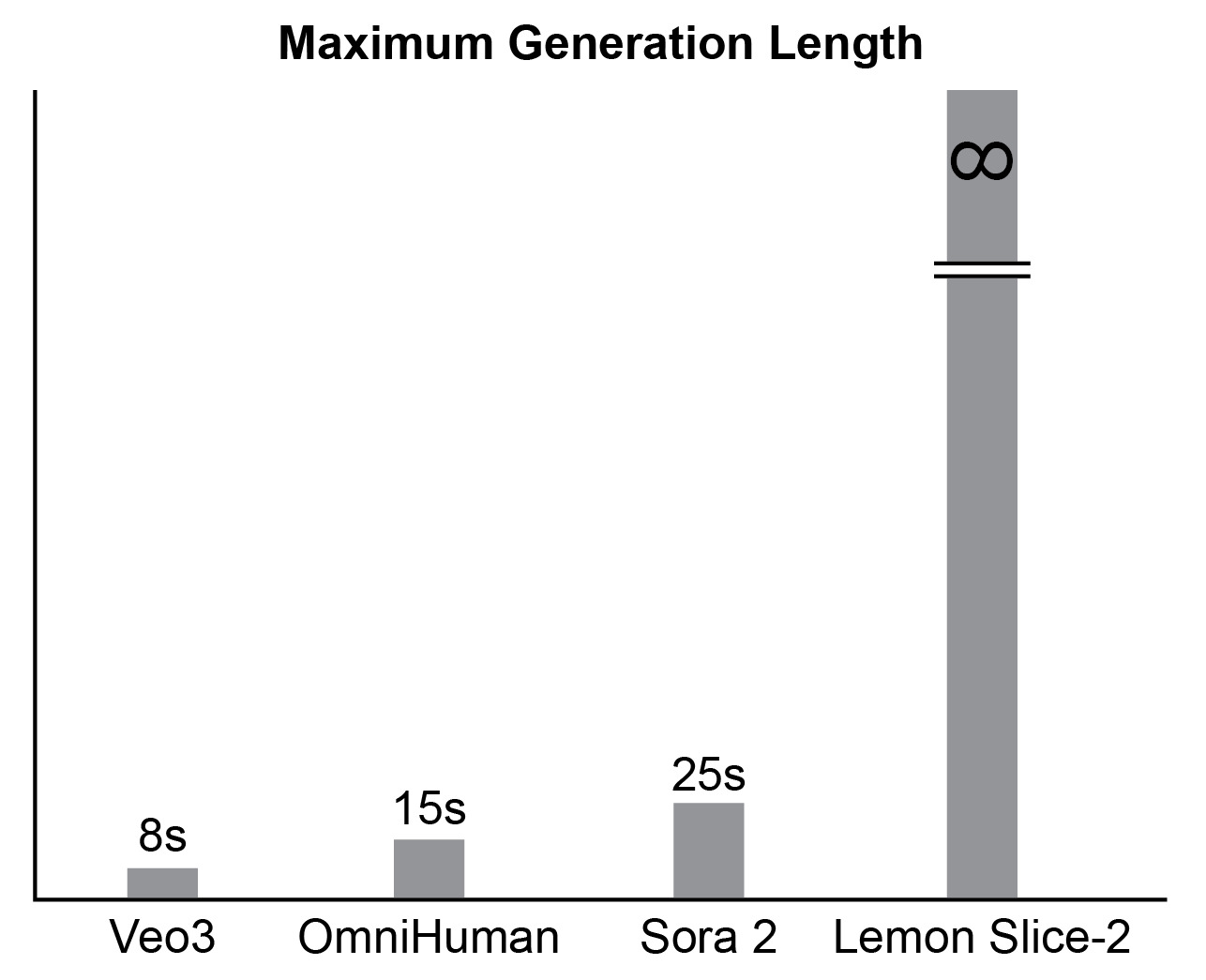
As an autoregressive model, LemonSlice-2 is not limited to generating videos of a fixed length. Critically, unlike other autoregressive models, it does not experience error accumulation, allowing for infinite-length video generation.

Dynamic text control
LemonSlice-2 enables real-time manipulation of video content through text prompting.