
Articles · Nov 3, 2026
What is an AI voice agent?
An AI voice agent answers and places calls on its own. Learn how AI voice agents work, what they handle, where they run, and which platforms build them.
An AI voice agent is software that answers and places calls and holds a spoken conversation on its own. It listens to the caller, works out what they need, takes an action such as booking an appointment, and replies in a natural voice, usually within about a second.
AI voice agents run on artificial intelligence models for speech and language. Businesses use them for customer support, sales calls, and front-desk work, on phone lines, websites, apps, and kiosks.
AI voice agents vs. IVRs, chatbots, and voice assistants
An AI voice agent is a conversational AI system, and it replaces or extends three tools businesses already use. It understands what a caller says in their own words, answers questions, and acts in your business systems, such as creating a ticket or updating a CRM record like Salesforce or HubSpot.
Three older tools do part of that job. A traditional IVR makes callers press keys through a fixed menu. Chatbots answer in text on a website. Siri helps one person with tasks on their own device. An AI voice agent talks with the people who call your business and works on their behalf.
| Traditional IVR | Chatbot | Voice assistant | AI voice agent | |
|---|---|---|---|---|
| How people use it | Key presses and short commands | Typing | Speaking | Speaking in their own words |
| Who it serves | A business's callers | A business's site visitors | One person | A business's callers and visitors |
| What it can do | Send the call to a menu option | Answer questions in text | Run tasks on a device | Answer, take actions, and hand off to a person |
How AI voice agents work
Most AI voice agents handle every turn of a call in four steps:
- Listening: speech recognition, also called speech-to-text or STT, turns the caller's words into text. A voice-activity detector tells the agent when the caller has stopped talking.
- Deciding: a large language model (LLM) reads the text, decides what to say, and calls tools such as a calendar or a CRM.
- Speaking: text-to-speech, or TTS, turns the reply into audio. Voice synthesis models now sound close to a person, and voice quality varies a lot between providers.
- Connecting: telephony carries the audio over a phone number, through a provider like Twilio or a SIP trunk. On a website, the call runs over WebRTC in the browser.

Earlier voice bots matched keywords with rule-based natural language processing (NLP), so they broke when a caller went off script. Generative AI and large language models let an AI voice agent follow the conversation wherever it goes.
Some newer agents skip the text step with speech-to-speech models, which take audio in and produce audio out. Retell, for example, offers OpenAI's GPT Realtime speech-to-speech models.
Callers expect a reply within about one second, the limit interface research has long set for a response that feels immediate. Each of the four steps adds delay, so vendors compete hard on speed.
What AI voice agents do
AI voice agents handle the calls that follow a pattern, and they pass the rest to people:
- Customer support: the agent answers inbound calls around the clock, looks up orders and accounts, and resolves routine questions.
- Sales and lead qualification: the agent places outbound calls to new leads, asks qualifying questions, and books a meeting with a rep.
- Appointment scheduling: the agent checks a live calendar and books, moves, or cancels appointments during the call.
- Call routing: the agent works out why someone is calling and transfers them to the right person with a summary of the conversation.
- After the call: the platform writes call summaries, runs sentiment analysis, and feeds conversation intelligence dashboards, so managers can see why customers call.
Most AI voice agents still answer the phone, through a phone number or SIP trunk connected to your contact center software. A growing number also run on websites, inside apps, and on kiosks, where people see the agent as well as hear it.
AI voice agent platforms to know
An AI voice agent platform gives you the models, phone connection, and tools to build and run an agent. Compare them on the build path, because some expect developers and others let an operations team build without code. Retell AI, ElevenLabs, Synthflow, and PolyAI show the range.
Retell AI
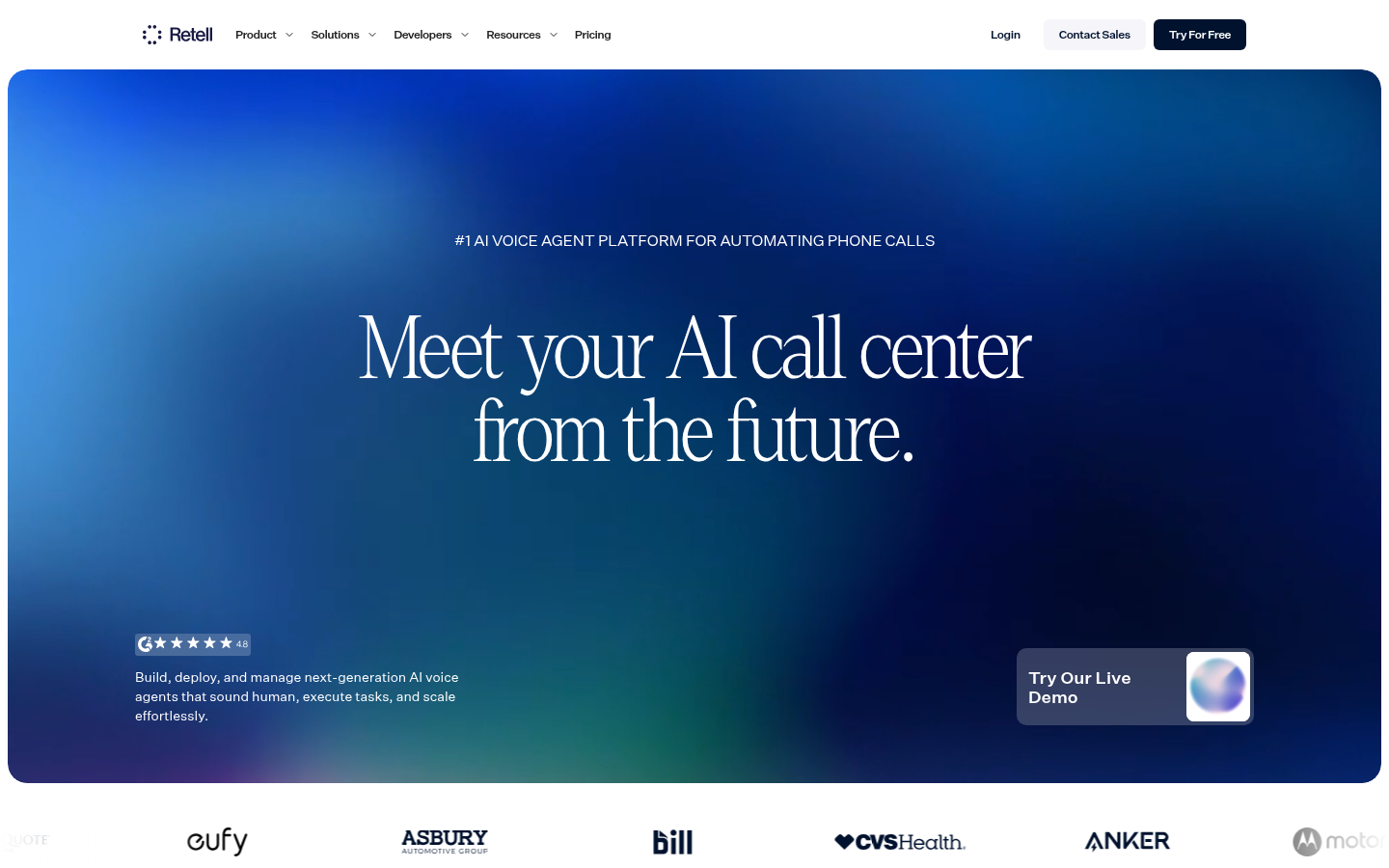
Retell AI gives developers an API and gives operations teams a drag-and-drop builder for the same agents. Its agents answer inbound calls, place outbound ones, qualify leads, book appointments, and transfer callers to a live agent.
Retell connects to phone systems through Twilio, Vonage, or SIP trunking, and its post-call automation logs data, creates tickets, and triggers follow-ups. Pay as you go starts at $0.07/min, with $10 in free credits.
Pros:
- An API and a visual builder for the same agent
- Inbound and outbound calling in one platform
Cons:
- Your per-minute cost depends on the models you pick
- About 600ms quoted latency
Bottom line: choose Retell AI if developers and an operations team will share the build, because Retell gives each group its own tool for the same agent.
ElevenLabs
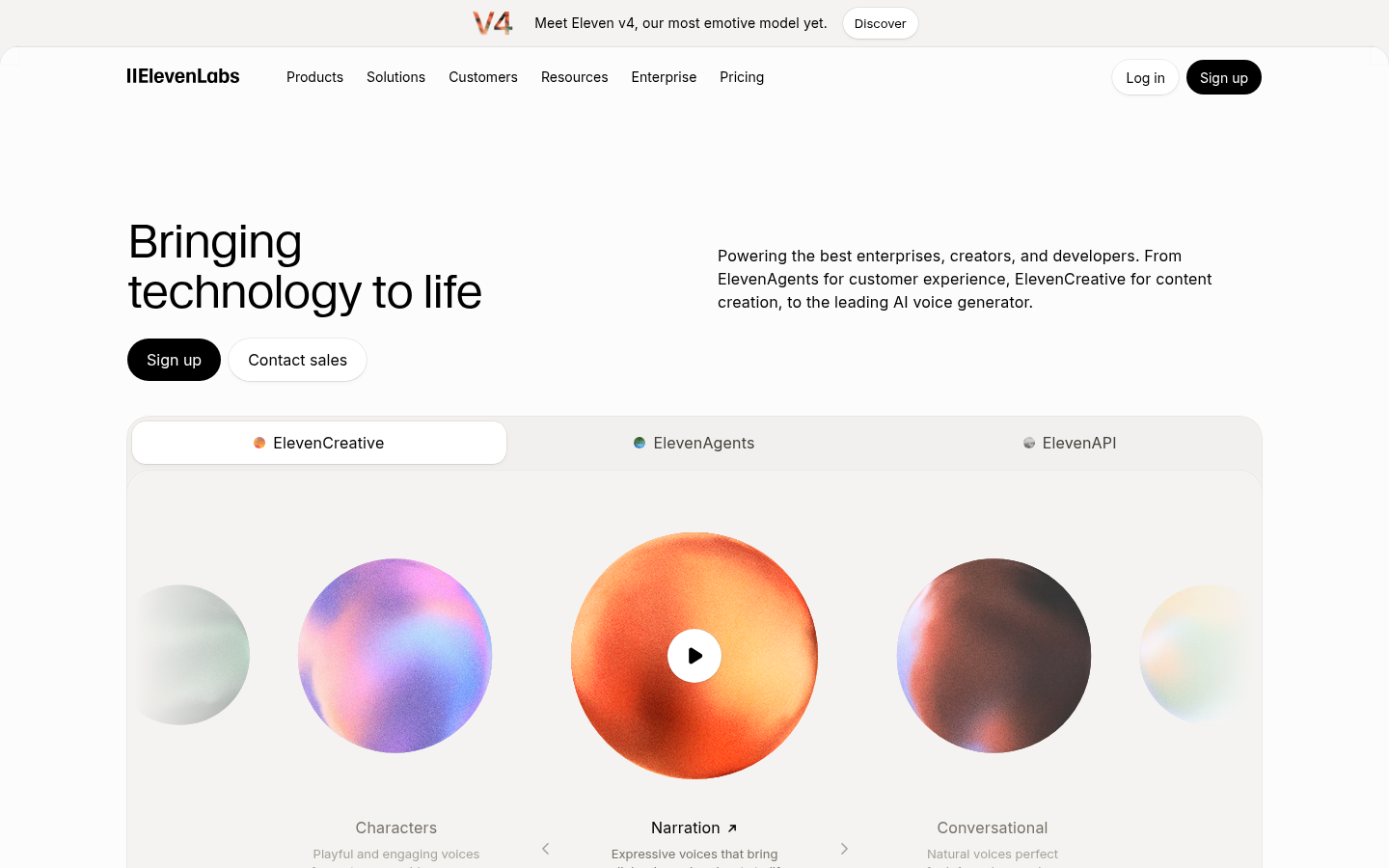
ElevenLabs makes voice models and runs them in ElevenAgents, which answer across phone, web, WhatsApp, SMS, and email. Agents speak 90+ languages and can switch between them mid-conversation.
ElevenLabs leads on voice quality. You choose from over 16,000 voices or clone your own, and you can bring your own language model. Agents cost $0.08/min.
Pros:
- Over 16,000 voices in 90+ languages
- One agent across voice and messaging channels
Cons:
- No end-to-end latency figure on the Agents page
Bottom line: choose ElevenLabs if voice quality matters most, because ElevenLabs builds its own voice models and offers over 16,000 voices.
Synthflow
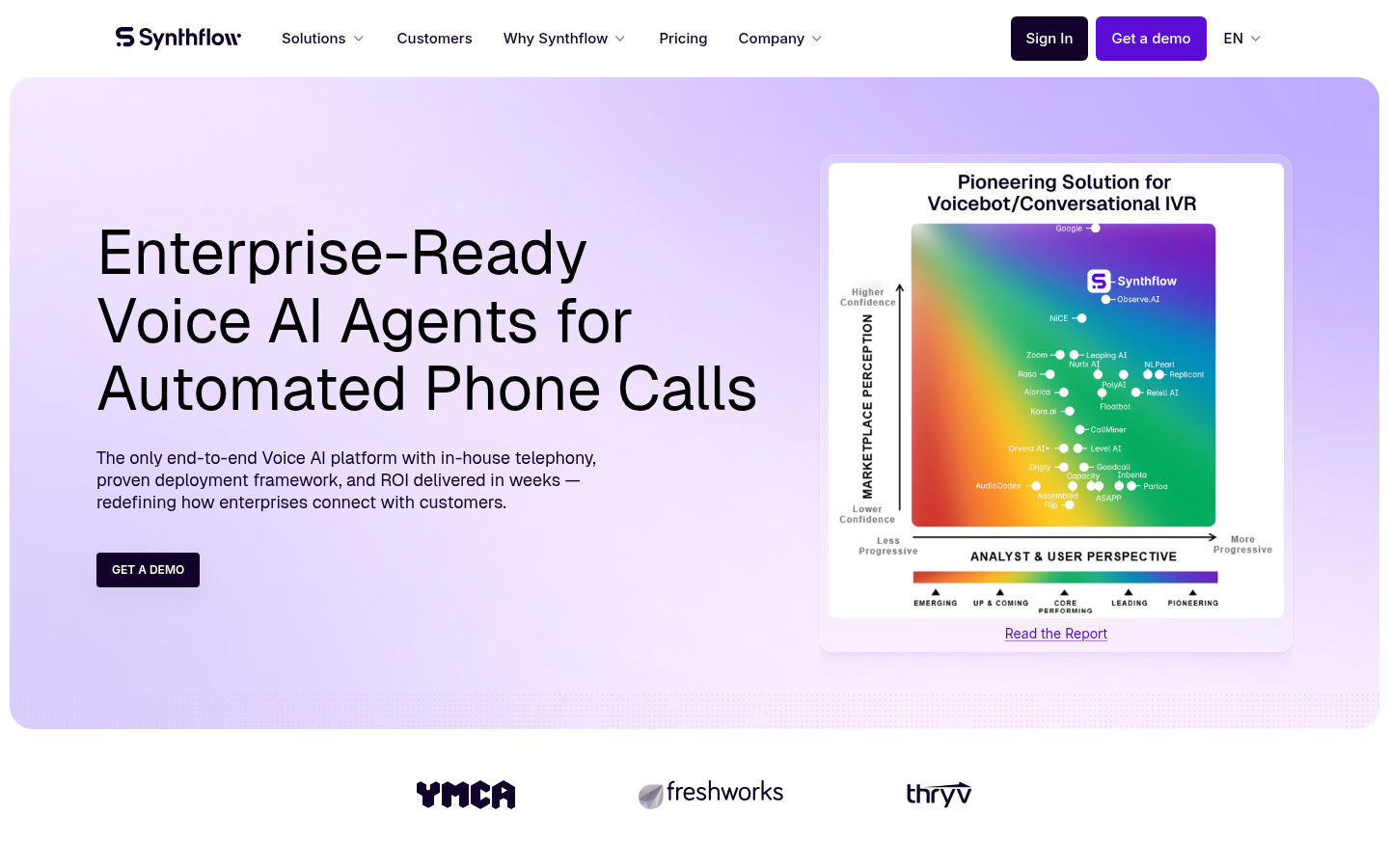
Synthflow builds enterprise AI voice agents on its own in-house telephony, which works with the SIP or PBX setup you already have. You design calls in the visual Flow Designer, and the Test Center tests each agent automatically.
Synthflow quotes latency under 100ms and uptime above 99.99% for its phone layer. Enterprise contracts start at $30,000 a year.
Pros:
- Its own telephony, which works with your current phone setup
- A visual builder with automatic testing
Cons:
- Contracts start at $30,000 a year
- The sub-100ms figure measures the phone layer only
Bottom line: choose Synthflow if you need tight control of call quality and uptime, because Synthflow runs its own phone network layer.
PolyAI
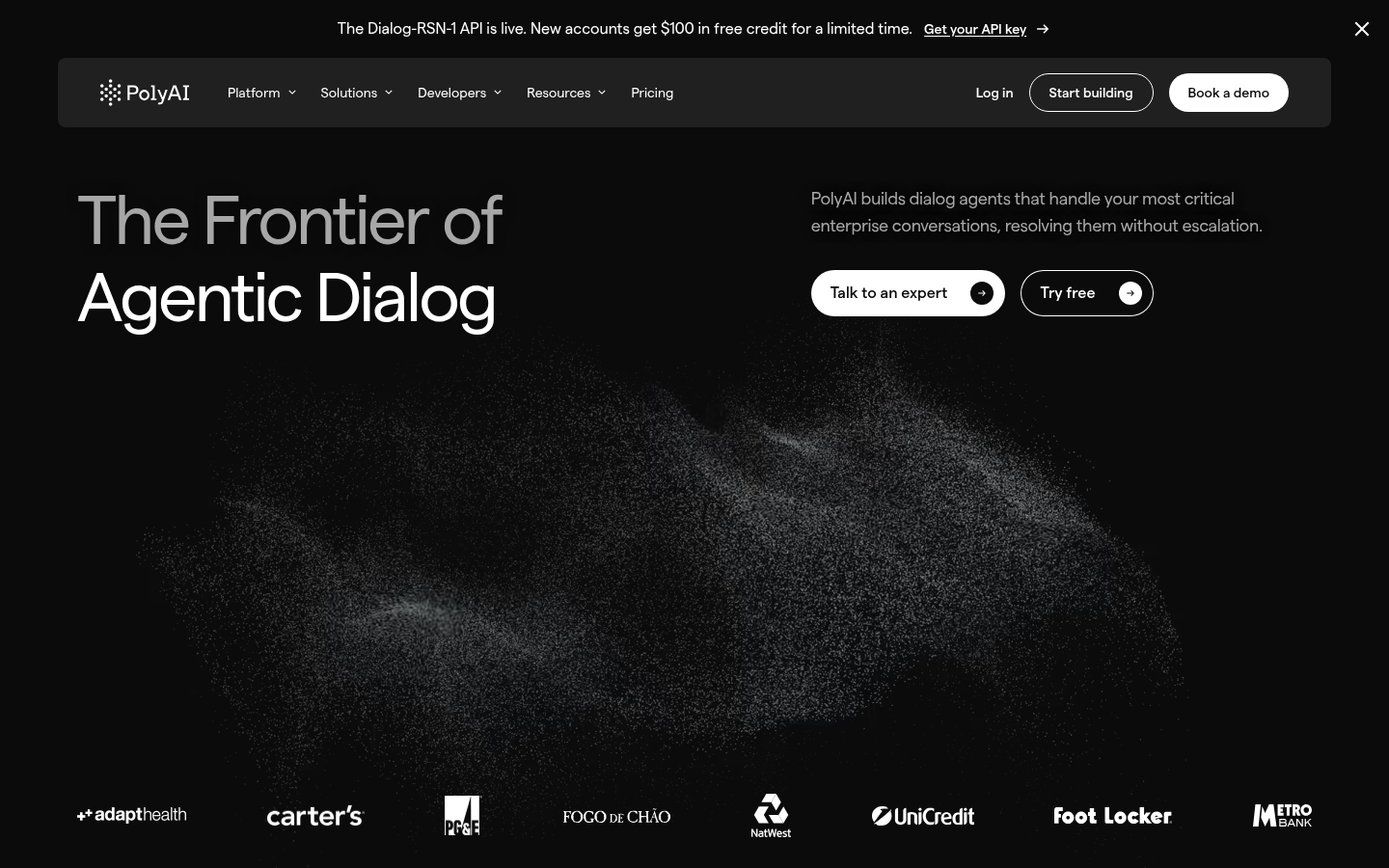
PolyAI builds agents for large enterprise customer service lines and runs them on its own models, trained on hundreds of millions of real business interactions. On its largest deployments, PolyAI reports 90% of calls resolved end to end with no human agent.
PolyAI integrates with Twilio, NICE, Zendesk, and ServiceNow. You buy the platform through a demo.
Pros:
- Own models trained on business calls
- 90% end-to-end resolution on its largest deployments
Cons:
- No public pricing for the full platform
- No labeled speed figure on its homepage
Bottom line: choose PolyAI if you run a large customer service line, because PolyAI trains its own models on business calls and reports 90% end-to-end resolution at scale.
Add a face to any AI voice agent with LemonSlice
LemonSlice is an interactive AI avatar platform. It adds a real-time face layer on top of the AI voice agent you already run. It works with any LLM and any TTS, so the rest of your stack stays as it is. LemonSlice turns your agent's audio into real-time character video in a WebRTC call.
- Any character from one photo: upload a photo and go live with no training or fine-tuning. LemonSlice is the only interactive avatar model that animates non-humans, like a turtle or a teacup, as easily as humans. It's also the only interactive avatar provider with hand gestures, its action and emotion engines trigger body movements and emotional states during a call, and every frame is generated live at 20 fps.
- Response speed: LemonSlice adds minimal latency on top of your existing voice agent, and its global fleet of GPUs means calls can run from regions close to your users.
- Built for screens that stay on: sessions stay live for up to 24 hours on Enterprise plans, long enough for an interactive museum exhibit, with a zero data retention mode for privacy-sensitive work.
- Let your coding agent add it: install the LemonSlice skill, then ask Cursor, Claude, or Copilot to add a video avatar to your voice app. The skill scaffolds a starter app with keys, the voice cascade, an image, and a ringing UI.
- Wire any stack: beyond the skill, the WebSocket integration drives an avatar from any audio stack, and the LemonSlice docs walk through the WebSocket sample below.
The WebSocket connection is the whole integration:
const socket = new WebSocket(websocketAddress);

{
  "command": "audio",
  "audio": "<base64_pcm16_mono>",
  "sampleRate": 16000,
  "encoding": "PCM16"
}
Code sample from lemonslice.com/docs/websocket
Developers can start with as little as $8 a month, and every plan includes unlimited avatars and API access. Add your first interactive AI avatar to your AI voice agent.
How to set up an AI voice agent
- Pick one job: start with one call type, such as inbound support calls or outbound lead qualification, and write down what a good call looks like.
- Choose a build path: operations teams can use a no-code builder with a visual flow designer. Developers can use an API or SDK and pick each model themselves, and Retell pairs an API with a drag-and-drop builder for the same agent.
- Connect your phone and tools: attach a phone number or SIP trunk, then connect the calendar, CRM, and knowledge base the agent needs.
- Test with real calls: listen for voice quality, response speed, and how the agent handles interruptions before you go live. Retell lets you simulate thousands of scenarios before launch.
- Launch with a handoff: send calls the agent can't resolve to a person, with a summary so the caller doesn't repeat themselves, and review transcripts every week.
How to choose an AI voice agent
Compare AI voice agents on five points, then shortlist two and test both on real calls.
| Criterion | What to check | From the platforms above |
|---|---|---|
| Build path | A no-code builder, or an API and SDK | Retell pairs an API with a drag-and-drop builder |
| Channel | A phone line, or a website, app, or kiosk | Retell connects to phone systems over SIP trunking, and ElevenLabs agents also answer on web, WhatsApp, and SMS |
| Voice quality and languages | Natural voices in your callers' languages | ElevenLabs offers over 16,000 voices in 90+ languages |
| Latency | A reply within about one second | Retell quotes about 600ms, and Synthflow quotes under 100ms for its phone layer |
| Pricing and scale | Per-minute billing or an annual contract | Retell is pay as you go, Synthflow sells annual contracts, and PolyAI prices through a demo |
If your agent will run on a website, in an app, or anywhere people see a screen, that's where a LemonSlice face layer fits, on top of whichever platform you pick.
Put your first AI voice agent to work
An AI voice agent answers and places calls on its own. It uses speech recognition, a language model, and text-to-speech to hold a natural conversation and take actions in your business systems. Match the build path to your team, then test voice quality and latency on real calls. Price it at your expected call volume before you sign. Retell, ElevenLabs, Synthflow, and PolyAI span the range from developer APIs to enterprise contact centers.
If your agent will run on a website, in an app, or anywhere people see a screen, give it an interactive avatar with LemonSlice. Try a featured avatar for free before you build your own.