
Articles · Nov 3, 2026
Best AI Voice Agents in 2026
The best AI voice agents for 2026, grouped by job: developer APIs, no-code builders, and contact centers, with prices, verdicts, and avatar pairing.
The best AI voice agents answer in about a second, sound like a person, and finish the job the caller rang about, whether that's booking an appointment or changing an order. The weaker ones talk over callers, lose track of the question, or can't pass the call to a human.
Vendors build these agents for very different buyers. Vapi sells an API to developers. Synthflow and Lindy let an operations team build without code. PolyAI and Cognigy sell to large contact centers.
What makes an AI voice agent good
Six things separate the best AI voice agents from the rest:
- Latency: callers expect a reply within about one second, the limit interface research has long set for a response that feels immediate. Ask each vendor for end-to-end figures, from the caller's last word to the agent's first.
- Voice quality and multilingual support: the TTS voice should sound natural in every language your callers speak.
- Interruption handling: a caller should be able to cut in mid-sentence, and the agent should stop and listen.
- Human handoff: when the agent can't help, it should pass the call to a person with a summary, so the caller doesn't repeat themselves.
- Telephony integrations: the agent should work with your phone numbers, SIP trunking, and contact center software.
- Pricing transparency: per-minute rates, platform fees, and model costs add up, so compare the total cost of ownership at your call volume.
Every conversational AI agent runs the same pipeline. Speech recognition (STT) turns speech into text, a large language model (LLM) decides the reply using natural language understanding, and text-to-speech speaks it. Older IVR systems relied on rule-based natural language processing and key presses. Generative AI lets today's agents handle questions nobody scripted.
How we picked these agents
Every agent here can take live calls or web conversations today. To make the cut, a vendor had to maintain the product actively, publish a price or a clear way to buy, and list its security certifications, such as HIPAA, SOC 2, or GDPR, on its own site.
| Agent | Best for | Build path | Pricing from |
|---|---|---|---|
| Vapi | Developers who want to pick every model | API | $0.05/min plus models |
| Retell AI | Developers and ops teams building together | API and visual builder | $0.07/min |
| Deepgram | Speech and orchestration from one API | API | $0.075/min |
| ElevenLabs | Voice quality in 90+ languages | Low-code and API | $0.08/min |
| Synthflow | Enterprise phone automation on its own telephony | Visual builder | $30,000/year |
| Voiceflow | CX teams running chat and voice together | Visual builder and API | Custom |
| Lindy | An AI receptionist for a small team | No-code | Free plan, then $29.99/user/month |
| PolyAI | Large customer service lines | Sales-led | Custom |
| Cognigy | Multilingual contact centers | Low-code and API | Custom, free trial |
| Cresta | AI agents plus agent assist in one platform | No-code | Custom |
| Bland AI | Regulated calls on the vendor's own models | API | $0.14/min, all in |
Product and pricing information: vendor product and pricing pages, October 21, 2026.
Top picks for developers
These four sell APIs to engineers who build the agent in code. Compare them on how much of the pipeline each vendor runs for you. Vapi, Retell AI, Deepgram, and ElevenLabs lead this group.
Vapi
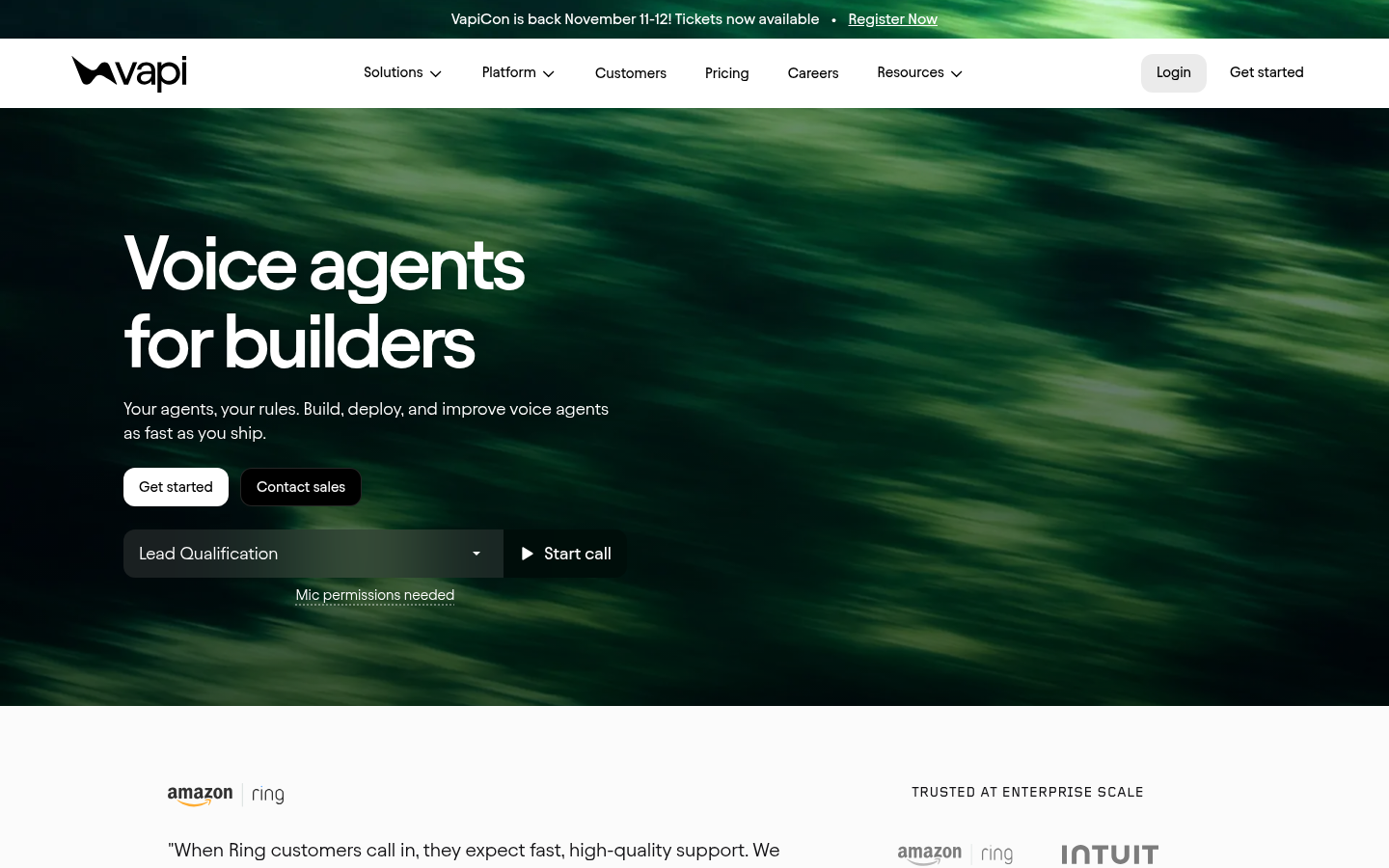
Vapi AI is an API-native platform where you choose every model in the call. Developers mix providers such as AssemblyAI for STT, OpenAI or Anthropic for the LLM, and Cartesia for TTS, and Vapi runs the call between them.
Vapi connects to Twilio, Telnyx, Genesys, Five9, Salesforce, and HubSpot. It quotes sub-500ms latency and lists SOC 2, HIPAA, and PCI compliance. Hosting costs $0.05/min, models pass through at cost, and new accounts get $5 in free credits.
Pros:
- Pick any provider at every step of the call
- Models billed at cost, with no markup
- Sub-500ms quoted latency
Cons:
- The pay-as-you-go plan allows 4 concurrent calls
- Your total per-minute cost depends on the models you choose
Bottom line: choose Vapi AI if your engineers want full control of the stack, because Vapi lets you swap each model and pays the model vendors at cost.
Retell AI
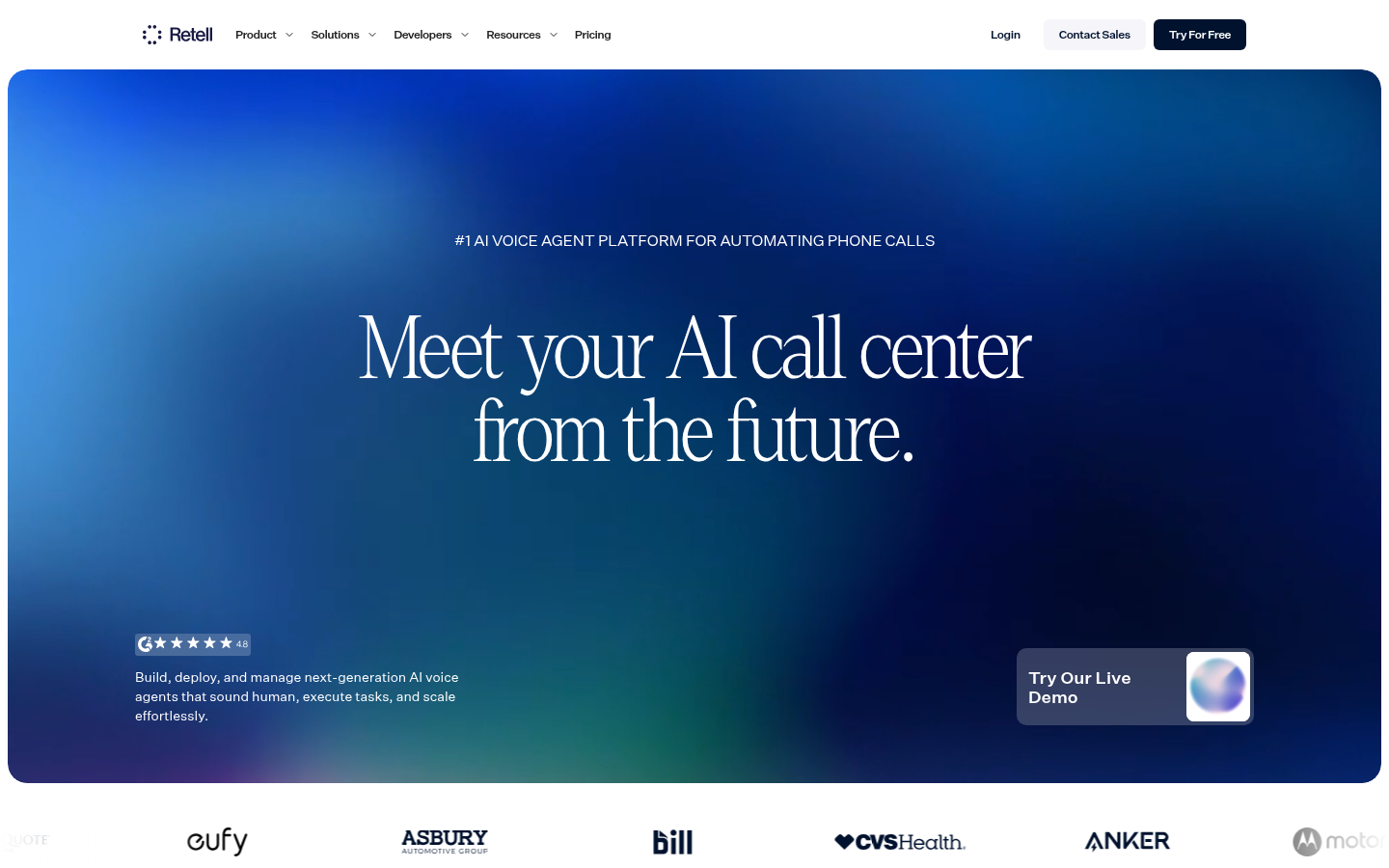
Retell AI, a real-time conversational AI platform, pairs an API with a drag-and-drop builder, so engineers and operations staff work on the same agent. Before launch, you can simulate thousands of scenarios and turn real calls into regression tests.
Retell agents detect IVR menus on outbound calls and press the right digits. Before a human handoff, the agent briefs the human agent and confirms they're ready to take over. Retell lists HIPAA, SOC 2 Type II, GDPR, and ISO 27001, and pay as you go starts at $0.07/min.
Pros:
- API and visual builder for the same agent
- Simulation testing before every launch
- Briefs the human agent before each handoff
Cons:
- Your per-minute cost depends on the models you pick
- About 600ms quoted latency
Bottom line: choose Retell AI if testing matters as much as launch day, because Retell runs simulated scenarios and regression tests on every change.
Deepgram
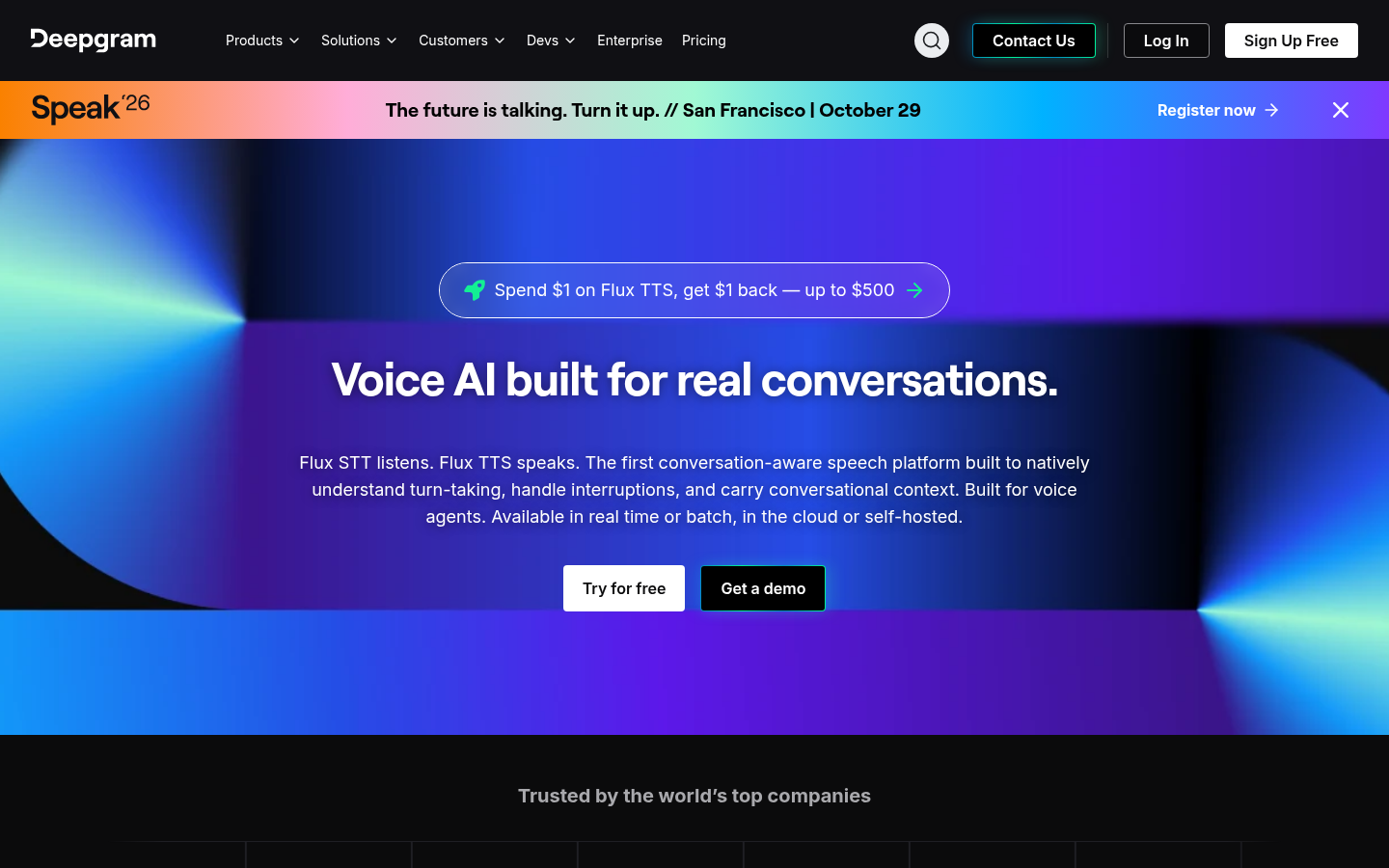
Deepgram builds its own speech models, and its Voice Agent API runs STT, TTS, and the LLM hand-off through one connection. It designed the models to handle turn-taking and interruptions.
You can run it in the cloud or self-hosted. The Voice Agent API costs $0.075/min, and new accounts get $200 in free credit.
Pros:
- One API for speech and agent orchestration
- Self-hosted option
Cons:
- Billing runs on connection time, so idle seconds count
- You build in code, so non-technical teams need an engineer
Bottom line: choose Deepgram if you want speech models and orchestration from one vendor, because the Voice Agent API handles listening, the model hand-off, and speaking in a single call.
ElevenLabs
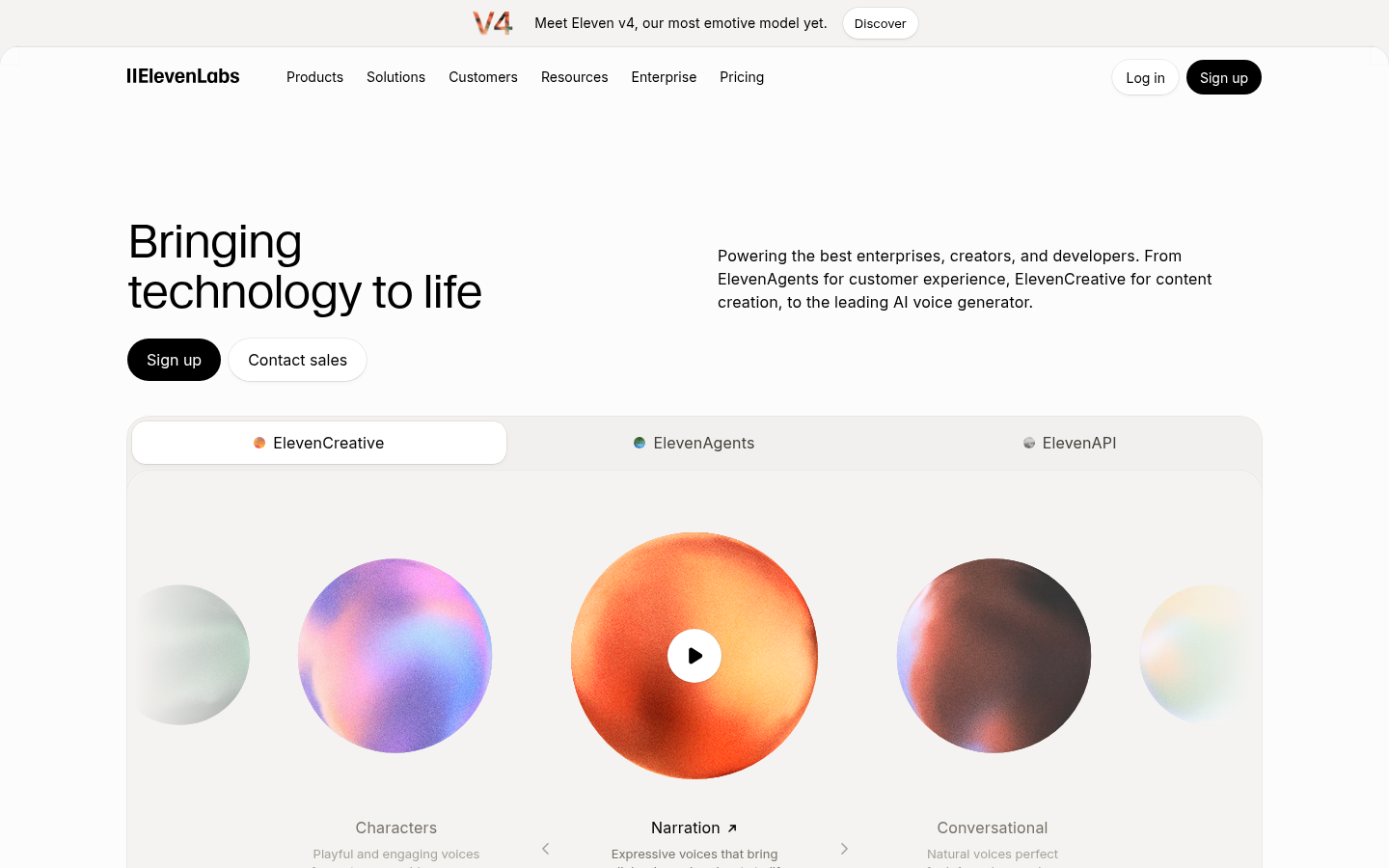
ElevenLabs makes its own voice models. ElevenAgents speak 90+ languages, switch languages mid-conversation, and draw on more than 16,000 voices, with voice cloning to match your brand.
The agent works across phone, web, WhatsApp, SMS, and email, and it's LLM-agnostic. It lists SOC 2 Type II, ISO 27001, PCI DSS Level 1, and HIPAA. Agents cost $0.08/min.
Pros:
- Over 16,000 voices, plus voice cloning
- Multilingual support in 90+ languages
Cons:
- No end-to-end latency figure on the Agents page
Bottom line: choose ElevenLabs if voice quality comes first, because it builds its own voice models and offers more than 16,000 voices.
Top no-code picks
These three let an operations or CX team build an agent without writing code. Compare them on how much phone control each one gives you. Synthflow, Voiceflow, and Lindy lead this group.
Synthflow
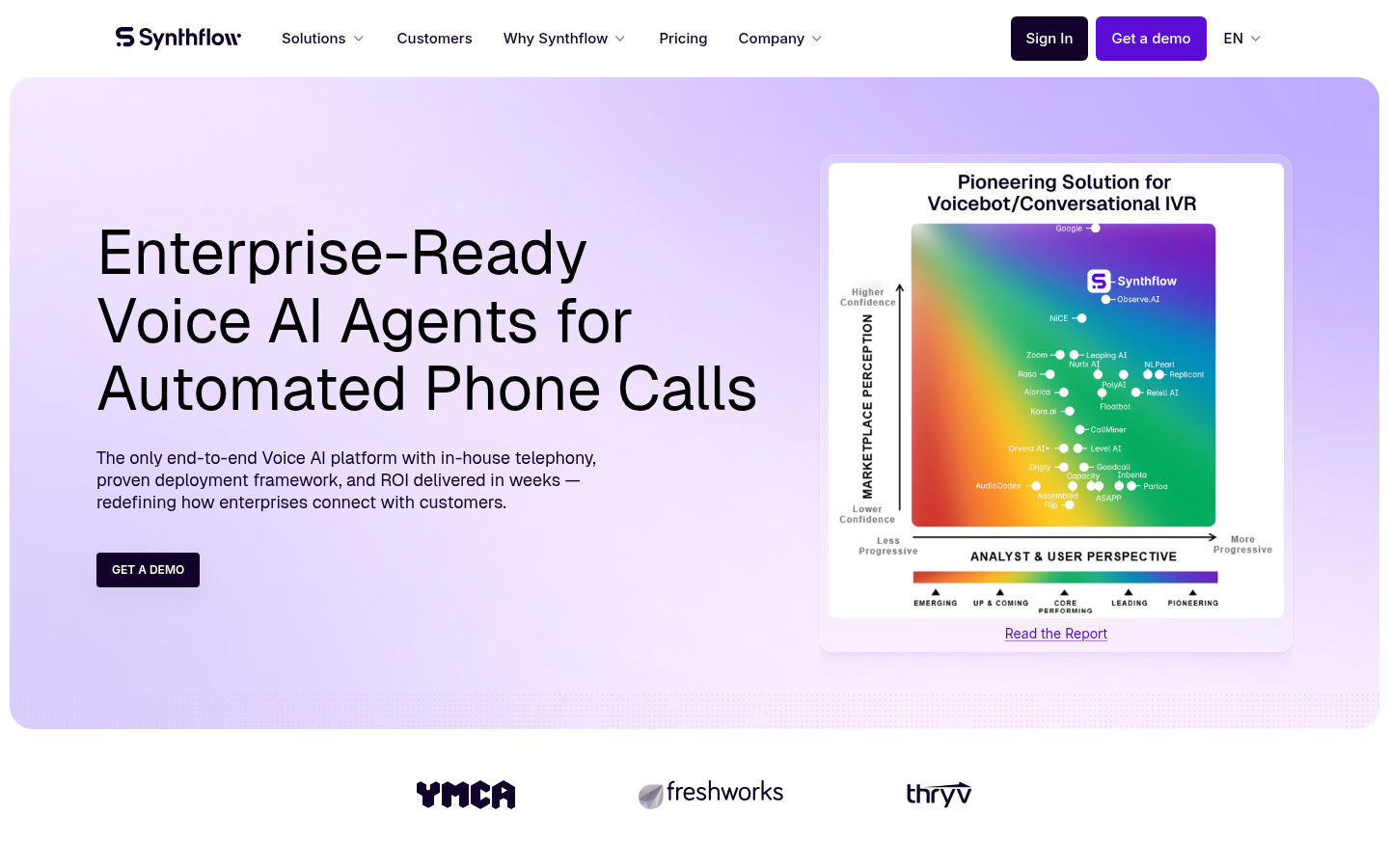
Synthflow AI runs enterprise phone automation on its own in-house telephony and works with your existing SIP or PBX setup. Teams build in the visual Flow Designer, and the Test Center checks every agent automatically.
Synthflow AI connects to CRMs, CCaaS platforms, and calendars for tasks like appointment scheduling and lead qualification. It quotes latency below 100ms and uptime above 99.99% for its phone layer, and it lists SOC 2, HIPAA, PCI DSS, and GDPR. Enterprise contracts start at $30,000 a year.
Pros:
- Its own telephony, alongside your current SIP or PBX
- Visual Flow Designer with automatic testing
- 99.99% uptime target
Cons:
- Contracts start at $30,000 a year
- The sub-100ms figure measures the phone layer only
Bottom line: choose Synthflow if you want enterprise phone automation without writing code, because Synthflow pairs a visual builder with its own telephony.
Voiceflow
Voiceflow builds customer service agents that work across web, app, WhatsApp, SMS, and voice from one design. Teams shape the agent in Agent Studio and use workflows to keep it on their business processes.
Voiceflow lets you pick a model provider or bring your own, and it integrates with Salesforce, Zendesk, HubSpot, Genesys, Five9, and Amazon Connect. Business pricing is by request.
Pros:
- One agent for chat and voice
- Real-time collaboration for CX teams
Cons:
- No public pricing for businesses
- No published latency figure
Bottom line: choose Voiceflow if one CX team runs both chatbots and voice support, because Voiceflow builds a single agent for every channel.
Lindy
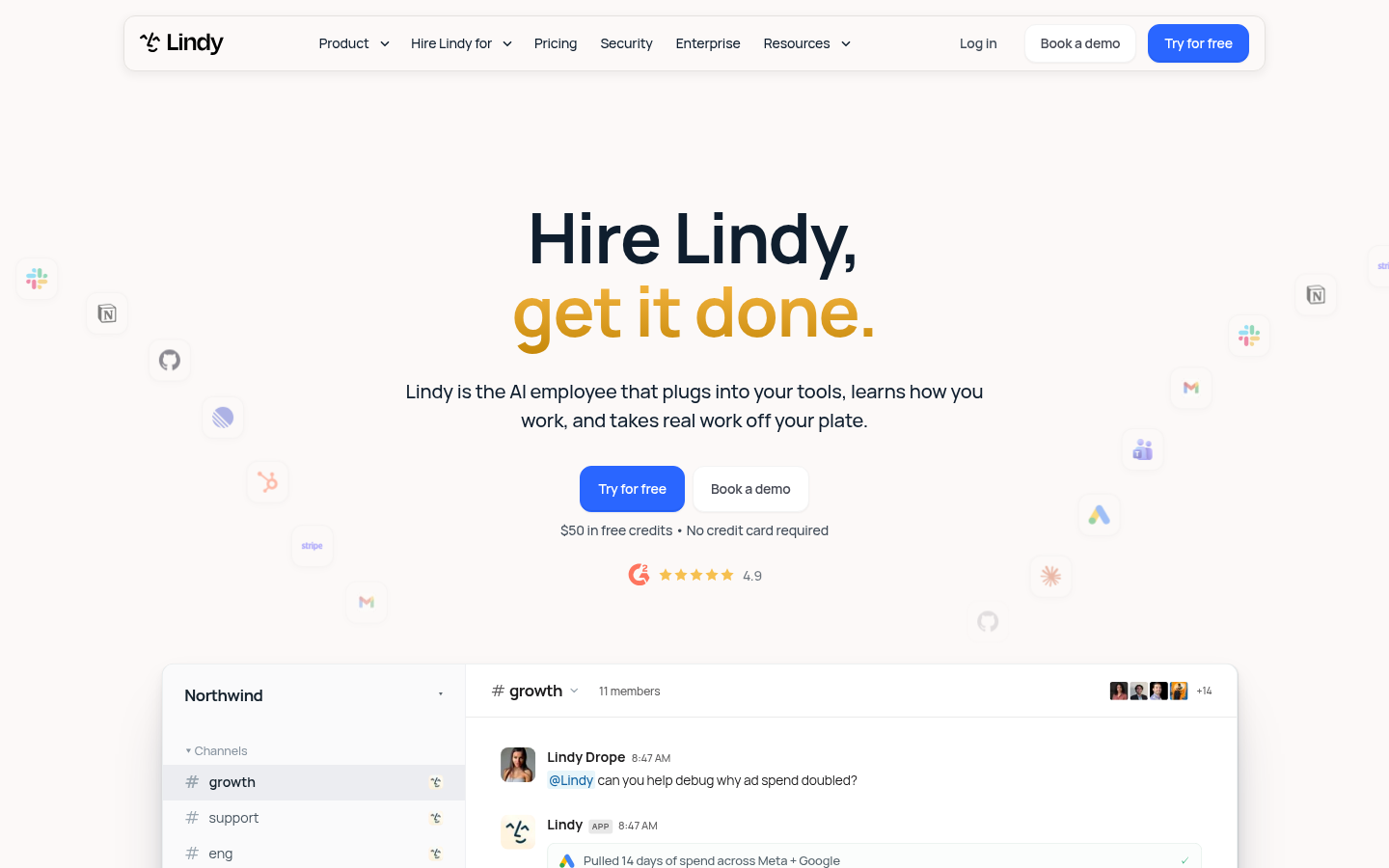
Lindy is an AI employee that connects to Gmail, Slack, Notion, HubSpot, and 1,500+ more apps, and you set it up in about 2 minutes. Since October 14, 2026, it has its own phone number and works as an AI receptionist. It answers calls, books callers onto your calendar, and calls businesses for you.
There's a free plan with $50 in credits, and paid plans start at $29.99 per user per month. The custom plan adds HIPAA compliance with a signed BAA.
Pros:
- An AI receptionist plus inbox and calendar work in one agent
- Free plan with $50 in credits
Cons:
- Phone numbers are US-only
- Calls draw from the same credit pool as all your other tasks
Bottom line: choose Lindy if a small team wants an AI phone agent that also handles email and scheduling, because one agent answers the call and does the follow-up.
Top picks for enterprise contact centers
These four sell to contact centers that take thousands of calls a day. Compare them on how they work with your human agents and your existing phone systems. PolyAI, Cognigy, Cresta, and Bland AI lead this group.
PolyAI
PolyAI builds dialog agents for critical enterprise conversations and runs them on its own models. One audio-native model handles turn-taking, recognition, and response directly from call audio.
On its largest deployments, PolyAI reports 90% of calls resolved end to end with no human agent. It integrates with Twilio, NICE, Zendesk, and ServiceNow, lists ISO 27001 and PCI DSS, and offers data residency in the US, UK, EU, and APAC. You buy through a demo.
Pros:
- Own models trained on business calls
- 90% end-to-end resolution at scale
- Data residency in 4 regions
Cons:
- No public pricing for the full platform
- No labeled speed figure on its homepage
Bottom line: choose PolyAI if you want most calls resolved without a human, because PolyAI reports 90% end-to-end resolution on its largest deployments.
Cognigy
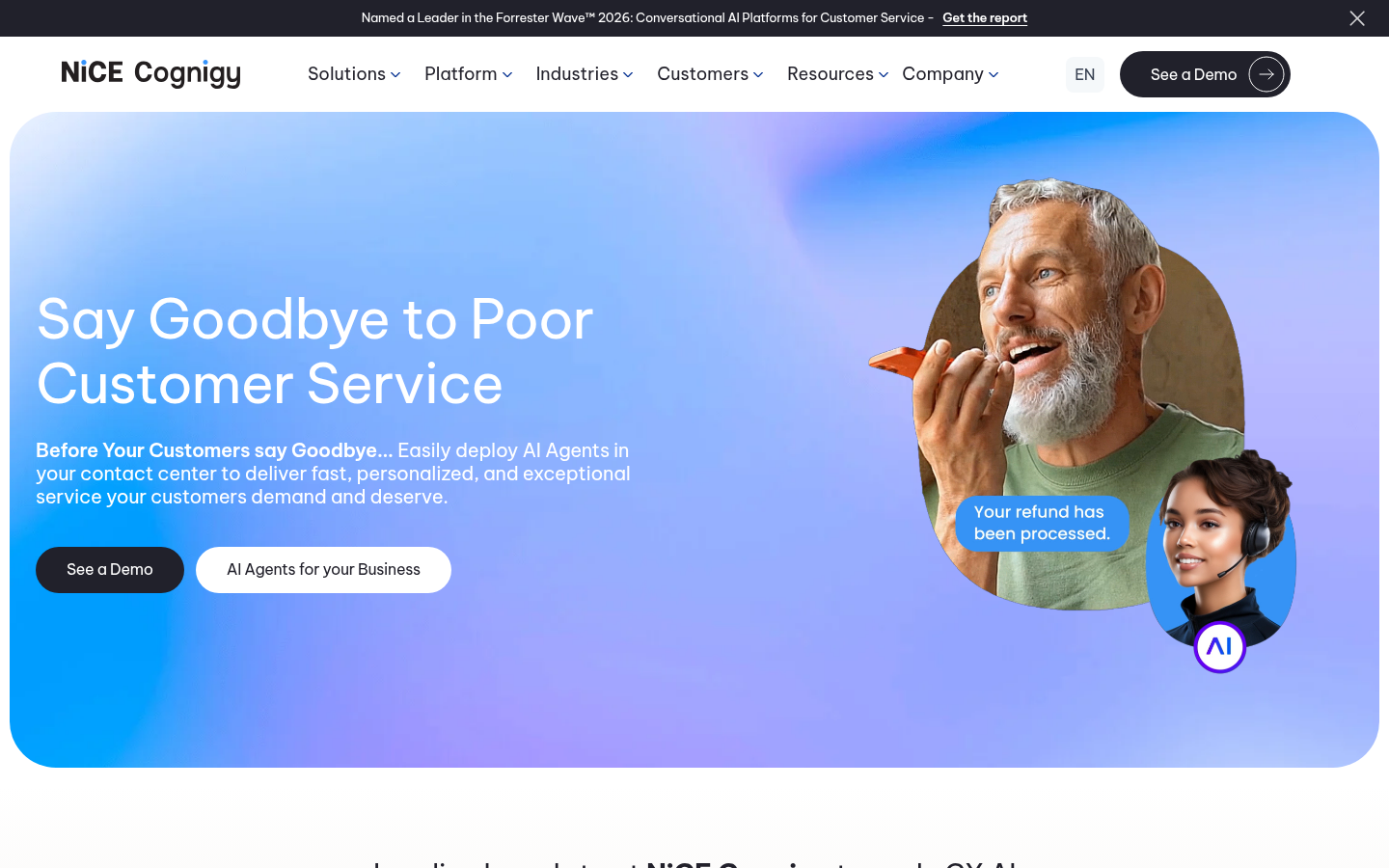
Cognigy, now NiCE Cognigy, puts AI agents in the contact center across voice and chat. Its voice AI agents replace legacy IVR menus, answer routine calls, and pass complex ones to the best-suited human agent with context.
Agents speak over 100 languages, with real-time translation for your support team. Cognigy works with the contact center systems you already run, and Agent Copilot coaches human agents in real time. You buy through a demo, and a free trial is available.
Pros:
- Over 100 languages with real-time translation
- Works with your existing contact center systems
Cons:
- No public pricing
- No published latency figure
Bottom line: choose Cognigy if you run a multilingual contact center, because Cognigy's agents speak over 100 languages and plug into the systems you already have.
Cresta
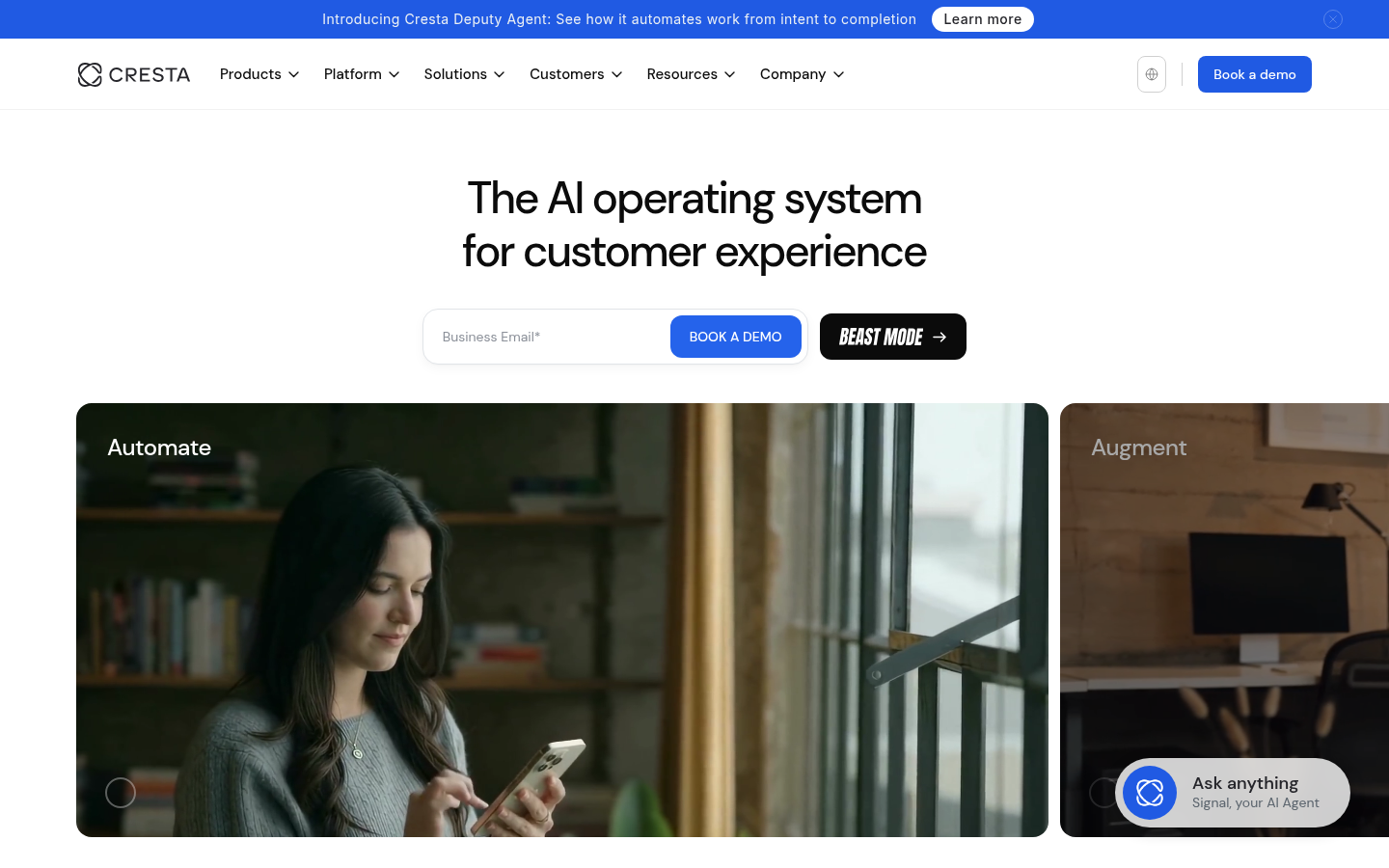
Cresta calls itself the AI operating system for customer experience. It combines AI agents that talk to customers, Agentic Assist that guides human agents during calls, and conversation intelligence that shows managers why customers call.
It builds everything on Opera, a no-code orchestration layer. One customer reports a 58% containment rate across its AI agents. You buy through a demo.
Pros:
- AI agents, agent assist, and conversation intelligence in one platform
- No-code orchestration layer
Cons:
- No public pricing
- No published latency figure
Bottom line: choose Cresta if you want AI agents and agent-assist tools for your human team in one platform, because it runs both on the same no-code layer and measures every conversation.
Bland AI
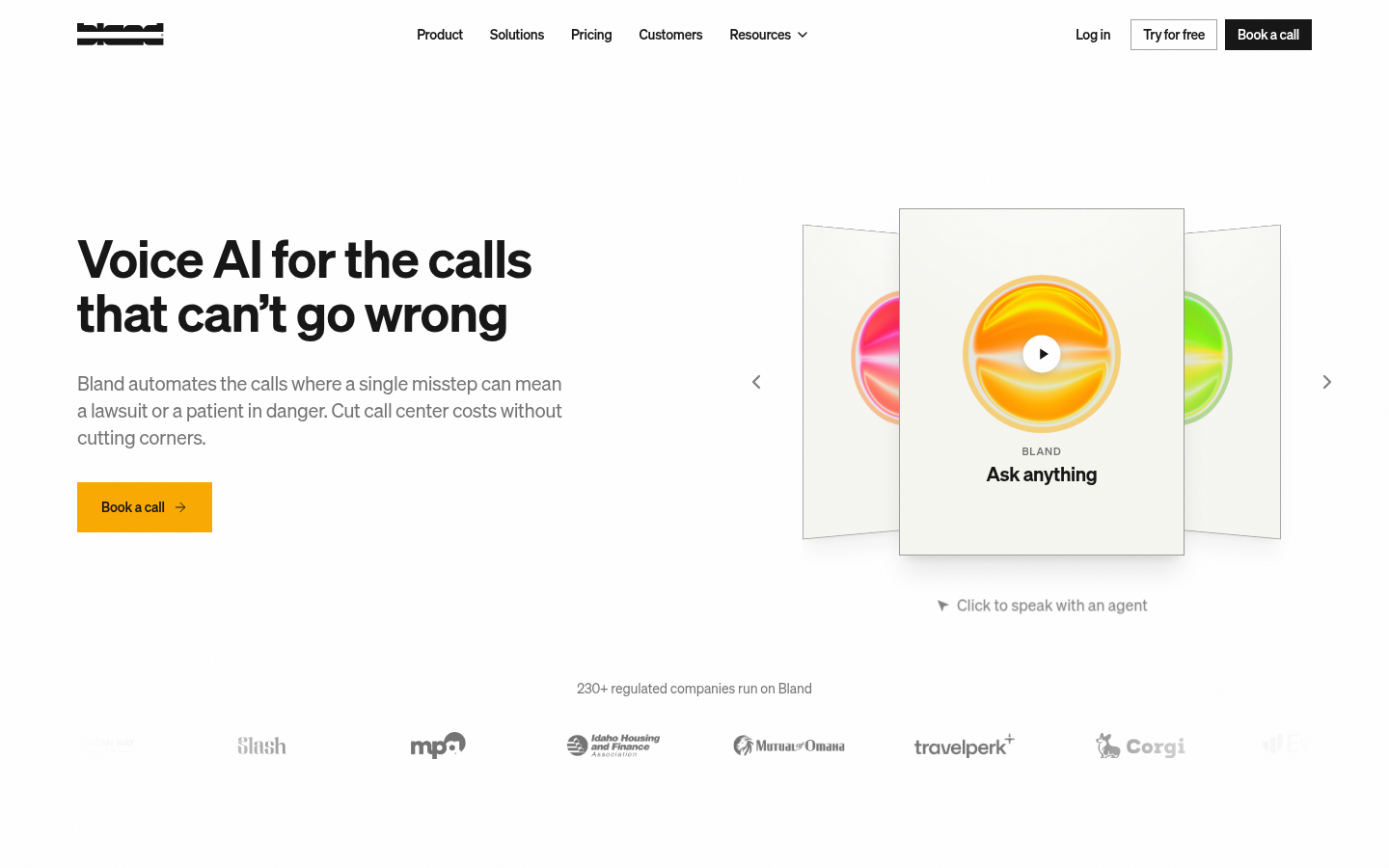
Bland AI runs every call on its own models, so your call data never passes to a third party. You build through an API and script call logic with Conversational Pathways.
Bland agents speak 40+ languages natively. Bland lists SOC 2 Type 2, HIPAA, PCI DSS, GDPR, and ISO 27001, and offers on-prem or VPC deployment on Enterprise. One rate includes the models and telephony, and the Start plan costs $0.14/min with no platform fee.
Pros:
- One rate includes every model and the phone line
- On-prem or VPC deployment on Enterprise
Cons:
- The Start plan caps you at 100 calls a day
- The Start plan includes 1 voice
Bottom line: choose Bland AI if your calls carry legal or medical risk, because Bland runs every model itself and can deploy on your own infrastructure.
Give the AI voice agent you choose a face with LemonSlice
LemonSlice is an interactive AI avatar platform that sits on top of whichever AI voice agent you pick above. It works with any LLM and any TTS, so the agent keeps its own voice and logic. Teams use it for customer support, sales training, tutoring, and lead qualification, where people see the agent while they talk.
- Any character from one photo: upload a photo of any character, with no training, and LemonSlice animates it, including non-humans like a turtle or a teacup. It's the only interactive avatar provider with hand gestures, its emotion engine changes the avatar's mood during a call, and every frame is generated live at 20 fps.
- Response speed: LemonSlice adds minimal latency on top of your existing voice agent, and it runs thousands of simultaneous sessions. Its global fleet of GPUs means calls can run from regions close to your users.
- Always on: sessions stay live for up to 24 hours on Enterprise plans, long enough for an interactive museum exhibit.
- Let your coding agent add it: install the LemonSlice skill, then ask Cursor, Claude, or Copilot to add a video avatar to your voice app. The skill scaffolds a starter app with keys, the voice cascade, an image, and a ringing UI.
- Wire any stack: beyond the skill, you can wire any agent that streams its audio using LemonSlice's WebSocket endpoints, and you keep the agent's own speech-to-text, LLM, and TTS settings, so you don't have to rebuild the agent.
The WebSocket connection is the whole integration:
const socket = new WebSocket(websocketAddress);

{
  "command": "audio",
  "audio": "<base64_pcm16_mono>",
  "sampleRate": 16000,
  "encoding": "PCM16"
}
Code sample from lemonslice.com/docs/websocket
Developers can start with as little as $8 a month, every plan includes unlimited avatars and API access, and the featured avatars in the library are free to talk to before you pay. Add your first interactive AI avatar to the voice agent you pick.
How to choose among the best AI voice agents
Shortlist two AI voice agent platforms on these five points, then test both on your own calls.
| Criterion | What to check | From the agents above |
|---|---|---|
| Build path | No-code builder, or an API | No-code: Synthflow, Lindy. API: Vapi, Bland |
| Channel | Phone, or web, app, and kiosk | Contact center phone lines: PolyAI, Cognigy. Phone plus web and messaging: ElevenLabs, Voiceflow |
| Voices and languages | Natural voices in your callers' languages | Cognigy: 100+ languages. ElevenLabs: 90+, with voice cloning |
| Latency | End-to-end figures, not one step | Vapi quotes sub-500ms, Retell about 600ms |
| Pricing and scale | Per-minute billing or a contract | Per minute: Vapi, Retell. Contract or demo: Synthflow, PolyAI |
During those test calls, interrupt the agent mid-sentence and ask something it can't answer, so you see how it hands the call to a person.
If your agent will run on a website, in an app, or anywhere people see a screen, that's where a LemonSlice face layer fits, on top of whichever agent you pick.
Test your shortlist on real calls
The best AI voice agents answer in about a second, sound natural, and hand calls to a person when they get stuck. Vapi and Retell AI suit developers, Synthflow and Lindy suit teams that build without code, and PolyAI and Cognigy suit large contact centers. Test your top two on real calls before you sign.
When your agent also talks to people on a screen, add an interactive avatar with LemonSlice. Developers can start prototyping for as low as $8 a month, and API access is included with every plan.