
Articles · Sep 5, 2026
Best Avatar APIs in 2026
Six avatar APIs for 2026, compared for developers on integration surface, latency, character range, and pricing, with pros, cons, and a verdict on each.
An avatar API lets your application create and control a digital character through code. Most products competing for the name today are real-time. You stream audio in, and a talking, listening character streams back out over WebRTC.
This guide is written for developers choosing an API to build with. We compared six avatar APIs on integration surface, stack interop, latency, character range, documentation, and pricing model.
Every profile below states what the API renders, which frameworks it plugs into, and how the pricing is structured, with pros, cons, and a verdict on each.
How we picked these APIs
Avatar APIs do two jobs. Some render a finished clip from a script, which is how D-ID built its name. Most of this list does the other job, driving a real-time avatar that listens and answers while a user talks to it. Each profile states which job its API does.
One note on the term. Avatar API also describes services that generate profile pictures for user accounts. Those are image libraries, and they solve a different problem than the talking characters this guide covers.
To make the cut, an API had to be actively maintained, publicly priced, and documented in public. Every product here has docs you can read before you sign up. Here's how the six compare at a glance:
| API | Best for | Build path | Paid plans from |
|---|---|---|---|
| LemonSlice | Expressive live avatars of any character | API, plus a no-code widget | $8/month |
| Tavus | The full conversational stack from one vendor | API, plus no-code PAL Maker | $22/month |
| HeyGen LiveAvatar | 1080p human avatars at high concurrency | API, full or avatar-only mode | $19/month |
| Anam | Fast photorealistic human personas | API and SDKs, plus Anam Lab | $22/month |
| D-ID | Clips and live streams from one credit pool | REST API | $14.40/month billed annually |
| Simli | A low-cost face layer for agent stacks | API and SDKs | Pay as you go |
Product and pricing information: vendor product and pricing pages, August 2026.
The six best avatar APIs
Every API in this list can drive a live conversation, and the pattern is the same everywhere. Your stack handles speech recognition and the reply, and the avatar API turns the reply's audio into synced character video over WebRTC.
Latency decides whether that feels like a conversation. Interface research going back decades puts the threshold near one second before a pause starts to feel broken.
The differences sit in what each API renders, which frameworks it supports, and how the pricing meters usage.
Media: One image inside this section with a one-line caption.
LemonSlice
LemonSlice builds interactive avatars, digital characters that listen, talk, and respond face to face inside your product or website. If you already run a chatbot or voice agent, you can add a talking, listening face to it the same day.
Characters are created from a single photo, instantly. There's no training to wait on and no per-avatar fee, and every plan includes unlimited avatars. If it has a face, LemonSlice can animate it, so cartoons, animals, and mascots work as well as photorealistic humans.
The character has a body and an environment. Hand gestures and natural body language emerge as part of the performance. You can trigger emotions like happiness, sadness, and anger through the Action Engine, and an image update changes the clothing or scene mid-conversation.
Teams use them to turn automated support into face-to-face conversations, run sales demos that respond to prospects, build tutors and onboarding guides, and power concierges on physical kiosks. LemonSlice offers the widget as a no-code way to add an interactive avatar into your site with two lines of code. You can chat with featured avatars in the library for free, then start building your own for only $8/month.
Underneath is a Character World Model, an end-to-end video diffusion transformer in the same class as Veo 3 or Sora, except it runs in real time on a single GPU. Nothing is composited or pre-recorded. Every pixel is generated from scratch at 20fps, which is what enables the models to animate not just the face and lips, but also the entire body, backgrounds, and non-humanoids.
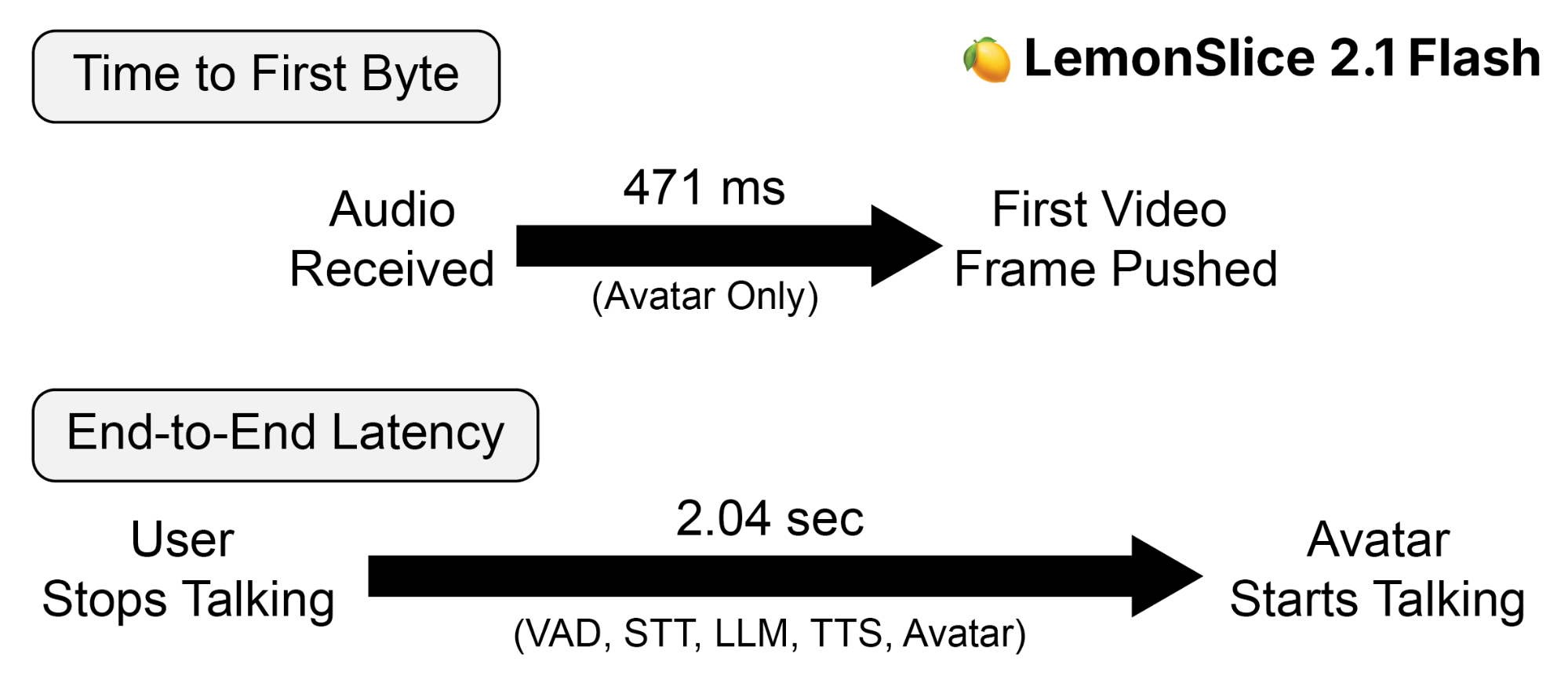
It's also fast. LemonSlice 2.1 Flash responds in 471ms on average, making it the fastest model among major avatar providers in published benchmarks.
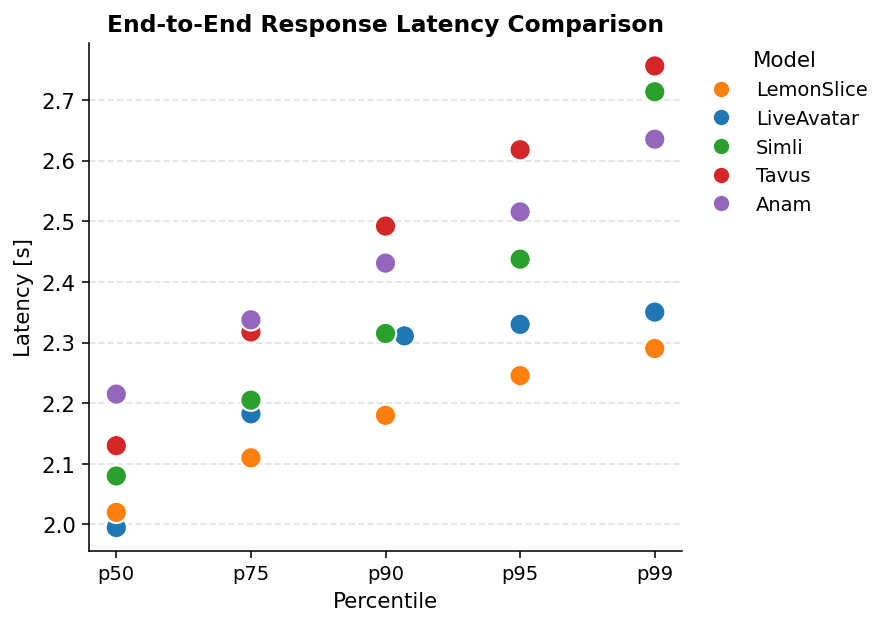
For developers who want to build interactive avatars into their own applications or products, LemonSlice also offers an API. It allows you to use LemonSlice with any LLM or voice provider. Integrations are also available for LiveKit, Pipecat, Agora, and WebSockets. The API supports 1000+ concurrent calls on Enterprise plans and is powered by a global fleet of GPUs, making it a robust choice for large-scale corporations.
Pros:
- Any character, including mascots, animals, and non-humanoids
- Highly expressive and attention-grabbing characters
- Full lip sync, facial animation, hand gestures, whole body movements, and even moving backgrounds
- Instant characters from one photo, with unlimited avatars on every plan
- The only provider with an action engine and emotion engine
- API-first, works with any LLM or voice provider
Cons:
- Calls on self-serve subscriptions are limited to 30 minutes (24 hrs available on Enterprise)
Bottom line: Choose LemonSlice when you need an interactive avatar that builds trust or holds a user's attention. LemonSlice avatars are consistently rated more expressive and natural, due to their novel Character World Model approach. Also choose LemonSlice when you want animals, cartoons, or non-human avatars. Or when you want hand gestures and whole-body actions.
Tavus
Tavus sells a complete avatar experience you build through one API. Its conversational product is the Conversational Video Interface, or CVI, and it runs on three in-house models. Phoenix-4 renders the avatar, Raven-1 handles perception, and Sparrow-2 manages turn-taking.
The per-minute price includes the LLM, text-to-speech, and WebRTC transport. A knowledge base, dynamic memories, guardrails, and function calling ship with the stack, and output runs at 1080p.
It integrates with Pipecat and LiveKit, and PAL Maker gives you a no-code path.
Custom avatars, called Replicas, take planning. Tavus trains a custom model for each Replica, which takes 2-6 hours, and each tier allows a fixed number of Replicas. A free tier includes 20 minutes of conversational video, and the Starter plan is $22/month.
Pros:
- A complete conversation stack, with perception and turn-taking models included
- Knowledge base, memory, and function calling for grounded agents
- 1080p output with Pipecat and LiveKit integrations
Cons:
- Each new Replica requires a 2-6 hour training step
- Custom Replicas occupy limited per-plan slots
- Metered minutes with overage once the included ones run out
Bottom line: Choose Tavus if you want one vendor to own the entire conversational stack, perception and turn-taking included. It's a good choice for shipping an interactive avatar experience with little code. If your product creates characters on the fly, plan around the multi-hour training step each new Replica needs.
HeyGen LiveAvatar
LiveAvatar is HeyGen's real-time avatar API. It streams photorealistic avatars at 1080p, in half-body or full-body framing, and HeyGen quotes a median time to first frame under 300ms.
You choose one of two modes per session. Full Mode ships HeyGen's complete voice stack, with speech recognition, an LLM, and text-to-speech included, and Avatar Only mode takes the audio from your own stack and returns the rendered avatar.
The library holds 100+ preset avatars. A custom avatar builds from a single image or two minutes of footage.
Concurrency is unlimited on paid plans, backed by a quoted 99.99% API uptime. Sessions are capped by tier, from two minutes on the free plan up to 60 on Business, and self-serve tiers include one custom avatar slot, at 720p until Business unlocks 1080p.
A free plan includes 10 credits, and paid plans start at $19/month. Enterprise volume pricing falls to $0.01 per minute.
Pros:
- 1080p full-body avatars with unlimited concurrency on paid plans
- Bundled voice stack or bring-your-own, chosen per session
- Custom avatars from one image or two minutes of footage
Cons:
- Session lengths capped by tier, from 2 to 60 minutes
- One custom avatar slot on self-serve tiers, 720p until Business
- Credit metering across the two modes takes forecasting
Bottom line: Choose LiveAvatar when the avatar must be a photorealistic human at 1080p and traffic is spiky, because concurrency doesn't cap on paid plans. The two modes let you start bundled and switch to your own stack later. Watch the per-tier session caps if your calls run long.
Anam
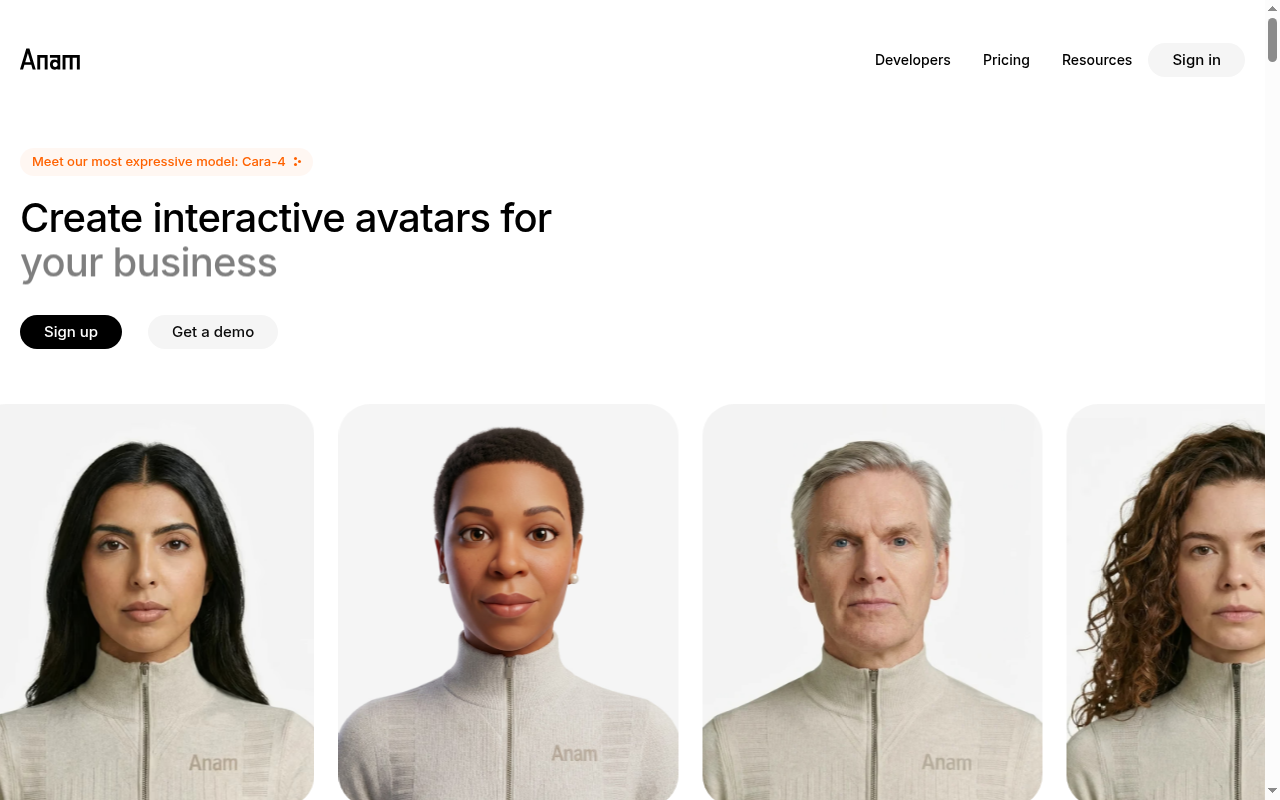
Anam animates photorealistic human personas. The company quotes 180ms median server-side latency, with a conversation engine that keeps the median round trip under a second.
Rendering runs on CARA III, a diffusion model that delivers 25 frames per second at 720x480.
You build with a JavaScript SDK, a Python SDK, or the REST API, plug in any LLM, and define personas at runtime. Anam Lab covers the no-code side, and speech reaches 50+ languages.
Billing runs by the second. Per-minute rates start at $0.16 on Starter and fall to $0.11 on Professional, and a free plan includes 30 monthly minutes with API access. Conversation length and custom avatars are capped below the Growth tier, at five minutes and two avatars on Starter.
Pros:
- Natural motion on photorealistic faces
- JavaScript and Python SDKs with runtime persona control
- Per-second billing and a free tier with API access
Cons:
- Conversation-length limits (5 min on Starter) until the Growth tier
- Custom avatars are capped per plan, with only two on Starter
- The focus on humans narrows the range of characters you can make
Bottom line: Choose Anam for believable human personas on customer-facing web deployments. The SDKs and runtime personas keep the integration quick. If your product needs stylized or non-human characters, LemonSlice above is the better fit.
D-ID
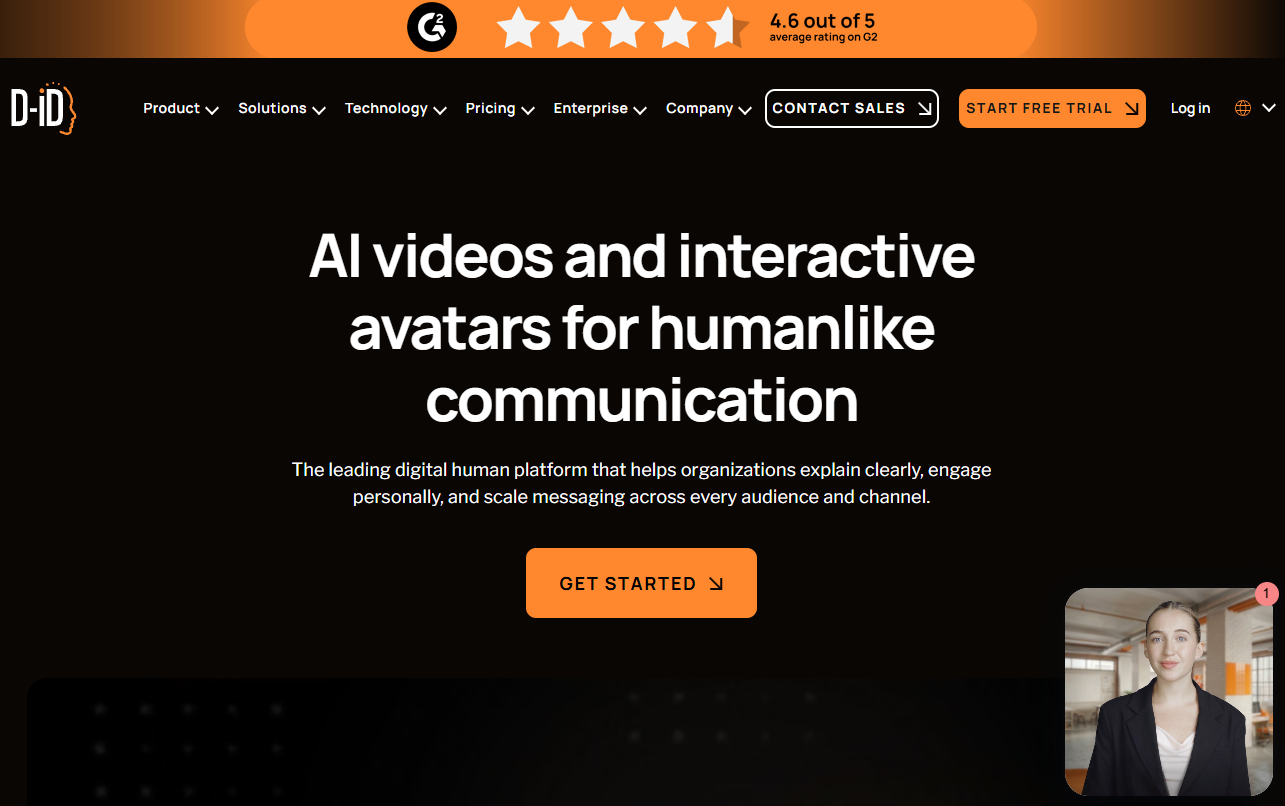
D-ID runs the most established talking-head API on this list. Send a photo and a script or audio file, and it returns a finished video, rendered at 100 frames per second, with 150 million+ videos generated to date.
A streaming mode drives the same avatars in real time, which puts a face on chatbots and live support agents.
One credit pool covers both jobs. The Build plan includes up to 16 minutes of offline video or 32 minutes of streaming, so a product can ship clips and a live agent from one subscription.
Voices come from hundreds of text-to-speech options across 100+ languages, or from your own recording.
Plans bill annually. Build works out to $14.40/month, and the commercial license starts on Launch at $35/month. Output stays watermarked until Scale swaps in your logo.
Pros:
- Clips and real-time streaming from one API and credit pool
- Hundreds of TTS voices across 100+ languages
- Proven at volume, with 150 million+ videos generated
Cons:
- Commercial use starts on the Launch plan
- A watermark stays on output below the Scale plan
- Credit math across video and streaming minutes takes forecasting
Bottom line: Choose D-ID when the same product needs pre-rendered clips and a streaming avatar, because one credit pool covers both. The API is mature and the language coverage is wide. For a live-only build wired into LiveKit or Pipecat, check its integration docs against your stack first.
Simli
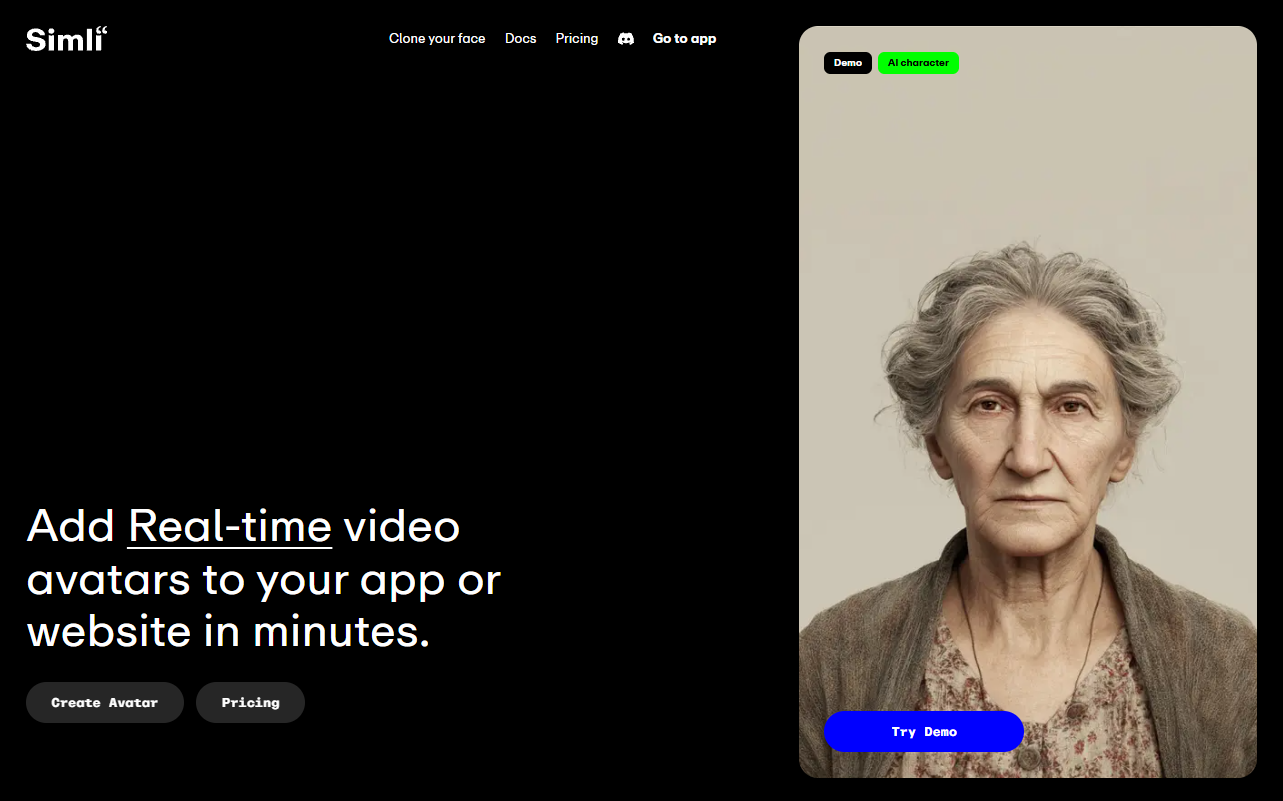
Simli is a face layer for real-time agent stacks. Stream audio to it, and it streams back a synced talking face over WebRTC, in under 300ms from speech to video.
Integrations cover LiveKit and Pipecat, alongside JavaScript and Python SDKs and published OpenAPI and WebSocket specs. Starter repos wire it to OpenAI and ElevenLabs stacks.
When you'd rather skip pipeline assembly, Simli Auto runs the full hosted session, with a custom LLM option.
The homepage charts where Simli sits in the full latency stack, beside the speech-to-text, LLM, and text-to-speech steps you bring, which makes its sub-300ms figure easy to interpret. Signing up brings a $10 credit and a monthly top-up of 50 free minutes, and paid usage is pay-as-you-go with volume discounts.
Pros:
- Sub-300ms speech-to-video generation
- LiveKit and Pipecat integrations with open API specs
- Free monthly minutes, then pay-as-you-go billing
Cons:
- Per-minute rates are published inside the app, after sign-in
- Output is a talking face rather than a full-body character
- Outside Simli Auto, you run the whole agent pipeline yourself
Bottom line: Choose Simli to put a low-cost face on a voice agent you already run, and test the fit with the free monthly minutes. The open specs and framework plugins keep the integration small. Price out your production volume inside the app, because the site doesn't publish per-minute rates.
Choosing the right avatar API
The quickest way to choose is to start from how you want to work.
If your avatar only ever needs to be a photorealistic human. Tavus, Anam, and HeyGen's LiveAvatar all build for exactly that job. Tavus bundles perception and turn-taking into its pipeline, Anam deploys through a widget or SDKs, and LiveAvatar holds 1080p with uncapped concurrency on paid plans.
If you need pre-rendered clips too, or you're validating on a small budget. D-ID covers clips and live streams from one credit pool. Simli plays a similar budget role for live-only builds, with free monthly minutes and pay-as-you-go after.
If the goal is an expressive interactive avatar that holds users' attention. That's exactly what LemonSlice was designed for. The avatar can be any type of character, from humans to animals. And it's the only interactive avatar provider that has dynamic hand gestures, whole body motions, and an emotion engine.
Every plan includes unlimited avatars and API access, and you can chat with a library of avatars for free to experience it firsthand.