
Articles · Nov 3, 2026
Cartesia vs ElevenLabs: Which TTS Fits Your Voice Agent?
Compare Cartesia vs ElevenLabs on latency, voice quality, cloning, languages, pricing, and deployment, and see which TTS fits your voice agent.
Cartesia and ElevenLabs make the voices that most AI voice agents speak with. Both sell a text-to-speech model tuned for live conversation, both clone voices, and both now sell speech recognition and an agent product too.
The Cartesia vs ElevenLabs decision comes down to two things a caller notices: how fast the first word arrives, and how human that word sounds. Cartesia leads its pitch with speed and a new model architecture. ElevenLabs leads with range: more voices, more languages, and finer control over performance.
All feature and pricing information in this comparison comes from each vendor's official website, docs, and pricing pages, as of October 26, 2026.
What is Cartesia?
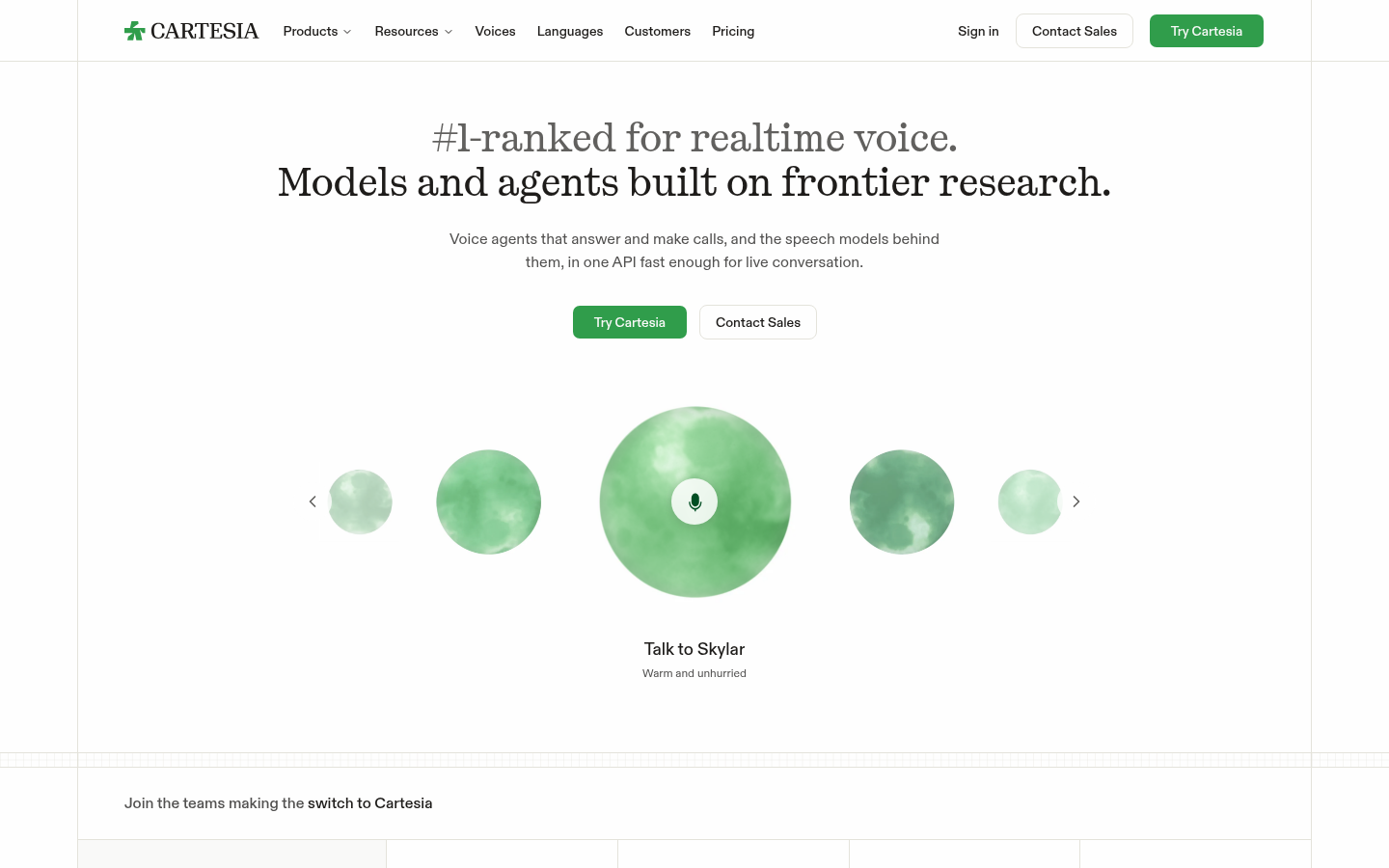
Cartesia is a voice AI company that builds speech models on a State Space Model (SSM) architecture, a different approach from the transformers most AI models use. SSMs bring lower cost and higher concurrency on long sequences, and Cartesia runs the same models in the cloud, on-premise, and on-device.
Its flagship product is Sonic, a text-to-speech model built for live conversation. The company also sells Ink, a streaming speech-to-text model, and managed voice agents built on Ink and Sonic together.
Teams that run voice agents at phone-call volume are the core customers. EliseAI runs 5M+ voice calls a month on Cartesia, which shows the models holding up at call-center scale.
What is ElevenLabs?
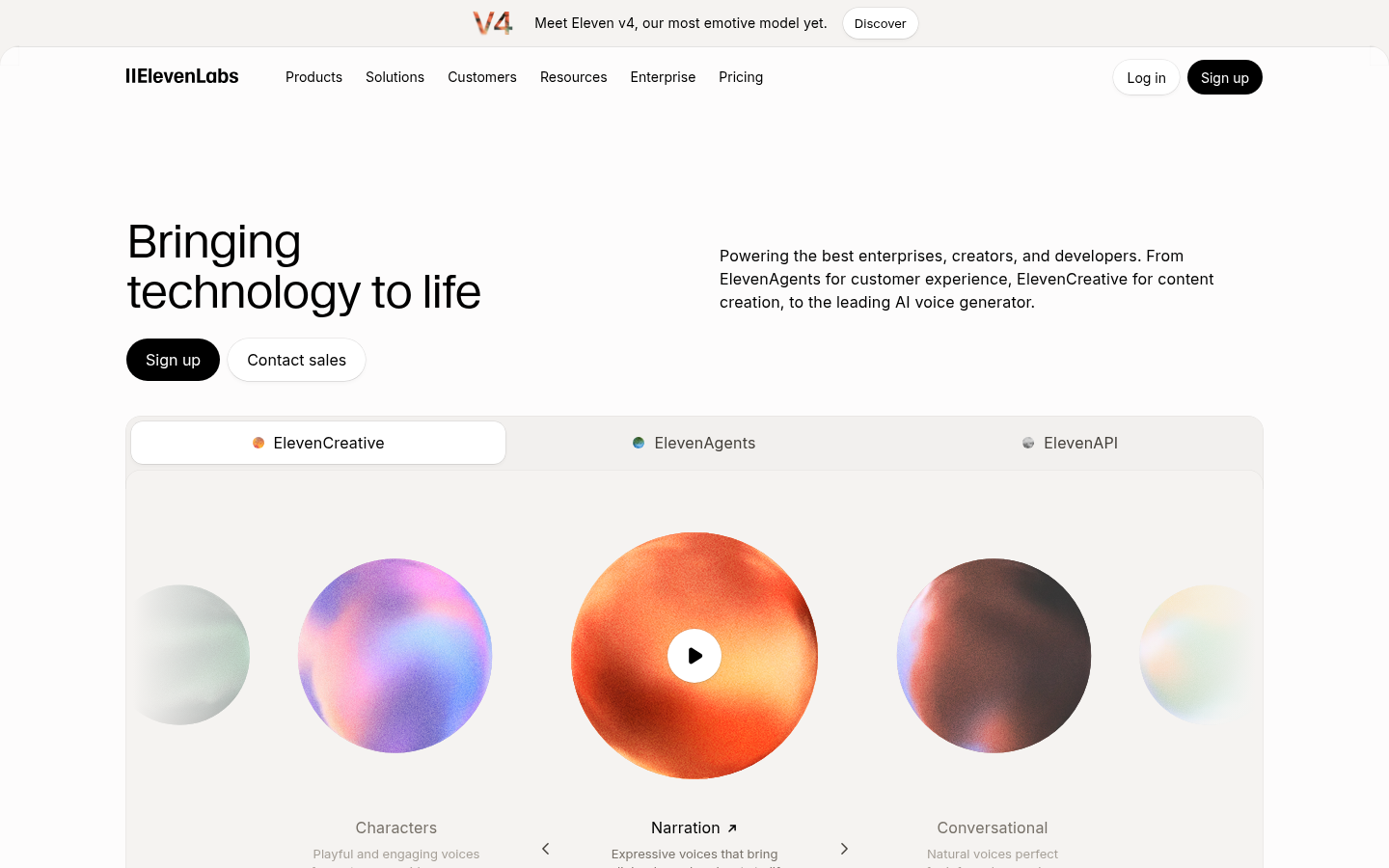
ElevenLabs builds its own voice AI models, starting with text-to-speech and now reaching into speech recognition and a full agent platform. It sells a family of TTS models, each tuned for a different job: Eleven v4 is the current generation, built on what the company calls an entirely new architecture, and Eleven v4 Turbo is its model for real-time speech and agents.
Range is the selling point. Its catalog of over 16,000 voices works with Eleven v4, the v4 family supports 90+ languages, and tags written straight into the script direct how a line is performed.
Product teams use ElevenLabs for narration, characters, support agents, and localization.
Cartesia vs ElevenLabs at a glance
The table lines up what each vendor sells today, and the sections below break each row down in detail.
| Cartesia | ElevenLabs | |
|---|---|---|
| Real-time TTS model | Sonic 3.6 | Eleven v4 Turbo, with Flash v2.5 still available |
| Architecture | State space model | Not disclosed beyond "entirely new" |
| Published latency | First audio in under 90ms | About 100ms inference on v4 Turbo |
| Languages | 44 | 90+ on the v4 family |
| Voice catalog | 500+ voices | 16,000+ voices |
| Instant clone input | 10 seconds of audio | Under two minutes of audio |
| Paid plans from | $5 a month | $6 a month |
| Self-hosted option | On-prem, air-gapped, VPC, or on-device | On-prem priced case by case |
Key terms in this comparison
The comparison below leans on these terms, so knowing what each one means makes it easier to weigh Cartesia and ElevenLabs feature by feature. Here is each one in plain language.
- TTS and STT: text-to-speech turns written text into a spoken voice, and speech-to-text turns spoken audio into written text. The speaking half and the listening half of every voice agent.
- Latency, time-to-first-audio, and P90: latency is the wait before something happens, and time-to-first-audio is how long a voice model takes to start speaking. P90 is the time 90% of requests beat, so it shows how slow the unlucky calls get, not the average ones.
- Streaming: sending audio out while the rest is still being generated, so the caller hears the first words right away. Every real-time voice agent depends on it.
- SSML and audio tags: SSML is the markup older voice systems use for pauses and emphasis. Both vendors now take direction from the script itself instead, through plain text or tags like [laughter] and [whispers].
- Deployment and compliance: on-prem, VPC, and air-gapped all mean running the model inside your own infrastructure, and data residency is which region stores your audio.
Latency: time-to-first-audio and P90
| Cartesia (Sonic) | ElevenLabs (Eleven v4 Turbo, Flash v2.5) | Why it matters | |
|---|---|---|---|
| Own headline figure | Under 90ms to first audio | About 100ms inference on v4 Turbo | Both are quicker than a blink, and each vendor measures a different step, so the two numbers don't compare directly. |
| Other published tests | 320ms median for Sonic 3.5, in an outside test | 150ms to first speech on its own chart, about 75ms on Flash v2.5 | Fuller measurements land higher than headline figures, and all of them stay under half a second, a wait a caller reads as instant. |
| Slow-call claim | 4x faster at P90, per Cartesia | No P90 figure on its own pages | P90 is the time 90% of requests beat. A P90 over one second means one call in ten pauses long enough for the caller to talk over the agent. |
What the numbers mean
- Headline figures: Cartesia says Sonic streams its first audio in under 90ms, fast enough for a live phone call, and ElevenLabs quotes about 100ms inference for Eleven v4 Turbo and about 75ms for Flash v2.5. All three are a fraction of the time a blink takes. The ElevenLabs footnote says its figures exclude application and network latency, so treat every headline number as a best case.
- Fuller measurements: when Sonic 3 launched, Cartesia's changelog listed about 190ms median latency, and its comparison page shows Sonic 3.5 at a 320ms median time-to-first-audio (TTFA) in tests run by Coval, an outside voice AI evaluation platform. ElevenLabs quotes about 150ms time to first speech for v4 Turbo, and on its own v4 chart it places Cartesia Sonic 3.6 at 262ms. Every one of those numbers is still under half a second, a gap most callers would never notice.
- P90, the slowest calls: P90 describes your unlucky calls rather than your average ones, and it is where Cartesia attacks hardest. Cartesia says every ElevenLabs model crosses one second at P90 in Coval's tests, and that it runs 4x faster on that measure. Those tests measured older ElevenLabs models, not v4 Turbo, so run your own P90 test on the model you plan to ship.
Verdict
- Pick Cartesia if you're building phone agents where the slowest call matters as much as the average one, because it is the only vendor here publishing a P90 claim, and that could make it the safer pick for latency-critical calls.
- Pick ElevenLabs if its published medians are already fast enough for your product, because at these levels the gap between the headline figures is too small to matter on its own.
Voice quality and emotional range
| Cartesia (Sonic 3.6) | ElevenLabs (Eleven v4) | Why it matters | |
|---|---|---|---|
| Benchmark cited | Speech Arena, 1282 Elo for Sonic 3.6 | No outside benchmark on its voice pages | An outside leaderboard is easier to trust than a vendor demo, but the published scores don't grade the newest ElevenLabs model. |
| Emotion | Read from the script, tags in English | Audio tags written into the script | Decides how much work it takes to make a line sound happy, apologetic, or urgent. |
| Nonverbal sounds | A [laughter] tag | [laughs], [whispers], and sound effects | Small human noises are what make an agent sound less robotic on a call. |
What the numbers mean
- Benchmarks: on the Artificial Analysis Speech Arena leaderboard in August 2026, Cartesia Sonic 3.6 scored 1282, against 1177 for Eleven v3 and 1084 for Flash v2.5. In Cartesia's own blind tests, US English listeners picked Sonic 3.6 over Eleven v3 92% of the time. Neither comparison includes Eleven v4, so the public scores grade the previous ElevenLabs generation.
- Emotion control: Sonic reads emotional subtext from the transcript by default, and optional emotion tags work in English only. Its primary emotions are neutral, calm, angry, content, sad, and scared, its voice controls set speed from 0.6 to 1.5, and disfluencies like "hmm" in the script give the voice a natural thinking pace. You write the line, and the model decides how to say it.
- Performance direction: ElevenLabs puts its emotional range into audio tags such as [laughs], [whispers], and even sound effects like [door slams], and Eleven v4 follows tag sequences more reliably than Eleven v3. A script reads like stage direction, so the writer, not the model, decides how each line lands.
Verdict
- Pick Cartesia if you want the voice to find the right tone on its own, and your scripts are in English, where its emotion tags add manual control.
- Pick ElevenLabs if you want to direct each line like a screenplay, with whispers, laughs, and sound effects written into the script. Since the published benchmarks skip Eleven v4, the fairest test of voice quality is a blind listen with your own script.
Voice cloning and the voice library
| Cartesia (Sonic 3.6) | ElevenLabs (Eleven v4) | Why it matters | |
|---|---|---|---|
| Instant clone input | 10 seconds of audio | Under two minutes of audio | Ten seconds is a voicemail, two minutes is a short recording session. Both are easy to collect, so the gap is too small to matter. |
| Professional clone | 30+ minutes of audio, from the Startup plan | Creator plan or higher | The higher-fidelity option for a brand voice sits behind a paid tier on both vendors. |
| Catalog | 500+ voices | 16,000+ voices | A catalog roughly 30 times larger means far more accents and styles to audition without recording anyone. |
What the numbers mean
- Instant clones: both vendors offer voice cloning in two tiers, instant and professional. Cartesia makes an instant voice clone from 10 seconds of audio, and Sonic 3.6 can use up to 60 seconds to hold onto an accent. ElevenLabs needs under two minutes, and its v4 instant clones now beat the professional clones of Multilingual v2. Either way, a usable copy of a real voice takes minutes to set up.
- Professional clones and plan gates: Cartesia's professional voice cloning needs at least 30 minutes of clean audio from one speaker, and training is free. Instant cloning starts on the Pro plan and professional clones on Startup, so the Free plan can't keep either. On ElevenLabs, professional clones start on the Creator plan.
- Clones and model upgrades: professional clones made on older Sonic models keep working, because Sonic 3.6 is backwards compatible with Sonic 3.5. ElevenLabs professional clones returned in v4 after v3 dropped them, and clones made before v4 need retraining to work well on the new model. If a cloned brand voice is central to your product, plan for that retraining step.
- The catalogs: Cartesia's library holds 500+ voices across 44 languages. The ElevenLabs catalog is the largest in this comparison at over 16,000 voices, though free-tier users can't call library voices through the API. For a brand voice built from a short recording, both work; for a big casting choice without recording anyone, ElevenLabs has more voices to audition.
Verdict
- Pick Cartesia if you want a clone from the shortest possible sample, or you want clones that keep working across model upgrades.
- Pick ElevenLabs if you'll cast the voice from a catalog rather than record one, because 16,000+ voices give you far more to audition.
Languages and regional accents
| Cartesia (Sonic 3.6) | ElevenLabs (Eleven v4, v3, Flash v2.5) | Why it matters | |
|---|---|---|---|
| Languages | 44 on Sonic 3.6 | 90+ on v4, 70+ on v3, 32 on Flash | If a language you need sits outside Cartesia's 44, the decision is made for you. |
| Accent handling | Native pronunciation in each language | Named regional variants on its older model | Callers can tell a local accent from a generic one in the first sentence, which shapes how much they trust the agent. |
What the numbers mean
- Language counts: Sonic 3.6 speaks 44 languages, the Eleven v4 family supports 90+, Eleven v3 supports 70+, and Flash v2.5 supports 32. The counts only decide things at the edges: an agent that must speak a language outside Cartesia's 44 can only run on ElevenLabs of these two.
- Accents: Cartesia says Sonic pronounces words and phrases the way a local would, which matters most for agents that answer in one country at a time. ElevenLabs lists regional accents by name on Multilingual v2, including US, UK, Australian, and Canadian English, Brazilian and European Portuguese, and Mexican and Spanish Spanish, and it advises picking a voice whose accent matches your target language and region.
- What to test: if your markets fall inside Cartesia's list, compare a native speaker's reaction to both voices before you count languages. A voice that sounds local in your main market matters more than a long list you'll never use.
Verdict
- Pick Cartesia if your markets sit inside its 44 languages and a native-sounding local accent is the bar to clear.
- Pick ElevenLabs if you need languages beyond that list, or you want named regional variants of the same language to choose from.
Pricing
| Cartesia | ElevenLabs | Why it matters | |
|---|---|---|---|
| Free plan | 20,000 credits a month | 10,000 credits a month, about 10 minutes of audio | Either allowance covers prototyping an agent before you pay anything. |
| Paid plans from | $5 a month | $6 a month | A dollar apart. The entry price gap is too small to matter. |
| Billing unit | Credits, one per character | US dollars per 1,000 characters on the API | Different units hide the real comparison, which is cost per spoken minute at your volume. |
What the numbers mean
- How Cartesia bills: one credit equals one character, and a minute of audio takes 750 to 800 credits, so a plan's credit total translates directly into spoken minutes. Overage on the Pro tier costs $65 per million credits. Its managed agents run $0.06 a minute, and a Cartesia-provided phone number adds a small per-minute telephony fee.
- How ElevenLabs bills: the TTS API charges $0.08 per thousand characters on its multilingual models, and Flash and v4 Turbo cost half that, with v4 Turbo billed as its best model for real-time and agents. The half-price models are the ones a live voice agent would use anyway, so most agent traffic lands on the cheaper rate.
- The number to compare: for a voice agent that speaks all day, convert both to cost per spoken minute at your volume. Cartesia's TTS pricing scales by credit tier, and ElevenLabs halves its per-character price on its fast models, so the winner depends on your monthly character count rather than the list price.
Verdict
- Pick Cartesia if you want the bigger free allowance to prototype with and credit pricing that scales as your tier grows.
- Pick ElevenLabs if your agent runs on Flash or v4 Turbo, because the half-price rate on its fast models could make it the better value at volume.
Deployment and compliance
| Cartesia | ElevenLabs | Why it matters | |
|---|---|---|---|
| On-prem | Yes, including air-gapped networks | Case by case | Decides whether audio can stay entirely inside your own walls, which some banks and agencies require. |
| Compliance | SOC 2 Type II, HIPAA-eligible, GDPR | PCI DSS Level 1, HIPAA with a signed agreement | The certifications a security review asks for first. Both vendors can support a HIPAA project. |
| Uptime SLA | 99.9% | Not stated on the pages checked | A written availability promise, which starts to matter once an agent answers real customer calls. |
What the options mean
- Where the model runs: Cartesia offers the wider choice. Sonic 3.6 deploys on-prem inside your data center, including air-gapped networks, in your own VPC on AWS, GCP, or Azure, or embedded in your product through OEM licensing, all under enterprise contracts. ElevenLabs runs mainly as a cloud service and handles on-premises deployment case by case, usually priced as a yearly license plus usage.
- Certifications: Cartesia is SOC 2 Type II certified, HIPAA-eligible with signed healthcare agreements, GDPR-compliant, and publishes a 99.9% uptime SLA. ElevenLabs holds PCI DSS Level 1 certification, and its HIPAA support requires Zero Retention Mode with the signed agreement in place. A HIPAA AI voice agent can run on either vendor.
- Data residency: ElevenLabs offers data residency as an Enterprise feature, and it applies to where your data is stored. If your rules govern where audio is processed rather than stored, ask each vendor to put the answer in writing.
Verdict
- Pick Cartesia if audio can't leave your environment, because an air-gapped network has a documented path only with Cartesia. That could make it the safer pick for a bank or government team.
- Pick ElevenLabs if a managed cloud service fits your rules and Enterprise data residency covers your storage requirements.
Beyond voices: STT and agent products
| Cartesia (Ink) | ElevenLabs (Scribe) | Why it matters | |
|---|---|---|---|
| Speech-to-text | Ink-2, 5 languages | Scribe, 90+ languages | The agent has to understand callers before it can answer them, so the listening model's language list matters as much as the voice's. |
| Agent product | Managed agents built on Ink and Sonic | ElevenAgents | A managed agent replaces the pipeline you would otherwise assemble from separate STT, LLM, and TTS parts. |
What the numbers mean
- Cartesia's listening half: Ink is a streaming STT model that Cartesia says has the lowest word error rate of any streaming model, and it handles phone numbers, dates, and emails natively, exactly the data a phone agent collects all day. Ink-2 supports English, Spanish, French, Hindi, and Japanese, and Cartesia's managed agents run on Ink and Sonic together.
- ElevenLabs' listening half: Scribe handles speech recognition across 90+ languages, matching the breadth of its voice side, and ElevenAgents is its product for full conversational AI agents. Either vendor can now supply the whole conversation loop on its own.
- Mixing vendors: most teams still mix, using one STT, one LLM, and one voice. Frameworks like LiveKit and Pipecat let you swap the voice with a one-line change, so you can test Cartesia and ElevenLabs inside the same agent. Keep the STT and LLM fixed while you compare, so the voice is the only variable.
Verdict
- Pick Cartesia if your agent reads back numbers, dates, and email addresses all day and its five STT languages cover your callers.
- Pick ElevenLabs if one vendor should both listen and speak in many languages, because Scribe's 90+ languages match its voice coverage.
Swap the voice, keep the face
LemonSlice, a real-time interactive avatar platform, adds a face layer on top of your voice agent and works with any text-to-speech provider, so a laughing Sonic voice or a whispering Eleven v4 voice drives the same character. The voice choice stays yours.
LemonSlice works best for AI characters, companion AI, interactive museum exhibits, customer support, and tutoring. Whatever your agent handles, here's what comes with it:
- Characters that match the voice: LemonSlice animates non-humans as easily as humans, so a cartoon mascot can speak with a cartoon-worthy voice. One image makes the character, and you can update its appearance, emotions, and actions during a live session.
- Response speed: LemonSlice adds minimal latency on top of your existing voice stack, so the avatar won't be the slow step in the call. Its global fleet of GPUs runs calls from the nearest region.
- Always-on sessions: for an interactive museum exhibit that runs all day, sessions stay live for up to 24 hours on Enterprise plans.
- Let your coding agent add it: install the LemonSlice skill, then ask Cursor, Claude, or Copilot to add a video avatar to your voice app. The skill scaffolds a starter app with keys, the voice cascade, an image, and a ringing UI.
- Wire any stack: you can wire any voice stack that streams its audio using LemonSlice's WebSocket endpoints, and you bring your own LLM or voice model on any tier. You can walk through the full setup in our docs.
In the LiveKit sample below, the avatar starts next to an AgentSession whose voice line names Cartesia Sonic 3, and changing that one line to an ElevenLabs voice makes the avatar follow the new audio with nothing else to rebuild:
async def my_agent(ctx: agents.JobContext):

    avatar = lemonslice.AvatarSession(
        agent_image_url="https://lemonslice.com/image.png",
        agent_prompt="Talk with hand gestures.",
    )

    session = AgentSession(
        stt="deepgram/nova-2",
        llm="openai/gpt-5.3-chat-latest",
        tts="cartesia/sonic-3",
    )

    await avatar.start(session, room=ctx.room)
    await session.start(
    )
Python code sample from lemonslice.com/avatar-api
Developers can start with as little as $8 a month, and every plan includes unlimited avatars and API access. Add your first interactive AI avatar to your Cartesia or ElevenLabs voice.
Which one should you choose?
Pick by what your callers will notice first.
| If you need | Lean toward | Why |
|---|---|---|
| The fastest first word on a phone call | Cartesia | First audio in under 90ms, per Cartesia |
| Languages outside a core 44 | ElevenLabs | 90+ languages on the v4 family |
| A huge voice catalog to cast from | ElevenLabs | 16,000+ library voices |
| Speech inside an air-gapped network | Cartesia | On-prem and air-gapped deployment |
Both vendors sell full agent products too, but most teams pick the voice first and keep their existing STT and LLM.
Choose Cartesia if you're building real-time voice agents for the phone and every millisecond counts, because Sonic 3.6 was built for low latency at scale and Cartesia publishes its P90 results.
Choose ElevenLabs if your agent needs many languages, a large cast of voices, or fine performance direction, because Eleven v4 pairs 90+ languages with audio tags and the largest catalog here.
Still torn? Settle it with a blind test. Write the ten lines your agent says most, generate each with Sonic 3.6 and Eleven v4 Turbo, and have teammates pick a favorite without knowing which vendor made which. Then measure P90 latency from your own servers. The deciding factor is usually whether your callers care more about the speed of the first word or the range of voices and languages behind it.
Whichever way you go, you can give your voice agent a face with LemonSlice. You can create the character from a single photo, and the real-time interactive avatar works with whichever TTS you pick. Responses come back with ultra low latency from LemonSlice's global fleet of GPUs, and developers can start prototyping for as low as $8 a month with the API included. Swap the voice later and the face carries over. Build your first interactive AI avatar with LemonSlice.