
Articles · Nov 3, 2026
Deepgram vs ElevenLabs: Which Voice AI Fits Your Stack?
Compare Deepgram vs ElevenLabs on transcription, voices, latency, pricing, deployment, and data residency, with a verdict for each kind of voice product.
Deepgram and ElevenLabs sell the two ends of voice AI. Deepgram built its name on speech recognition and later added voices and an agent product. ElevenLabs started with a human-like voice model and later added transcription and its own agent platform.
That history still shapes the Deepgram vs ElevenLabs decision. Each vendor is strongest at the half it started with, so the right pick depends on whether your product mostly listens, mostly speaks, or does both on a live call.
All feature and pricing information in this comparison comes from each vendor's official website, docs, and pricing pages, as of October 26, 2026.
What is Deepgram?
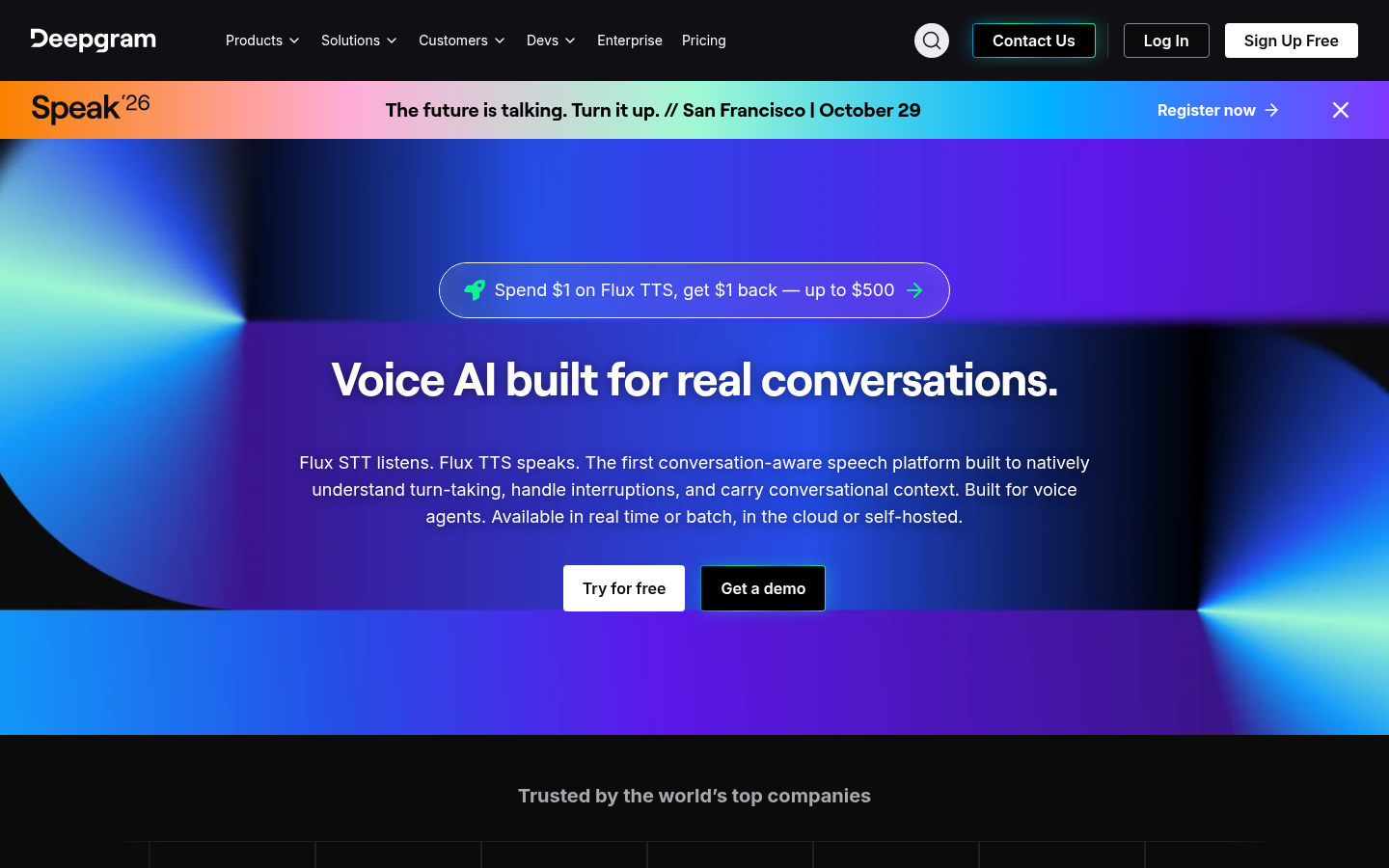
Deepgram is a speech AI platform built for developers. It sells three things: speech-to-text, text-to-speech, and a Voice Agent API that runs both with a language model in one connection. Its current pairing is Flux, where Flux STT listens and Flux TTS speaks, in real time or batch, in the cloud or self-hosted.
Listening is the deeper half. Nova-3 handles general transcription in 45+ languages, Flux adds built-in turn detection for live conversation, and both accept a live stream or a recorded file. Speaking is newer: the company ships expressive English voices today and lists more languages and voice cloning on its roadmap. Call centers, media teams, and healthcare products use it where transcription accuracy at volume matters most.
What is ElevenLabs?
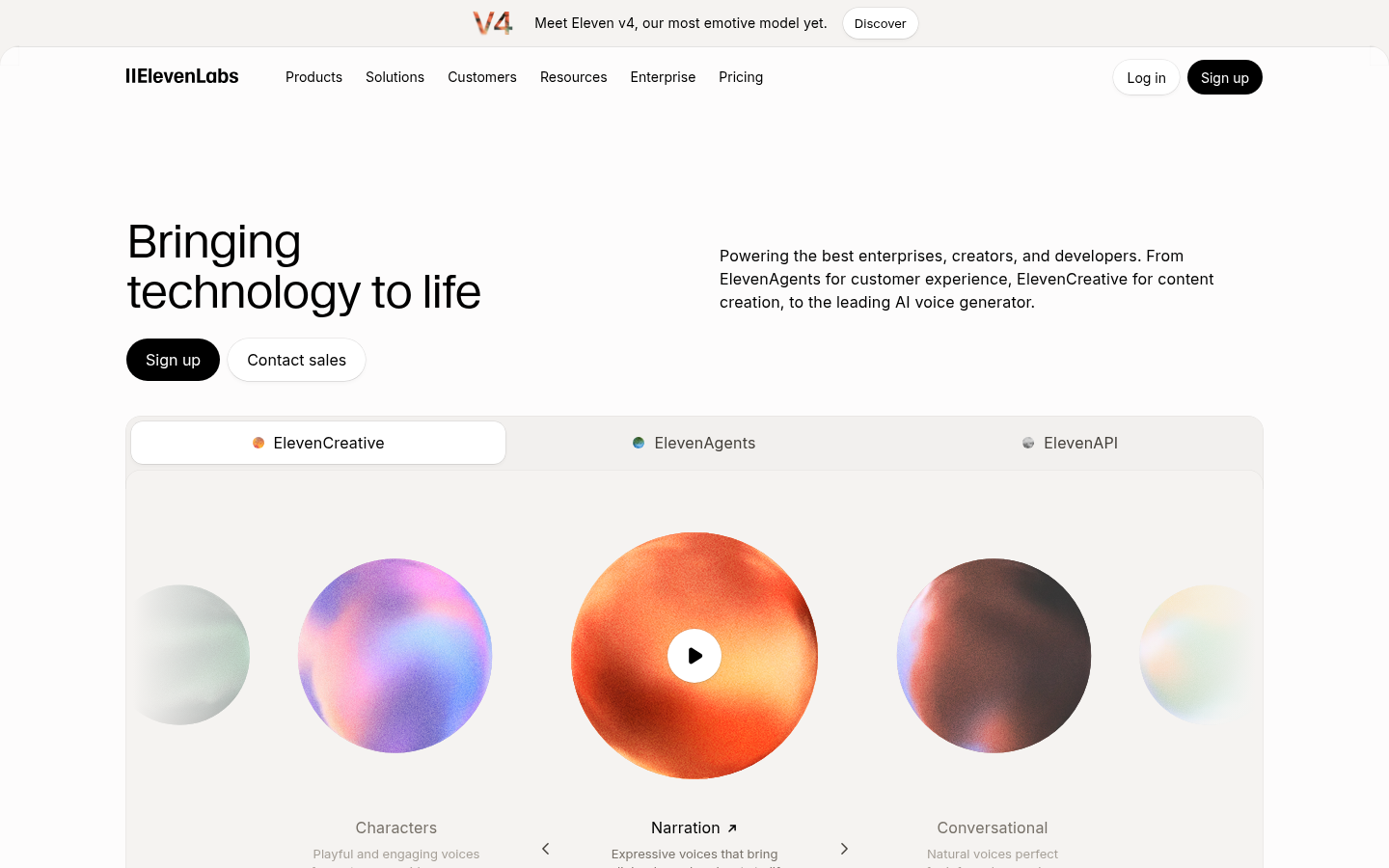
ElevenLabs builds its own foundation models, starting with a human-like voice model and now reaching well beyond voice. Its library lists over 16,000 voices, and its speech models span 90+ languages.
Speaking is the deeper half. A clone takes under two minutes of audio, and Voice Design builds a new voice from attributes like age, accent, and tone.
The company added listening with its Scribe models, sells dubbing for teams that translate finished video, and runs its own agent platform. Product teams use it for narration, characters, support agents, and localization.
Deepgram vs ElevenLabs at a glance
The table lines up what each vendor sells today, and the sections below break each row down in detail.
| Deepgram | ElevenLabs | |
|---|---|---|
| Started with | Speech recognition | Voice generation |
| Live transcription | Nova-3 and Flux, 45+ languages on Nova | Scribe v2 Realtime, 90+ languages |
| Voices | Flux TTS and Aura-2, English today | 16,000+ library voices in 90+ languages |
| Voice cloning | On the roadmap | Instant and professional clones |
| Free start | $200 in credit | 10,000 credits a month, about 10 minutes of audio |
| Agent product | From $4.50 an hour on the Standard tier | $0.08 a minute plus the language model |
| On-prem option | VPC or on-prem containers | Priced case by case |
| Data residency | EU, Australia, and India endpoints | EU, India, and Singapore storage on Enterprise |
Key terms in this comparison
The comparison below leans on these terms, so knowing what each one means makes it easier to weigh Deepgram and ElevenLabs feature by feature. Here is each one in plain language.
- STT and TTS: speech-to-text turns spoken audio into written text, and text-to-speech turns written text into a spoken voice. The listening half and the speaking half of every voice product.
- Latency: the wait before something happens. Time-to-first-audio is how long a voice model takes to start speaking, and time-to-first-byte (TTFB) is how long the first piece of data takes to arrive. Smaller is better, but only when two numbers measure the same thing.
- Word error rate: the share of words a transcription model gets wrong. Lower means more accurate text.
- Diarization and turn detection: diarization labels which person said which words in a recording, and turn detection is how an agent knows you finished talking and it is time to reply.
- Voice cloning: creating a synthetic copy of a specific voice from a short recording of it.
- Streaming, batch, and concurrency: streaming processes live audio as it arrives, batch processes a finished file, and concurrency is how many calls your plan can run at the same time.
- Deployment and compliance: self-hosted, VPC, and on-prem all mean running the software in your own infrastructure, and data residency is which region stores your audio.
Speech-to-text: Nova-3 and Flux vs Scribe v2
| Deepgram (Nova-3, Flux) | ElevenLabs (Scribe v2) | Why it matters | |
|---|---|---|---|
| Languages | 45+ on Nova | 90+ | If your calls come in many languages, the wider list wins by default. |
| Speaker labels | Diarization, who said what | Up to 32 speakers | Lets a transcript show who said each line in a meeting or group call. |
| Accuracy evidence | Relative error cut against competitors | Error rate published per language | A per-language rate is easier to check against the language you actually need. |
| End of turn | Built into Flux | Part of the agent product | The model senses when a caller stops talking, so an agent can reply without interrupting. |
What the numbers mean
- Accuracy: word error rate is the share of words a model gets wrong. Nova-3 cuts it by more than 50% against competing models in streaming and batch, and ElevenLabs publishes a rate for each language Scribe supports. The two measures aren't comparable, so run both on your own recordings instead of comparing the marketing pages.
- Cleanup savers: Deepgram's keyterm prompting lifts recall on product names and jargon by up to 90%, which matters when transcripts are full of SKUs or drug names. Its speaker diarization labels who said what, and Scribe labels up to 32 speakers.
- Turn detection: Flux builds end-of-turn detection into the listening model, so a conversational AI agent knows when to answer. ElevenLabs ships this as part of its agent product rather than the standalone transcription API.
- Billing: both vendors bill silence. Deepgram meters every second of audio, pauses included, and ElevenLabs bills per second of the audio you send. A quiet call costs the same as a talkative one.
Verdict
- Pick Deepgram if speech recognition in one or two languages at volume is the job, or you want turn detection built into the listening layer for a live agent.
- Pick ElevenLabs if one product must transcribe many languages and you want a published error rate for each one.
Voices: Flux TTS and Aura-2 vs Eleven v4
| Deepgram (Flux TTS, Aura-2) | ElevenLabs (Eleven v4, Flash v2.5) | Why it matters | |
|---|---|---|---|
| Languages | English today | 90+ on v4, 32 on Flash | If your users aren't all English speakers, Deepgram is out for now. |
| Voice library | A curated set | 16,000+ voices | A big library lets you browse voice options for a specific accent or mood instead of settling for the closest match. |
| Cloning | On the roadmap | Instant and professional clones | Cloning turns a real person's recording into a synthetic voice. Deepgram doesn't offer it yet. |
| Price per 1,000 characters | $0.045 on the newest model | $0.04 on Flash and v4 Turbo | 1,000 characters is about a minute of speech. The half-cent gap only matters at high volume. |
What the numbers mean
- Languages: the biggest real difference. Deepgram's new model is English-only today, with the earlier Aura-2 voices still available. Eleven v4 covers 90+ languages and Flash covers 32. If you need Spanish, Hindi, or Japanese, the decision is made for you.
- Voices and cloning: Deepgram offers a curated set of voices and lists cloning as a future feature. ElevenLabs has over 16,000 voices that work across its models, plus an instant clone from under two minutes of audio and a higher-quality professional clone on the Creator plan or above. If you want a voice that sounds like your CEO or a branded character, only ElevenLabs can do that right now.
- Price: $0.045 per 1,000 characters on Deepgram's newest model against $0.04 on ElevenLabs Flash and v4 Turbo. A 10-minute script, roughly 10,000 characters, runs about 45 cents against 40. Negligible unless you produce hours of audio a day.
- Watermarking: every clip from Deepgram's new model carries an inaudible watermark marking it as Deepgram audio. It doesn't affect quality, but it makes the audio traceable, which compliance teams tend to want and some brands would rather avoid.
- Quality tests: each vendor runs its own blind tests and wins them. Treat those as marketing; the reliable test is running your own script through both.
Verdict
- Pick ElevenLabs if you need speech synthesis in any language beyond English, a cloned or branded voice, or a specific character from a large catalog.
- Pick Deepgram if you need a clear English voice for a phone assistant or app narration and don't need cloning. The price gap is too small to decide it.
Latency: what each number measures
| Model | Published figure | What it measures | Why it matters |
|---|---|---|---|
| Deepgram Flux TTS | As low as 80ms | Time to first audio | The pause before the voice starts speaking. |
| Deepgram Nova-3 and Flux | Under 300ms | Returned text | How quickly spoken words come back as text. |
| ElevenLabs Scribe v2 Realtime | About 150ms | Returned text | The listening latency on the ElevenLabs side. |
| Deepgram Aura-2 | 184 ms | First byte, in the vendor's own test | A vendor-run test; useful as a reference point, not a guarantee. |
| ElevenLabs Flash v2.5 | About 75ms | Inference only, no network | Model time only; a real call adds network time on top. |
| ElevenLabs Eleven v4 Turbo | About 100ms | Inference only, no network | Same caveat: the clock stops before the network starts. |
What the numbers mean
- Different clocks: both vendors publish small numbers, and none of them measures the same thing. Deepgram's 80ms is time to first audio for its newest voice, its sub-300ms latency figure refers to listening, and Aura-2's published time-to-first-byte (TTFB) of 184 ms comes from Deepgram's own comparison test. ElevenLabs' 75ms and 100ms exclude application and network latency, so they describe the model, not what a caller hears. Time-to-first-audio is the pause between sending text and hearing the first sound, and ElevenLabs now recommends Flash over its older Turbo models for live use.
- What a caller feels: every published figure here sits under a third of a second, inside the pause of a normal conversation and fast enough for live captions or a phone agent, so a caller couldn't tell the vendors apart. Real-time streaming adds network hops, and an agent adds a language model between the listening and speaking steps, so the stack around the model usually adds more delay than the model itself.
Verdict
- Don't let a published latency figure decide this choice; the gaps are smaller than the network noise of a real call.
- Measure the whole exchange in your own region, from the user's last word to the first audio back, before one number rules a vendor out.
Agent products: Deepgram's Voice Agent API vs ElevenAgents
| Deepgram (Voice Agent API) | ElevenLabs (ElevenAgents) | Why it matters | |
|---|---|---|---|
| Price | From $4.50 an hour on the Standard tier | $0.08 a minute plus the language model | $4.50 an hour works out to 7.5 cents a minute; ElevenLabs' 8 cents excludes the language model, so compare all-in totals. |
| Bring your own parts | Your own model or voice provider | Your choice of language model | Swapping parts avoids lock-in and lets you keep a voice you already tuned. |
| Phone calls | Metered on connection time | Same rate as other channels | Neither vendor adds a telephony surcharge; you pay for time on the line. |
What the numbers mean
- Price: Deepgram's Voice Agent API costs from $4.50 an hour on the Standard tier, about 7.5 cents a minute, metered on connection time, and the rate drops when you bring your own models. ElevenAgents plans include a set number of minutes, extra minutes cost $0.08 each, and the language model bills separately on top, so put your own traffic numbers against both before comparing rates.
- What's in the box: Deepgram combines listening, language model orchestration, and speech in one connection, with barge-in detection (noticing when a caller interrupts), turn-taking prediction, and function calling (letting the agent trigger actions in your systems), and you can bring your own language model or voice provider while it runs the stream. ElevenLabs' Realtime models bundle listening, turn-taking, a language model, and speech into one tuned system, and each plan includes a set number of concurrent calls, meaning how many can run at once.
- Phones: telephony costs nothing extra on ElevenAgents, because phone calls bill at the same minute rate as any other channel. Deepgram meters on connection time.
Verdict
- Pick Deepgram's Voice Agent API if you want the lower per-hour bill and the freedom to swap in your own language model or voice, for example a phone bot that keeps a voice you already use.
- Pick ElevenAgents if you want ElevenLabs' full voice range inside the agent and one vendor running the whole stack.
Pricing
| Deepgram | ElevenLabs | Why it matters | |
|---|---|---|---|
| Listening | $0.29 an hour on promo, $0.46 regular | $0.39 an hour (Scribe v2 Realtime) | An hour of live transcription costs under half a dollar either way; the promo makes Deepgram the cheapest while it lasts. |
| Voices | Per 1,000 characters | Per 1,000 characters in US dollars | 1,000 characters is about a minute of finished speech, which makes quotes easy to compare. |
| Free start | $200 in credit | 10,000 credits a month | Deepgram's credit covers a real pilot; ElevenLabs' free tier is about 10 minutes of audio a month. |
What the numbers mean
- Listening: Deepgram prices by the hour and bills per second, so a 14-second file costs 14 seconds. ElevenLabs' Scribe batch rate starts at $0.22 an hour for files processed after the fact. The gaps are cents per hour, so only high volume makes them matter.
- Speaking: ElevenLabs' API charges $0.08 per 1,000 characters on its multilingual models; the lower rates for its live-conversation models sit in the Voices section above. The agent product carries its own per-minute rate on top.
- Two price lists: ElevenLabs' API prices in US dollars, but its subscription plans use credits, where one character costs one credit on Multilingual v2. Check which pricing your account sits on before estimating a bill.
- Starting credit: Deepgram's $200 covers about 43,000 minutes of Nova transcription, enough to test on real traffic rather than samples. ElevenLabs' 10,000 free credits are about 10 minutes of audio a month.
Verdict
- Pick Deepgram if listening dominates your bill; the hourly meter could be easier to forecast, and the free credit funds a serious pilot.
- Pick ElevenLabs if speaking dominates; compare your monthly character count on both first, since the model you choose can double the per-character rate.
Deployment, compliance, and data residency
| Deepgram | ElevenLabs | Why it matters | |
|---|---|---|---|
| Where it runs | Cloud, single-tenant, VPC, or on-prem | Cloud, with on-prem case by case | Running it inside your own infrastructure means audio never leaves your servers. |
| Healthcare | HIPAA agreement for Enterprise | HIPAA with Zero Retention Mode | Healthcare work needs the vendor to sign for HIPAA and keep no copies of your audio. |
| Regional data | EU, Australia, and India endpoints | Storage in the EU, India, or Singapore | Decides which country your audio sits in, which EU and Indian rules often require. |
What the options mean
- Running it yourself: Deepgram runs in its cloud, in single-tenant hosting, in your VPC, or on your own NVIDIA hardware, and publishes self-hosted deployment as a standard Enterprise option. ElevenLabs runs mainly in its own cloud and prices on-prem speech models one deal at a time, typically an annual license fee plus usage.
- Certifications: Deepgram is SOC 2 Type 2 certified and HIPAA compliant, and signs the healthcare agreement for Enterprise customers. ElevenLabs holds SOC 2 certification, and its HIPAA support needs Zero Retention Mode switched on plus the signed agreement.
- Data retention: Deepgram requests join its model improvement program by default, so opt out if you need zero data retention.
- Residency: Deepgram offers dedicated EU, Australia, and India endpoints. ElevenLabs stores data in the EU, India, or Singapore on Enterprise, and residency applies to storage, so processing may still happen elsewhere.
Verdict
- Pick Deepgram if a regulator or security team requires audio to stay inside your own environment; banks, hospitals, and government buyers get a published path rather than a one-off deal.
- Pick ElevenLabs if cloud hosting is acceptable; healthcare work is covered with Zero Retention Mode plus the signed agreement.
Give your voice agent a face with LemonSlice
Many teams don't choose at all. They transcribe with Deepgram and speak with ElevenLabs. LemonSlice adds the third piece, a real-time interactive AI avatar that speaks that voice as the words stream. You keep your own text-to-speech, and we render the matching character video.
LemonSlice works best for tutoring, language learning, healthcare intake calls, customer support, and sales training. Whatever your agent handles, here's what comes with it:
- Any face from one photo: one upload goes live with no training, fine-tuning, or video shoot, and you can trigger gestures and emotions mid-call, so the character reacts instead of reciting.
- Response speed: LemonSlice adds minimal latency on top of your existing voice stack. Its global fleet of GPUs runs calls from the nearest region.
- Let your coding agent add it: install the LemonSlice skill, then ask Cursor, Claude, or Copilot to add a video avatar to your voice app. The skill scaffolds a starter app with keys, the voice cascade, an image, and a ringing UI.
- Wire any stack: you can wire any agent that streams its audio using LemonSlice's WebSocket endpoints, and you bring your own language model or voice on any tier. You can walk through the full setup in our docs.
The Pipecat sample below uses exactly this pairing, a Deepgram STT service, an ElevenLabs voice service, and a LemonSlice transport that joins a Daily room:
transport = LemonSliceTransport(
    bot_name="Pipecat", api_key=lemonslice_api_key,
    session=http_session,
    session_request=LemonSliceNewSessionRequest(
        agent_image_url=AGENT_IMAGE_URL,
        daily_room_url=request.daily_room_url,
        daily_token=request.daily_token,
    ), params=LemonSliceParams(...),
)

stt = DeepgramSTTService(...)
llm = GroqLLMService(...)
tts = ElevenLabsTTSService(...)

pipeline = Pipeline([
    transport.input(), stt, user_aggregator, llm, tts,
    transport.output(), assistant_aggregator,
])
Pipecat code sample from lemonslice.com/avatar-api
Developers can start with as little as $8 a month, and every plan includes unlimited avatars and API access. Add your first interactive AI avatar on top of your Deepgram or ElevenLabs stack.
Which one should you pick?
Start from what your product does most.
| If you need | Lean toward | Why |
|---|---|---|
| Accurate English listening at volume | Deepgram | Nova-3 accuracy and per-second billing |
| Many voices, cloning, or dubbing | ElevenLabs | 16,000+ voices and instant clones |
| Audio that stays on your own servers | Deepgram | VPC and on-prem containers |
| Listening in many languages | ElevenLabs | Scribe v2 supports 90+ languages |
Choose Deepgram if your product mostly listens, or your data can't leave your environment, because transcription and on-prem deployment are where it started and where it is still strongest.
Choose ElevenLabs if your product mostly speaks, because its voice library, cloning, and language coverage are deeper.
Whichever way you go, you can give your voice agent a face with LemonSlice. Keep Deepgram's listening or an Eleven v4 voice, and we render a real-time interactive avatar on top of the stack you already run. You can create the character from a single photo, responses come back with ultra low latency from LemonSlice's global fleet of GPUs, and developers can start prototyping for as low as $8 a month with the API included. Swap the voice later and the face carries over. Build your first interactive AI avatar with LemonSlice.