
Articles · Sep 4, 2026
Best Runway Alternatives in 2026
Six Runway alternatives for 2026, split into general video generation platforms and character performance tools, with verified pricing and verdicts.
Runway builds video models. Gen-4.5 handles text and image to video, Aleph edits existing footage, and the Creative platform wraps the whole set in one cloud workspace.
It also does something narrower that a lot of teams actually pay for. Act-Two takes a recorded performance and transfers the movement, expressions and gestures onto a character.
Those are two different jobs, and the tools that compete for each are not the same. This guide covers six alternatives, three for general video generation and three for character work, with pros, cons, and a verdict on each.
How we picked these tools
General video versus character performance
General video generation starts from a prompt or an image. You describe a shot, the model renders it, and what you get back is footage. The character is not yours to direct.
Character performance starts from a face. You supply a character and a performance to drive it, and the tool transfers expression, lip sync and gesture onto that character.
| General video generation | Character performance | |
|---|---|---|
| What you supply | A text prompt, an image, or footage to edit | A character, plus a script, an audio track or a driving performance |
| What you get | A rendered shot or sequence | The same character speaking and moving on cue |
| Runway's product | Gen-4.5 and Aleph | Act-Two |
| Typical uses | Concept work, b-roll, music video, previs | Presenters, explainers, dialogue scenes |
The six tools below split across those two jobs, three and three. To make the cut, a tool had to be actively maintained, publicly priced, and independent of Runway. Here's how they compare at a glance:
| Tool | Best for | Job | Paid plans from |
|---|---|---|---|
| Pika | Short-form clips and effects on a small budget | General video | $8/month billed annually |
| LTX Studio | Storyboard-to-video production in one workspace | General video | $15/month |
| Luma | Access to many frontier models from one account | General video | $30/month |
| Hedra | Character video from a photo and an audio track | Character | $15/month |
| HeyGen | Presenter video with identity consistency | Character | $24/month billed annually |
| LemonSlice | Characters that hold a live conversation | Character | $8/month |
Product and pricing information: vendor product and pricing pages, August 2026.
General video generation
Runway's product here is Gen-4.5, which the company calls the world's best video model on motion quality, prompt adherence and visual fidelity.
Credits are the thing to compare. Runway's free tier is 125 one-time credits, and paid plans run from $15 a month, so throughput per dollar is what separates the options below.
The three tools below compete for that job. None of them animates a character you supply. If that's what you came for, skip ahead to the next section.
Media: One image inside this section with a one-line caption.
Pika
Pika is the cheapest way into this lane. Text to video and image to video sit alongside a set of named editing effects, and the whole product is tuned for short clips.
Pikascenes, Pikadditions, Pikaswaps and Pikaffects handle the editing side, which is where Pika differs from a raw model.
Generations run at five or ten seconds, and paid tiers reach 1080p.
A free plan includes 80 credits a month at 480p. Paid plans start at $8 per month billed annually for 700 credits.
Pros:
- The lowest paid entry price of the six tools here
- A free tier with 80 monthly credits, where Runway's free credits are one-time
- Named editing effects built around short-form output
Cons:
- Free-plan output is capped at 480p
- Clips run five or ten seconds, so longer sequences need assembly elsewhere
- Credit-based pricing takes some forecasting at scale
Bottom line: Pika is the pick for social clips and effects work on a small budget. The monthly free credits make it the cheapest way to keep experimenting, which Runway's one-time allowance does not. For longer-form or higher-fidelity work, the other two tools in this lane go further.
LTX Studio
LTX Studio wraps generation in a production workspace. You start from a storyboard, then build shots out from there.
That shape suits work with a script behind it. Editing tools, upscales and watermark-free export arrive on the entry paid tier.
Credit allowances are generous relative to the price. The Lite plan carries 8,000 credits a month and Standard carries 28,000.
A free plan includes 800 one-time credits. Paid plans start at $15 per month, or $12 billed yearly.
Pros:
- Storyboard-first workspace built for multi-shot projects
- 8,000 monthly credits on the entry paid tier
- Editing, upscales and watermark-free export from the first paid plan
Cons:
- The free tier is 800 one-time credits, so it runs out
- The workspace adds structure you do not need for one-off clips
- Credit-based pricing takes some forecasting at scale
Bottom line: LTX Studio suits projects with a script and a sequence behind them. The storyboard workspace is the reason to choose it, and the credit allowance at the entry tier is the most generous here. For a single clip, that structure is overhead.
Luma
Luma takes a different approach to the others. The platform gives you access to many models from a single account, with no commitment to one house model.
Its own Ray line sits alongside Seedance, Kling, Veo and Minimax models, so you can pick a model per shot.
That breadth is the reason to be here. If a competitor releases something better next month, you reach it without another subscription.
Plans carry large credit allowances. Plus includes 10,000 credits a month and Pro includes 40,000.
There is no free tier. Paid plans start at $30 per month, or $25 billed yearly.
Pros:
- Many frontier video models available from one account
- 10,000 monthly credits on the entry paid plan
- Model choice per shot, with no commitment to one house model
Cons:
- No free tier, so evaluation starts at the paid plan
- The highest entry price in this lane
- Model choice adds a decision to every generation
Bottom line: Luma is the pick when you want to stop betting on one model. Access to several frontier models from one account is the whole proposition, and the credit allowance is sized for real production. If you want to try before paying, start with Pika or LTX Studio.
Character performance
Runway's product here is Act-Two, a motion capture model that tracks head, face, body and hands. You give it a character and a driving performance, and it transfers the expressions, gestures and lip sync onto that character.
The performance is the requirement worth noticing. Act-Two needs someone to act the scene first, on camera, before the character can say anything.
The three tools below approach the same character job differently. Two generate the performance from a script or an audio track, and the third generates it live, in response to whoever is talking.
Media: One image inside this section with a one-line caption.
Hedra
Hedra is the closest match to what Act-Two does, without the filming. Character-3 takes a start frame and an audio track and returns lip-synced character animation.
It is an omnimodal model, processing image, text and audio together, and it outputs at up to 1080p across square, landscape and vertical framings.
Omnia, released in February 2026, extends the same approach with moving environments and camera control.
Generation is not instant. Hedra lists a typical time around 19 minutes and bills 8 credits per second of finished video.
There is no free tier. Paid plans start at $15 per month for 1,500 credits.
Pros:
- A character speaks from an audio track, with no performance to film
- Omnimodal model handling image, text and audio together
- Omnia adds moving environments and camera control
Cons:
- Typical generation time is around 19 minutes
- No free tier, so evaluation starts at the paid plan
- Billing at 8 credits per second makes longer clips expensive
Bottom line: Hedra is the direct swap when Act-Two's filming step is the friction. An audio track replaces the driving performance entirely. Budget for the render wait and the per-second credit burn before committing to long clips.
HeyGen
HeyGen approaches the character job from the presenter side. Avatar V, launched in April 2026, lip-syncs in 175+ languages with phoneme-level accuracy.
Identity consistency is what it sells hardest. The same face and the same micro-expressions carry across every angle and every clip you generate.
The platform runs wider than the model. One-click translation works from a file or a YouTube link, and AI Studio edits video from a text transcript.
A free plan covers three videos a month at up to one minute each. Paid plans start at $24 per month billed annually.
Pros:
- Avatar V holds one identity across angles, expressions, and clips
- Lip-sync in 175+ languages with phoneme-level accuracy
- A free plan, where Hedra and Luma have none
Cons:
- The free plan allows three videos a month, capped at one minute each
- Built around presenters, so stylized character work is narrower here
- Business plans add a $20 per seat monthly fee on top of the plan price
Bottom line: HeyGen suits character work where the character is a person delivering a script. Identity consistency across clips is the strongest reason to pick it, and translation is built in. For stylized or non-human characters, Hedra above and LemonSlice below cover more ground.
LemonSlice
LemonSlice builds interactive avatars, digital characters that listen, talk, and respond face to face inside your product or website. If you already run a chatbot or voice agent, you can add a talking, listening face to it the same day.
Characters are created from a single photo, instantly. There's no training to wait on and no per-avatar fee, and every plan includes unlimited avatars. If it has a face, LemonSlice can animate it, so cartoons, animals, and mascots work as well as photorealistic humans.
The character has a body and an environment. Hand gestures and natural body language emerge as part of the performance. You can trigger emotions like happiness, sadness, and anger through the Action Engine, and an image update changes the clothing or scene mid-conversation.
Teams use them to turn automated support into face-to-face conversations, run sales demos that respond to prospects, build tutors and onboarding guides, and power concierges on physical kiosks. LemonSlice offers the widget as a no-code way to add an interactive avatar into your site with two lines of code. You can chat with featured avatars in the library for free, then start building your own for only $8/month.
Underneath is a Character World Model, an end-to-end video diffusion transformer in the same class as Veo 3 or Sora, except it runs in real time on a single GPU. Nothing is composited or pre-recorded. Every pixel is generated from scratch at 20fps, which is what enables the models to animate not just the face and lips, but also the entire body, backgrounds, and non-humanoids.
It's also fast. LemonSlice 2.1 Flash responds in 471ms on average, making it the fastest model among major avatar providers in published benchmarks.
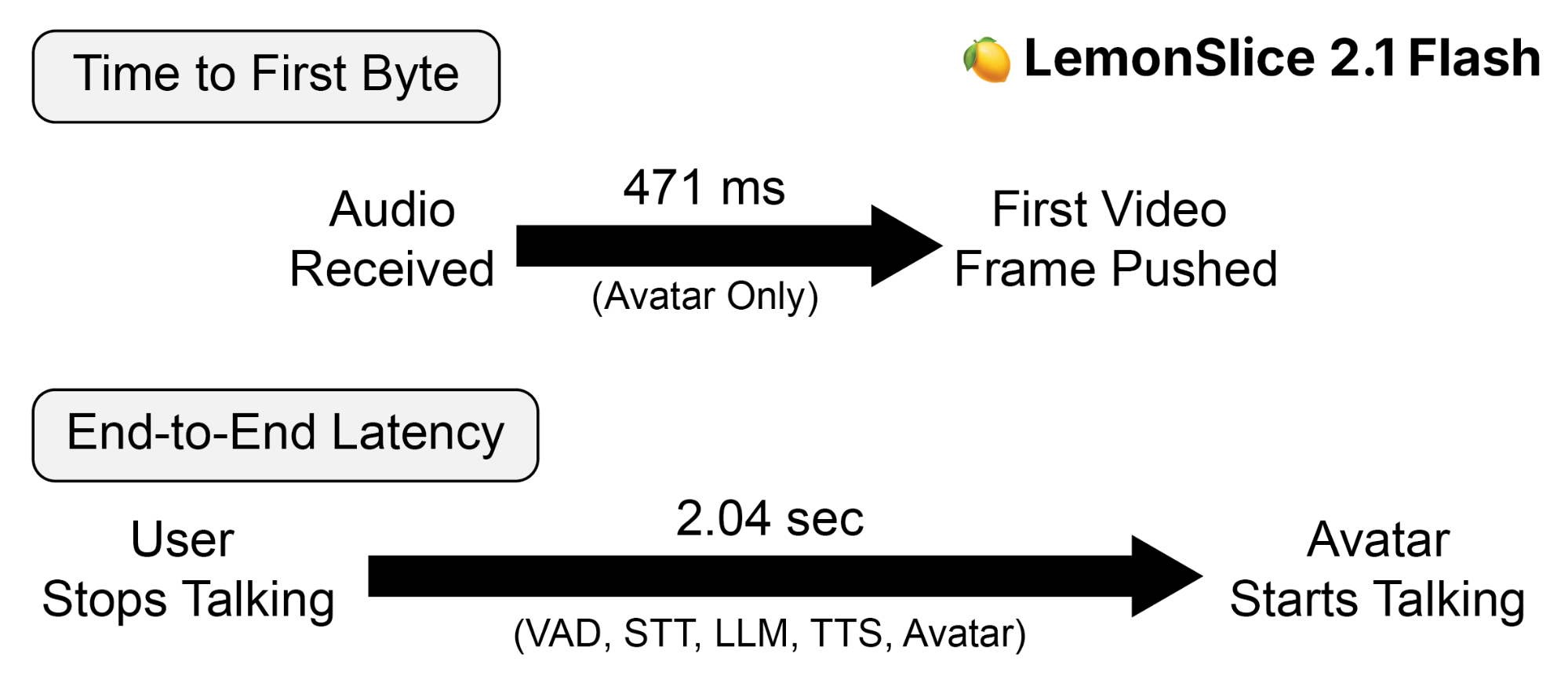
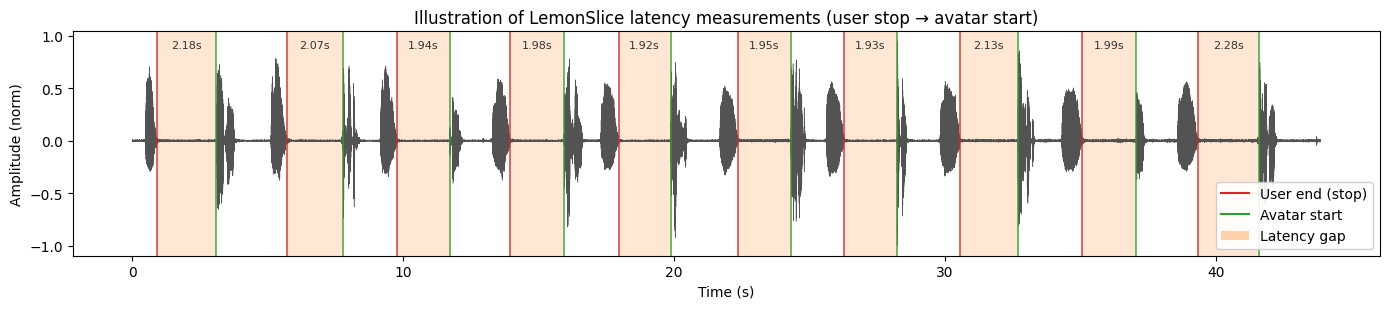
For developers who want to build interactive avatars into their own applications or products, LemonSlice also offers an API. It allows you to use LemonSlice with any LLM or voice provider. Integrations are also available for LiveKit, Pipecat, Agora, and WebSockets. The API supports 1000+ concurrent calls on Enterprise plans and is powered by a global fleet of GPUs, making it a robust choice for large-scale corporations.
Pros:
- Any character, including mascots, animals, and non-humanoids
- Highly expressive and attention-grabbing characters
- Full lip sync, facial animation, hand gestures, whole body movements, and even moving backgrounds
- Instant characters from one photo, with unlimited avatars on every plan
- The only provider with an action engine and emotion engine
- API-first, works with any LLM or voice provider
Cons:
- Calls on self-serve subscriptions are limited to 30 minutes (24 hrs available on Enterprise)
Bottom line: Choose LemonSlice when you need an interactive avatar that builds trust or holds a user's attention. LemonSlice avatars are consistently rated more expressive and natural, due to their novel Character World Model approach. Also choose LemonSlice when you want animals, cartoons, or non-human avatars. Or when you want hand gestures and whole-body actions.
Choosing the right alternative
The quickest way to choose is to start from what you were using Runway for.
If the job is general video generation. Pika is the cheapest way in and the only one here with recurring free credits, LTX Studio suits work that starts from a storyboard, and Luma gives you several frontier models from one account.
If the job is Act-Two, and filming the performance is the friction. Hedra takes an audio track instead of a driving video, and HeyGen covers presenter work with identity consistency across clips.
If the character needs to answer rather than replay. That's a different category, and it's what LemonSlice was designed for. The avatar can be any type of character, from humans to animals, and it's the only tool in this guide with an action engine and an emotion engine.
Every plan includes unlimited avatars and API access, and you can chat with a library of avatars for free to experience it firsthand.