
Articles · Sep 5, 2026
Best Tavus Competitors in 2026
Five Tavus competitors for 2026, split into platforms that own the whole conversation and avatar layers you attach to your own agent, with verified pricing and verdicts.
Tavus calls itself the human computing company and sells agents it calls PALs. Its Conversational Video Interface runs on three models built in house, with Phoenix-4 rendering the face, Raven-1 handling perception, and Sparrow-2 managing turn-taking.
That bundle is the whole proposition. You get a working conversational agent without assembling one, and you accept the vendor's choices at every layer.
So teams leaving Tavus tend to want one of two things. Either another platform that owns the conversation, or just the face, wired to the agent they already run. This guide covers five competitors, two of the first kind and three of the second, with pros, cons, and a verdict on each.
How we picked these tools
Complete platforms vs avatar layers
A complete platform owns the loop. The vendor supplies perception, turn-taking and memory alongside the rendering, so you configure an agent instead of building one. Tavus works this way.
An avatar layer renders the face and stops there. You bring your own model, your own voice provider and your own conversation logic, and the vendor turns that stream into a talking character in real time.
| Complete platform | Avatar layer | |
|---|---|---|
| What you supply | Configuration, knowledge sources and a prompt | Your own LLM, voice provider and conversation logic |
| What the vendor supplies | Rendering plus perception, turn-taking and memory | Real-time rendering of the character |
| Where it fits | You want a working agent without building the stack | You already run an agent and want to give it a face |
| Trade-off | Faster to ship, less control over each component | More wiring, full control of the model layer |
The five tools below split across those two approaches, two and three. To make the cut, a tool had to be actively maintained, publicly priced, independent of Tavus, and genuinely real-time. Here's how they compare at a glance:
| Tool | Best for | Approach | Paid plans from |
|---|---|---|---|
| Anam | Configurable agents in any avatar style | Complete platform | $12/month |
| Beyond Presence | Managed avatar agents with white-label | Complete platform | €49/month |
| LemonSlice | Live conversations with any character | Avatar layer | $8/month |
| LiveAvatar | Avatar streaming at high concurrency | Avatar layer | $19/month |
| Spatius | Avatars running on low-power devices | Avatar layer | $19/month |
Product and pricing information: vendor product and pricing pages, August 2026.
Complete conversation platforms
This is the approach Tavus takes. Its API returns a working agent with memory and knowledge-base features included, and PAL Maker offers a no-code path to the same thing.
Custom avatars are the usual sticking point. Tavus trains a model for each Replica, which takes 2-6 hours, and every tier allows only a fixed number.
The two tools below compete for that job. They differ mainly in how avatars get created, what styles they support, and how pricing scales with usage.
Media: One image inside this section with a one-line caption.
Anam
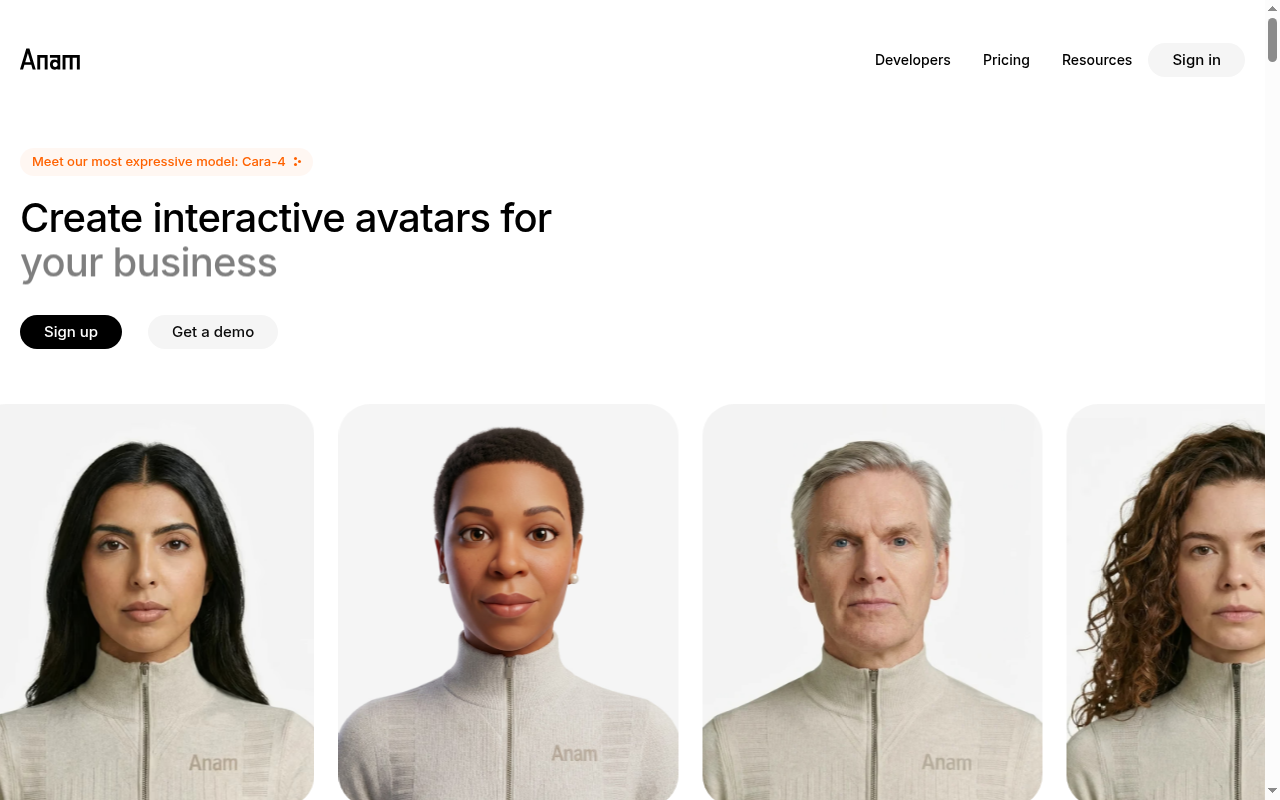
Anam is the closest like-for-like swap. Its Cara-4 model ranks first on the avatar benchmark the company cites, and Anam quotes 180ms average agent response time.
The platform side adds tool calling, knowledge-base retrieval and runtime configuration, so the vendor handles the conversation as well as the face. An API covers the other approach for teams that want it.
Avatar creation is where it pulls away from Tavus. You upload an image or write a text prompt, and Anam says a character generates in under two minutes.
Style range is broad. Anam advertises photorealistic, anime, comic book and 3D avatars, alongside 70+ languages and 70+ voices.
A free playground tier gets you started, and the Starter plan is $12 per month.
Pros:
- Custom avatars from an image or text prompt in under two minutes
- Tool calling and knowledge-base retrieval built into the platform
- Photorealistic, anime, comic book and 3D styles supported
Cons:
- Conversation length is capped below Growth, at three minutes on Free and five on Starter
- Custom avatars are capped per plan, with only two allowed on Starter
- The embed widget carries an Anam watermark until the Explorer tier
Bottom line: Anam is the swap to make when the Replica training step is what pushed you off Tavus. Characters generate in under two minutes from an image, and the platform still handles tool calling and retrieval. Check the conversation caps against your session lengths before committing, because they bite well before the minute allowance does.
Beyond Presence
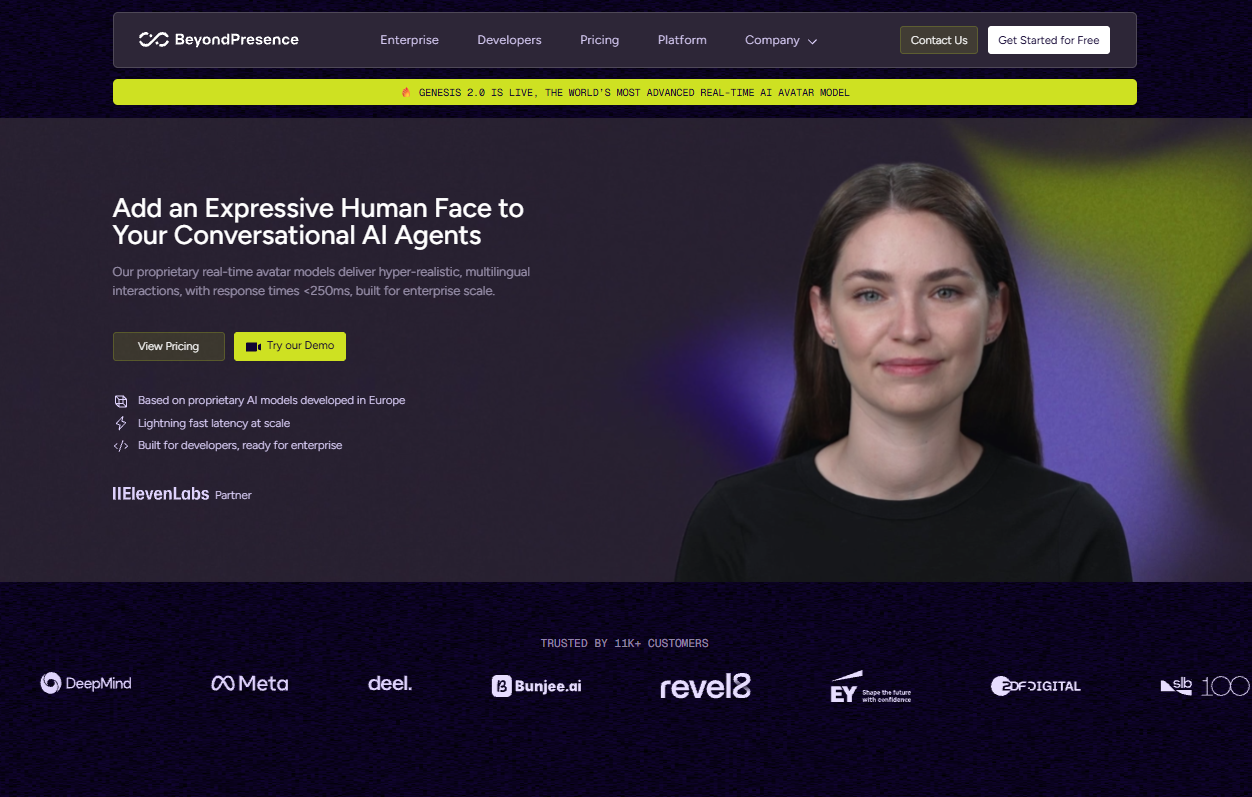
Beyond Presence runs on Genesis 2.0, which it calls the world's most advanced real-time avatar model. Output is 1080p, with lip sync, facial movement and what the company describes as empathetic listening animations.
A Managed Agents API covers the platform approach, and a Speech-to-Video API covers the other, so one account spans both halves of this guide.
Integration is broad. There are LiveKit Agents and Pipecat integrations, an iFrame embed, REST endpoints, and Python and JavaScript SDKs, and you can connect your own LLM.
Plans are priced in credits and in euros. A free tier includes 2,000 credits a month, Starter is €49 for 14,000, and Growth is €149 for 74,500 with overage falling as the tier rises.
One gap matters for products that mint characters on demand. Self-serve avatar generation is documented as coming soon, so custom avatars go through the company today.
Pros:
- Sub-100ms streaming inference on the Genesis 2.0 model
- Managed Agents and Speech-to-Video APIs, so either approach works
- White-label and UI customisation from the Starter tier
Cons:
- Self-serve custom avatar generation is not available yet
- The highest entry price of the five tools here
- Credit-based pricing in euros takes conversion work for dollar budgets
Bottom line: Beyond Presence suits teams that want one vendor across both approaches while they settle on which they need. The integration surface is the broadest here, and white-label arrives earlier than on most plans in this guide. If you create characters yourself today, the self-serve gap is the thing to check first.
Avatar layers for your own agent
Tavus does not sell a rendering-only option, so this half of the guide covers what unbundling looks like. You keep your own model and voice provider, and the vendor supplies the face.
Latency is what these tools compete on hardest. Interface research going back decades puts the threshold near one second before a pause starts to feel broken, and every vendor here publishes a figure well inside it.
The three tools below compete for that job. They differ mainly in the characters they can animate, where the rendering runs, and how pricing scales with usage.
Media: One image inside this section with a one-line caption.
LemonSlice
LemonSlice builds interactive avatars, digital characters that listen, talk, and respond face to face inside your product or website. If you already run a chatbot or voice agent, you can add a talking, listening face to it the same day.
Characters are created from a single photo, instantly. There's no training to wait on and no per-avatar fee, and every plan includes unlimited avatars. If it has a face, LemonSlice can animate it, so cartoons, animals, and mascots work as well as photorealistic humans.
The character has a body and an environment. Hand gestures and natural body language emerge as part of the performance. You can trigger emotions like happiness, sadness, and anger through the Action Engine, and an image update changes the clothing or scene mid-conversation.
Teams use them to turn automated support into face-to-face conversations, run sales demos that respond to prospects, build tutors and onboarding guides, and power concierges on physical kiosks. LemonSlice offers the widget as a no-code way to add an interactive avatar into your site with two lines of code. You can chat with featured avatars in the library for free, then start building your own for only $8/month.
Underneath is a Character World Model, an end-to-end video diffusion transformer in the same class as Veo 3 or Sora, except it runs in real time on a single GPU. Nothing is composited or pre-recorded. Every pixel is generated from scratch at 20fps, which is what enables the models to animate not just the face and lips, but also the entire body, backgrounds, and non-humanoids.
It's also fast. LemonSlice 2.1 Flash responds in 471ms on average, making it the fastest model among major avatar providers in published benchmarks.
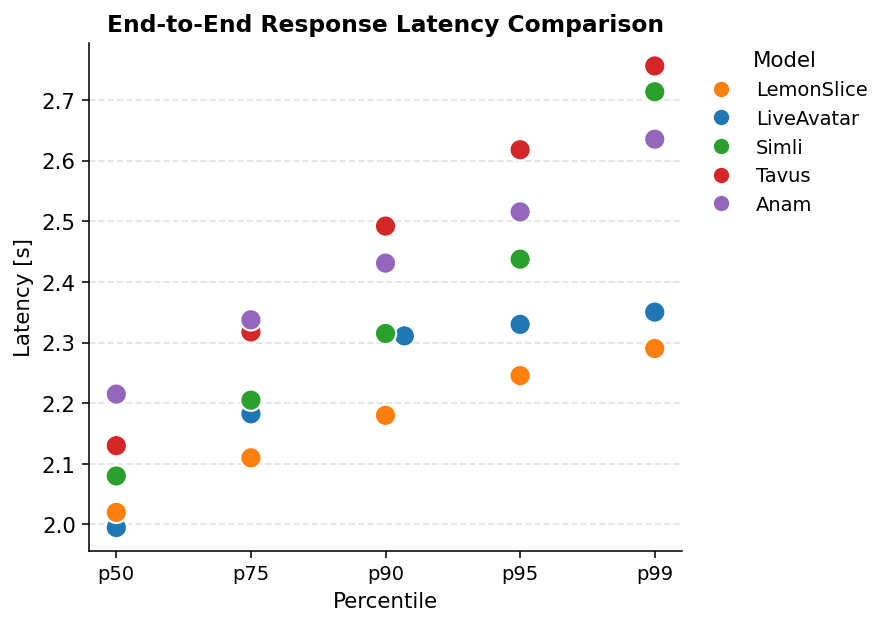
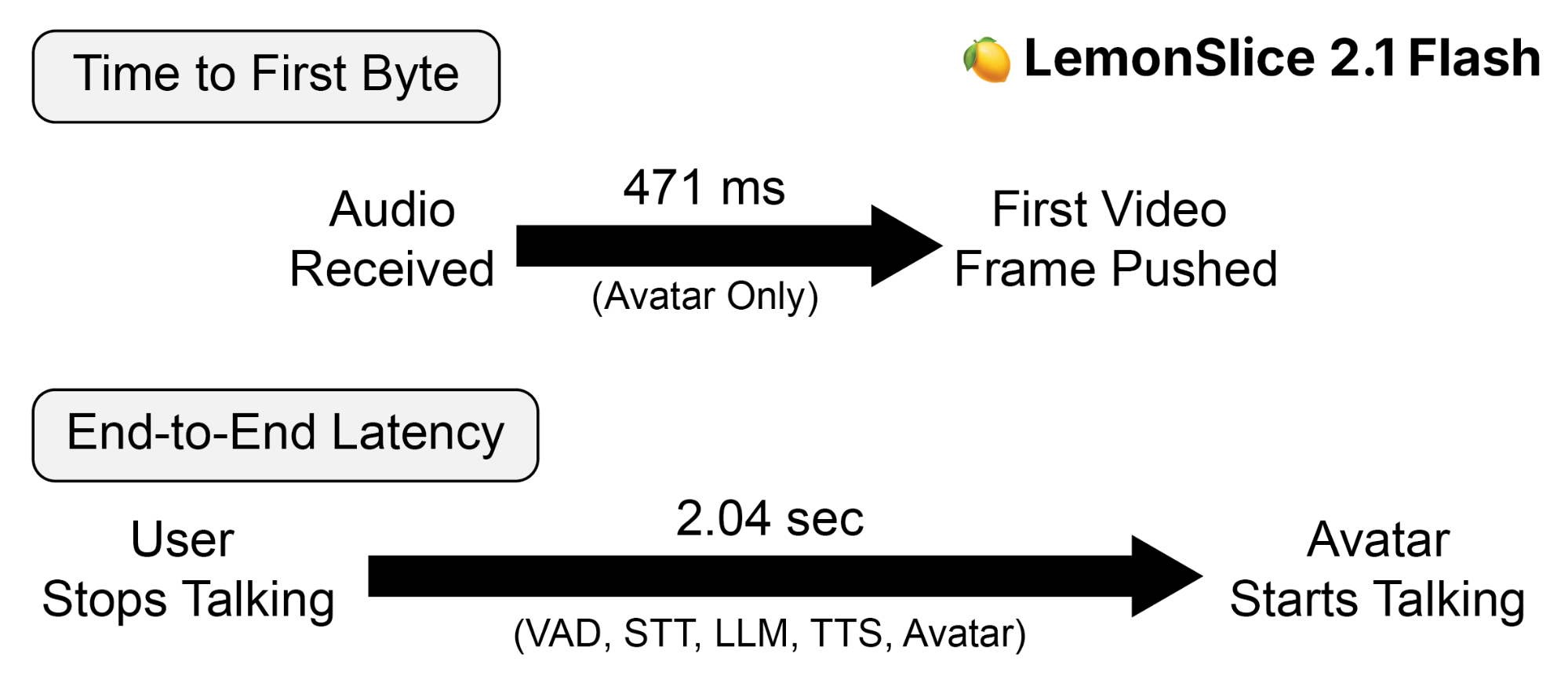
For developers who want to build interactive avatars into their own applications or products, LemonSlice also offers an API. It allows you to use LemonSlice with any LLM or voice provider. Integrations are also available for LiveKit, Pipecat, Agora, and WebSockets. The API supports 1000+ concurrent calls on Enterprise plans and is powered by a global fleet of GPUs, making it a robust choice for large-scale corporations.
Pros:
- Any character, including mascots, animals, and non-humanoids
- Highly expressive and attention-grabbing characters
- Full lip sync, facial animation, hand gestures, whole body movements, and even moving backgrounds
- Instant characters from one photo, with unlimited avatars on every plan
- The only provider with an action engine and emotion engine
- API-first, works with any LLM or voice provider
Cons:
- Calls on self-serve subscriptions are limited to 30 minutes (24 hrs available on Enterprise)
Bottom line: Choose LemonSlice when you need an interactive avatar that builds trust or holds a user's attention. LemonSlice avatars are consistently rated more expressive and natural, due to their novel Character World Model approach. Also choose LemonSlice when you want animals, cartoons, or non-human avatars. Or when you want hand gestures and whole-body actions.
LiveAvatar
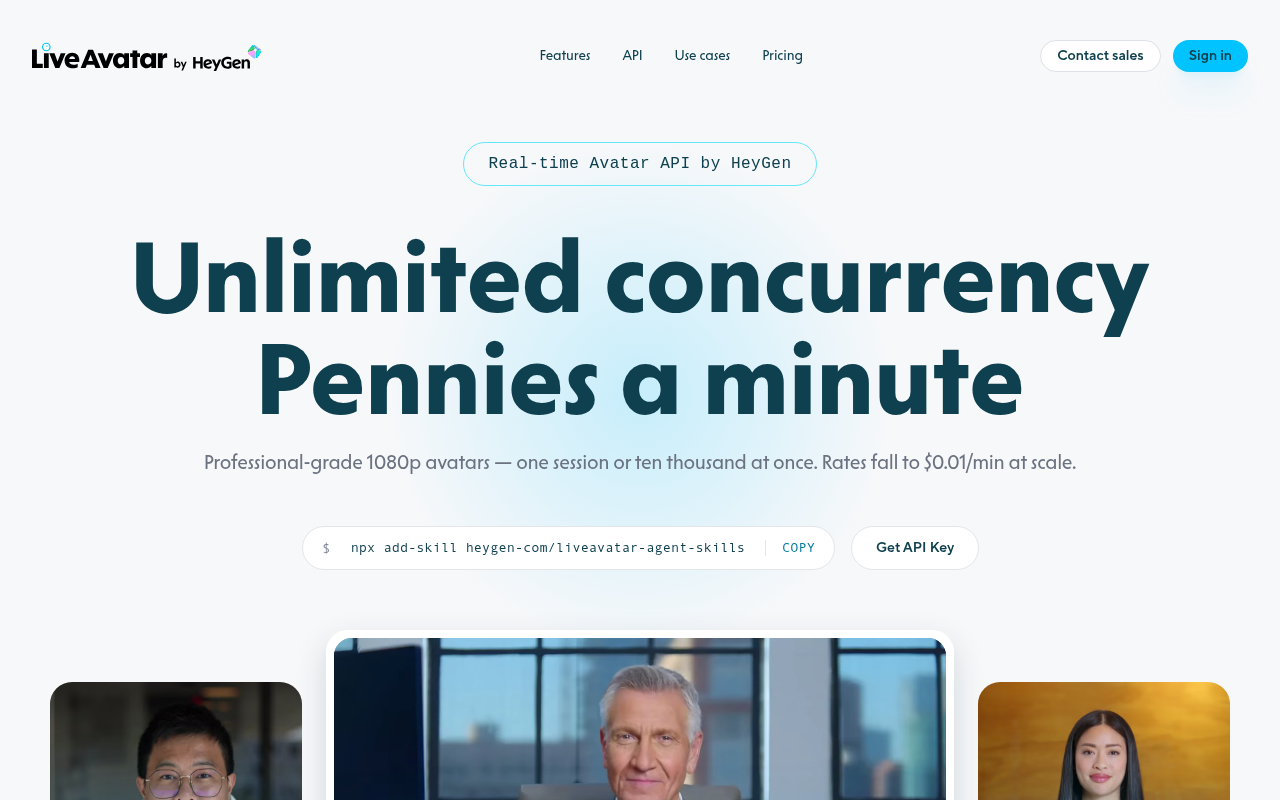
LiveAvatar is HeyGen's real-time avatar API, sold separately from its video generation product. It streams 1080p avatars and lets you choose half-body or full-body framing.
Concurrency is where it makes its case. Additional concurrent sessions cost nothing, so one session and ten thousand carry the same per-session price.
Rates fall to a penny a minute at the top volume tier. Median time to first frame is under 300ms and the published API uptime is 99.99%.
The library holds 100+ preset avatars, and you can build your own from an image or two minutes of footage. Setup is documented as a five-minute job a developer runs alone.
A developer tier starts at $19 per month for 200 credits, with session length capped at five minutes. The Essential plan at $99 adds a custom avatar.
Pros:
- Unlimited concurrency with no charge for additional sessions
- 1080p output with half-body or full-body framing
- Rates fall to $0.01 per minute at the top volume tier
Cons:
- Sessions are capped at five minutes on the entry tier
- Custom avatars require the $99 plan, above the entry tier
- Credit-based pricing takes some forecasting at scale
Bottom line: LiveAvatar is the pick when concurrency is the constraint. Free additional sessions and a penny-a-minute floor make it predictable at volume in a way per-session pricing is not. If you need a character that is not a human presenter, look at LemonSlice above.
Spatius
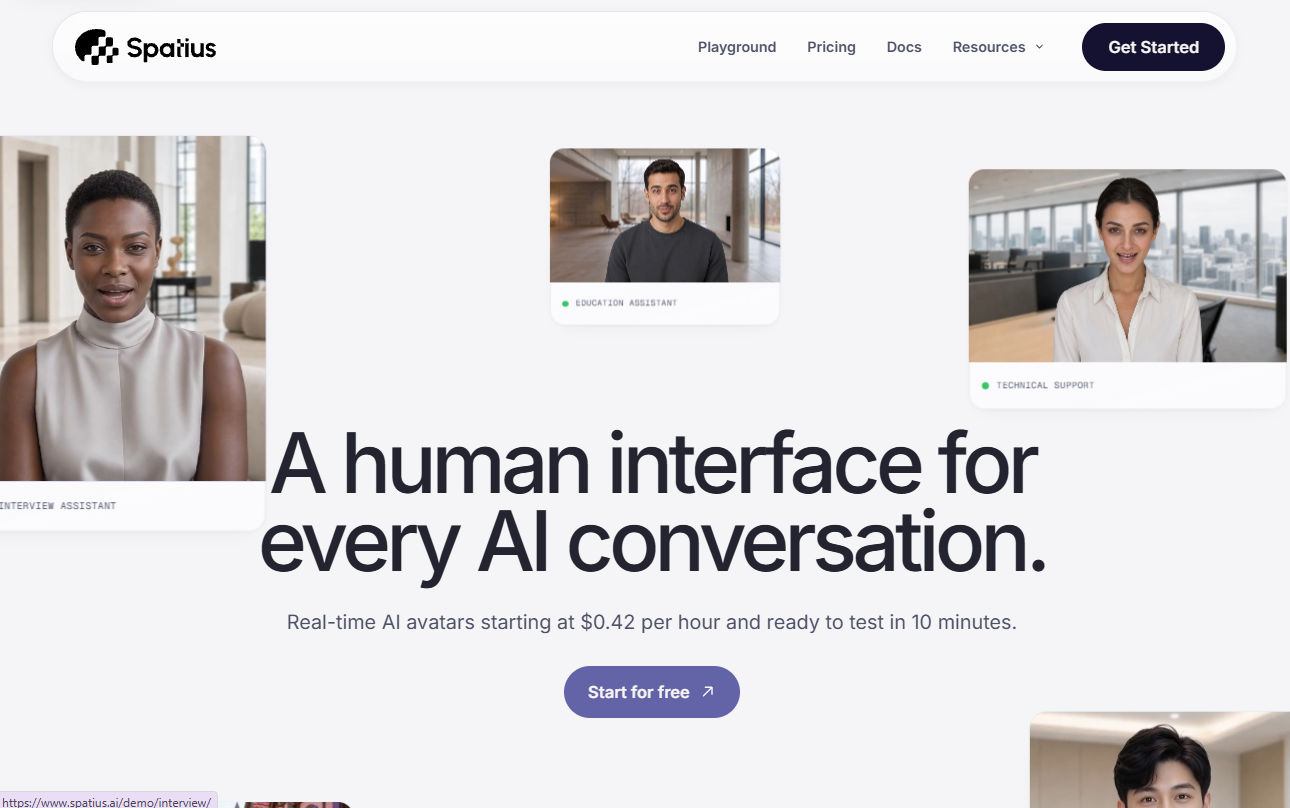
Spatius is a real-time avatar SDK built around where the rendering happens. It takes an audio stream and returns lip-synced 3D facial animation, with the work pushed to the edge instead of the cloud.
That choice is the product. It runs 1080p at 25fps on entry-level chipsets without a dedicated GPU, and the stream it sends is about 100 kbps.
Cost follows from the same design. Spatius quotes $0.007 per minute against a cloud-streaming average it puts near $0.15.
Characters are 3D animation, so the output is not photoreal video. Free stock avatars are included, and the platform supports deploying custom-trained 3DGS models.
A free tier exists, and paid plans start at $19 per month.
Pros:
- Runs 1080p at 25fps on entry-level chipsets without a dedicated GPU
- Per-minute cost quoted at $0.007, far below cloud streaming
- A roughly 100 kbps stream suits constrained networks
Cons:
- Characters are 3D animation, so photoreal video is not the output
- Custom avatars need a trained 3DGS model, so a single photo is not enough
- No published latency figure, unlike the other tools here
Bottom line: Spatius fits hardware and mobile deployments where bandwidth and per-minute cost decide the project. Running on entry-level chipsets without a GPU opens places cloud streaming cannot reach. If you need photoreal video or a character built from one photo, the other tools in this lane cover that better.
Choosing the right competitor
The quickest way to choose is to start from how much of the conversation you want to own.
If you want another vendor to own the whole conversation. Anam and Beyond Presence both do that, and both create custom avatars faster than a multi-hour training step allows. Anam generates a character from an image in under two minutes, and Beyond Presence covers either approach from one account.
If the constraint is cost, bandwidth or the device. LiveAvatar charges nothing for additional concurrent sessions and drops to a penny a minute at its top tier. Spatius goes further down, quoting $0.007 a minute by rendering at the edge on hardware without a dedicated GPU.
If the goal is an expressive interactive avatar that holds users' attention. That's exactly what LemonSlice was designed for. The avatar can be any type of character, from humans to animals. It's also the only tool in this guide with an action engine and an emotion engine, so gestures and emotional states can be triggered on cue.
Every plan includes unlimited avatars and API access, and you can chat with a library of avatars for free to experience it firsthand.