Lead Routing: Automate Lead Distribution
.avif)

Deploy an avatar that answers questions, guides customers, and drives meaningful conversations 24/7.
Businesses take 47 hours on average to respond to leads. Yet 78% of customers buy from the first responder. The disconnect is expensive, and in 2026, it's entirely avoidable.
The 5-minute lead rule is well-documented: leads contacted within 5 minutes are 21x more likely to qualify than those contacted after 30 minutes. Lead routing solves the speed problem by automatically assigning incoming leads to the right sales reps based on predefined rules, enriched data, or AI-driven logic.
This guide covers automated lead routing strategies, tools, and best practices for effective lead management. We'll also show how conversational AI video agents like LemonSlice transform instant lead engagement by responding to visitors in real-time video, qualifying them through natural dialogue before routing enriched data to your sales team.
What Is Lead Routing?
Lead routing is the process of automatically assigning incoming leads to the most suitable sales representative based on predefined rules, data attributes, or AI. Modern lead routing systems use natural language understanding and machine learning to make smarter assignment decisions at scale.
The lead routing process follows a predictable sequence:
- Lead captured via form, chat, or call
- Data enriched with firmographics (company size, industry, location)
- Lead scored against qualification criteria
- Assignment rules applied (territory, availability, account ownership)
- Rep notified via CRM, Slack, or email
- Follow-up initiated within response window
Automated lead routing helps you segment new leads by criteria like company size, industry, or deal stage, so hot leads reach reps fastest.
Lead scoring and lead routing are related but distinct. Scoring determines if a lead is qualified by assigning numerical values based on fit and engagement indicators. Routing determines who receives the qualified lead. Both functions work in sequence: lead scoring filters quality, then routing handles assignment.
How Lead Routing Works
A standard lead routing example illustrates the speed advantage. A visitor requests a demo at 3:47 PM. Enrichment identifies an enterprise account in the West region. The lead score exceeds the MQL threshold. Assignment rules route to the West Coast enterprise AE. A Slack notification fires. The AE calls within 4 minutes.
That's effective lead routing in action: capture, enrich, score, assign, notify, engage.
But there's still a gap. Between form submission and human response, the lead waits. For high-intent visitors, that wait is friction. They might navigate to a competitor's site in the interim.
How LemonSlice Video Agents Close This Gap
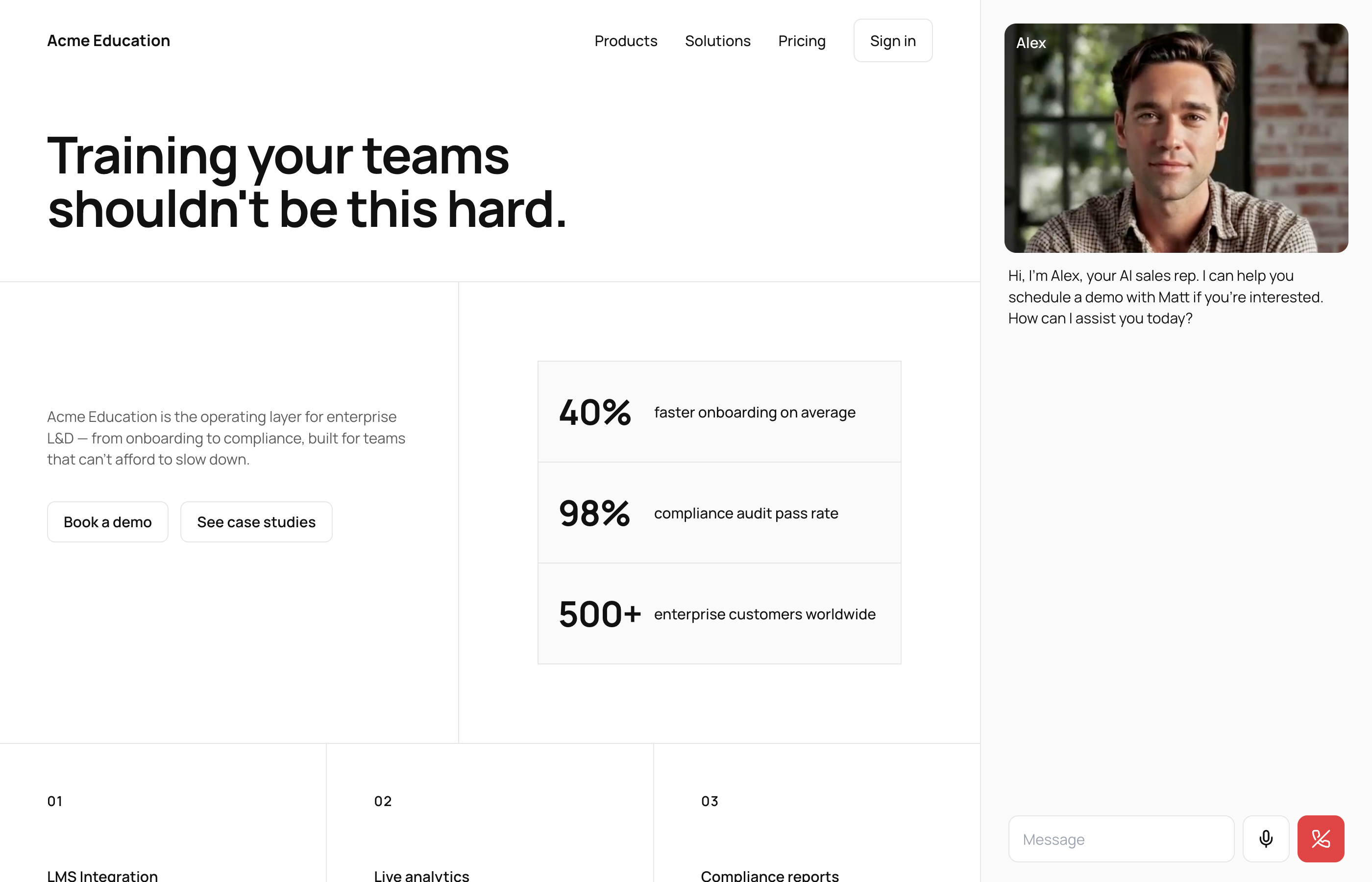
LemonSlice Video Agents eliminate the response delay entirely. Instead of a form submission triggering a queue, visitors engage immediately with a video avatar that responds in real-time video format.
The agent qualifies leads through natural conversation, asking questions and answering inquiries using its knowledge base. It captures requirements, addresses objections, and collects the context that makes follow-up calls productive. When the conversation ends, enriched lead data routes to the appropriate rep through your existing CRM workflows.
The result: instant engagement plus qualified handoff. Visitors get immediate attention. Sales reps get lead intake context they'd never capture from a form.
Types of Lead Routing Strategies
Different go-to-market motions require different routing approaches. Here are the most common lead routing strategies and when each works best.
Round-Robin Routing
Round-robin distributes leads sequentially across team members: A→B→C→repeat. It's the simplest approach and ensures balanced workloads across your sales floor. The limitation: it ignores rep expertise, availability, and account context. Best for SMB sales teams with high lead volumes and generalist reps.
Territory-Based Routing
Territory-based routing assigns leads by geographic region. Field sales teams and companies with localized presence rely on this approach. The challenge is uneven distribution when regions vary in lead volume. Some territories overflow while others run dry. Marketing teams and RevOps must monitor distribution to optimize performance.
Account-Based Routing
When a new contact matches an existing account, route to the account owner. This preserves relationship continuity and supports customer expansion motions. Account-based routing requires accurate lead-to-account matching and duplicate detection, which gets complex with enterprise hierarchies and subsidiaries.
Skills-Based Routing
Skills-based routing matches lead complexity or product interest to rep expertise. A technical question about API integrations goes to a solutions engineer. A pricing inquiry goes to a closer. This strategy works well for multi-product companies and technical sales cycles.
Availability-Based Routing
Availability-based routing prioritizes reps who are online and not in meetings. It integrates with calendar systems for real-time status checks. When speed-to-lead matters most, this strategy delivers.
Trigger-Based Routing
Trigger-based routing uses behavior patterns: pricing page visits, demo video completion, multiple sessions in one day. High-intent inbound leads get priority treatment and faster routing.
Lead Routing Tools and Platforms
The lead routing software landscape includes CRM-native features, standalone platforms, and hybrid solutions. Here's how the major options compare.
Salesforce Lead Routing
Salesforce offers native routing through Assignment Rules, Flow Builder, and Queues. The strength is deep CRM integration: routing logic lives alongside your customer data. The limitation is complexity. Configuring sophisticated routing rules requires admin expertise, and real-time availability checks need additional integrations.
HubSpot Lead Routing
HubSpot provides routing through Workflows with rotation and property-based assignment. It's user-friendly for SMB teams with no-code setup, and handles straightforward round-robin and territory-based logic well. Advanced scenarios with multiple conditions and fallbacks push against its native routing features.
Chili Piper
Chili Piper specializes in instant scheduling and routing from form submission. Leads book directly on rep calendars without the back-and-forth. The focus on speed-to-lead makes it popular with high-velocity sales teams. The interaction remains text and form-based.
LeanData
LeanData handles enterprise-grade matching and routing. Complex account hierarchies, territory overlaps, and partner routing rules are its specialty. Priced for larger organizations with advanced lead management needs.
LemonSlice Video Agent Advantage
LemonSlice goes beyond automated lead routing. Where other tools manage lead assignment, LemonSlice engages leads instantly via conversational video before routing occurs.
The avatar responds in real-time video format with synchronized lip movement, natural gestures, and context-aware dialogue. It qualifies through dialogue, not forms, capturing richer context about needs, objections, and timeline. The agent connects to your knowledge base to answer questions accurately and stay on-brand.
Optional integrations feed qualified lead data into your existing CRM, marketing automation, and routing workflows. Deployment takes a single line of embed code. The widget integrates natively without iframes or layout constraints.
For lead generation and contact center solutions, the combination of instant engagement plus intelligent routing creates a response experience competitors can't match.
Setting Up LemonSlice Video Agent for Lead Routing
Deploying a video agent takes minutes, not weeks. LemonSlice streamlines the setup process:
1. Create Your Avatar
Upload a single photo: portrait, cartoon, or brand mascot. LemonSlice animates it into a speaking avatar in seconds. No video recording or model training required.
2. Customize Appearance
Adjust welcome screens, default expressions, and visual styling. LemonSlice supports photorealistic humans, illustrated characters, and stylized designs.
3. Configure Voice
Choose from the built-in voice library or create custom voices with AI (use prompts like "warm, professional female voice") or voice cloning from audio samples. The same avatar can speak multiple languages fluently. Switch languages mid-conversation without changing the character or retraining the model.
4. Connect Your LLM
LemonSlice is LLM-agnostic. Plug in OpenAI, Anthropic, or any model you use via API. The conversational interface stays consistent regardless of which model powers the responses.
5. Upload Your Knowledge Base
Provide the information your agent needs to reference to answer questions accurately and stay on-brand. Upload documents, FAQs, product specs, or company policies.
6. Enable Real-Time Interaction
The system streams video, audio, and conversational state simultaneously with a 2-3 second average latency: low enough for natural turn-taking. Agents listen continuously and handle interruptions naturally, stopping mid-response to process new input and adjust their reply. This real-time generation is what separates conversational AI from scripted video playback.
7. Deploy Instantly
Embed the agent with a single line of code. The widget integrates natively into your site as a lightweight, responsive interface element, without iframes, layout constraints, or performance issues.
8. Go Live
Users click to start conversing. Avatars respond with synchronized lip movement, natural gestures, and context-aware dialogue that adapts dynamically based on what users say and how the conversation unfolds.
Lead Routing Best Practices
Effective lead routing combines smart rules with disciplined execution. These practices separate high-performing RevOps teams from the rest.
Prioritize Speed-to-Lead
The 5-minute lead rule isn't arbitrary. Leads contacted within 5 minutes are 21x more likely to qualify than those contacted after 30 minutes. Research published in Harvard Business Review, based on an MIT-led lead response study, confirms: speed is the defining factor. After an hour, odds crater. Every minute of delayed response costs the pipeline. Define SLAs for response time and hold team members accountable.
Implement Lead Scoring Before Routing
Use a lead scoring system based on fit (firmographics like company size and industry) and engagement (behavior patterns like page visits and content downloads) before routing. This prevents reps from wasting time on unqualified leads and keeps SDRs focused on high-value opportunities.
Maintain Data Quality with Enrichment
Clean, enriched data enables accurate routing. Use default enrichment to fill gaps in company size, industry, and contact details automatically. Without enrichment, routing rules break down.
Balance Workload Fairly
Monitor round-robin distribution and adjust for PTO, capacity limits, and performance differences. Unbalanced routing creates frustrated reps and dropped leads.
Build Fallback Rules
Every routing flow needs a catch-all queue. Leads with incomplete data or no matching rules must route somewhere, not disappear into a void. Rerouting logic should handle edge cases gracefully. Audit your fallback queue regularly to identify routing gaps.
Audit Quarterly
Review distribution fairness monthly. Revisit routing logic quarterly against GTM strategy changes. As territories shift and team structures evolve, routing rules need updates. Build appointment booking workflows that reflect your current sales motion, not last year's.
Conclusion
Every minute of delayed lead response costs the pipeline. Effective lead routing combines smart assignment rules with real-time engagement. The best systems don't just route fast; they engage instantly.
Conversational AI video agents eliminate the response gap entirely. Instead of waiting for a human to call back, visitors get immediate, personalized attention from an avatar that qualifies, answers questions, and routes enriched data to your team.
See how LemonSlice Video Agents deliver instant lead engagement that qualifies and routes in real time.
Frequently Asked Questions
What is the 5-minute lead rule?
The 5-minute lead rule states that leads contacted within 5 minutes of inquiry are 21 times more likely to qualify than those contacted after 30 minutes. Speed-to-lead is the single most important factor in conversion rates.
What is the 3-3-3 rule in sales?
The 3-3-3 rule is an engagement framework: capture attention in the first 3 seconds, deliver core value in the next 3 minutes, and follow up within 3 days to maintain momentum.
What is default enrichment?
Default enrichment automatically appends firmographic and contact data to incoming leads using waterfall data providers. This enables more accurate routing decisions by filling gaps in company size, industry, location, and job title.
Answer
Create your first interactive AI avatar
Design your avatar, upload your knowledge base, and launch it on your website in minutes.


.avif)

.avif)
.avif)